


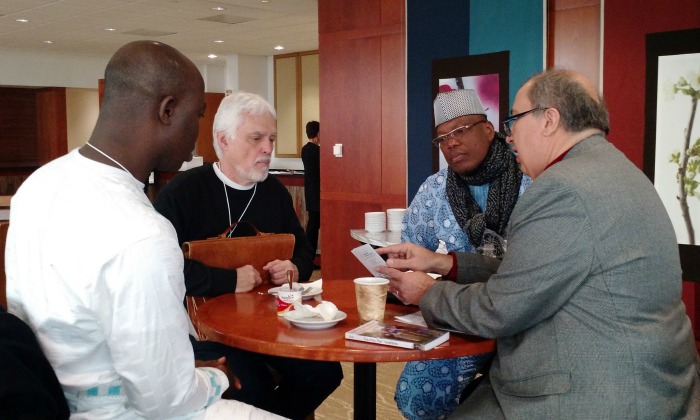
Photo: Victor Gbedo (at left) and Raphael Tamadaho (second from right), educators from Benin, visit with James Krabill (second from left), senior executive for Global Ministries, and Carlos Romero (at right), executive director of Mennonite Education Agency, at the Feb. 4–6 Mennonite Educators Conference in Leesburg, Virginia. (Photo by Janie Beck Kreider)
“Mennonite education is a precious gift given to us by God,” said Carlos Romero, executive director of Mennonite Education Agency. “Why would we not want to share it with the world?”
Romero spoke these words as he addressed more than 475 Anabaptist-Mennonite educators, administrators, faculty and staff from 26 Mennonite schools from across the U.S., Canada, Puerto Rico, Colombia and Benin at the biennial Mennonite Educators Conference (MEC), which took place Feb. 4–6 in Leesburg, Va. MEC is co-hosted by Mennonite Education Agency (MEA) and Mennonite Schools Council (MSC). Everence also helped sponsor the event.
The conference provides professional development opportunities designed to strengthen teaching, classroom management and Christian formation skills from an Anabaptist perspective. This year’s event included more than 20 workshops, networking sessions and four keynote presentations reflecting on the theme, “In the Image of God: Faith, Community, Reconciliation.”
Keynote speakers included Daniel Schipani, professor of pastoral care and counseling at Anabaptist

Mennonite Biblical Seminary in Elkhart, Indiana; Ewuare Osayande, anti-oppression coordinator with Mennonite Central Committee U.S., Philadelphia area; Hesston (Kansas) College faculty Marissa King (education and English), Karen Sheriff LeVan (English) and Marelby Mosquera (biology and chemistry); and J. Richard “Dick” Thomas, who has served as superintendent at Lancaster (Pa.) Mennonite School (LMS) for the last 33 years. Thomas also announced his retirement from a 43-year tenure at LMS in a private meeting for LMS faculty and staff at the conference.
In the Image of God: Faith, Community, Reconciliation
Palmer Becker’s three distinctives of Anabaptist-Mennonite faith—that Jesus is the center of our faith, community is the center of our lives and reconciliation is the center of our work—inspired the theme for the conference and the keynote presentations.
“In order to communicate that Jesus is the center of our faith, community the center of our life and reconciliation the center of our work, we need to first of all create a learning community of love and acceptance,” said Thomas.
He then outlined practical ways to move toward this goal:
- Encouraging schools to deal with white privilege and racism, growing in intercultural competence
- Making restorative justice discipline normative in MSC schools
- Helping students develop empathy
- Practicing biblical discernment—even forbearance—in places where we understand Scripture differently from each other
Quoting Sara Wenger Shenk, president of AMBS, Thomas asked, “How might our schools lead with a faith orientation that is conservative in that we unapologetically root our faith in an ancient, wise tradition—and progressive in that we lead with an innovative, justice-seeking theological vision like Jesus and the Anabaptists?”
The same morning, Osayande spoke about multicultural education in his keynote address.
“The truth is that the educational system in this country has never honored the potential and possibility inherent in every child,” he said. “But studies show that multicultural education — education that highlights and honors the contributions of all people in this country — is a benefit not just for students of color, but for white students, too. It benefits all teachers as it creates a classroom environment that is more dynamic and engaging.”

As a way to move Mennonite educators to “embody the educational and theological tenets of reconciliation” in classrooms that are becoming more diverse, King, Sheriff LeVan and Mosquera addressed the issue of “stereotype threat” in their Saturday morning keynote presentation.
“Stereotype threat is like having multiple tabs open on your computer,” explained King. “It is the background noise of identity-based threats and micro-aggressions that can compromise student performance.”
After having participants listen to audio clips of students reflecting on their experiences of identity-related stress, King, Sheriff LeVan and Mosquera facilitated table group discussions to brainstorm ways to reduce stereotype threat in Mennonite schools and classrooms.
Schipani offered a transcultural model of holistic growth and the human spirit, which incorporates the personal-spiritual (being); academic-interdisciplinary (knowing); and professional-ministerial (doing).
“The spirit is transcultural, but expresses itself in particular contexts, cultures and religions,” said Schipani. “Intercultural competency is imperative, while at the same time there are converging experiences simply because we are human.”
Developing new curriculum
On Friday afternoon, Thomas; Dawn Yoder Graber, director of academics at Sarasota (Florida) Christian School; and Rose Stutzman, project director for MennoMedia’s Shine curriculum, Elkhart, Indiana; offered an extended workshop track to discuss faith formation curriculum and resourcing for children in early childhood through grade 5.
Topics ranged from faith formation vs. biblical knowledge skills to theme-based vs. story-based curriculum. The group also discussed the possibility of adopting MennoMedia’s Shine Sunday School curriculum for the classroom.
“We want the new curriculum to value student-driven, discovery-based learning, but the workshop

participants weren’t quite ready to make a decision about how to move forward,” said Graber. “Overall, this was a good initial conversation to name opportunities and challenges.”
Worship reflections
Rachel S. Gerber of Bloomington, Indiana, denominational minister of youth and young adults for Mennonite Church USA, planned worship guided by 2 Corinthians 3:18 and the conference theme. Tim Shue, director of music at Central Christian School, Kidron, Ohio, led music. Mirrors of all sizes were set up around the gathering hall and at the center of each table.
“We are called to reflect the image of God in this world, and that starts by us recognizing that we are beloved,” said Gerber. “We are invited to participate in a community of light and love in a world that so desperately needs light. Jesus is the light that we reflect.”


Have a comment on this story? Write to the editors. Include your full name, city and state. Selected comments will be edited for publication in print or online.