


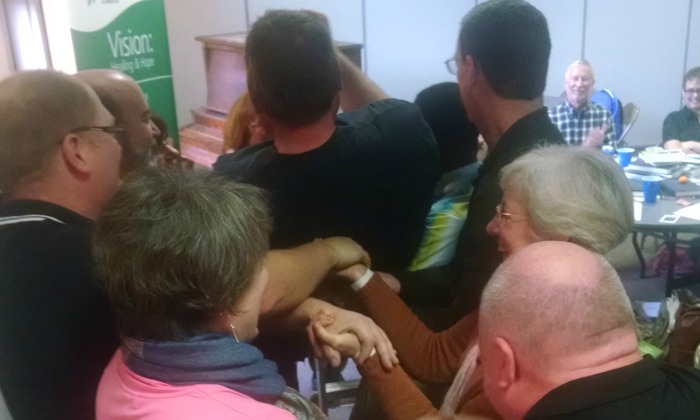
Photo: CLC members collaborate to catch Rodger Schmell, moderator for Eastern District Conference, after a “trust fall” exercise. Photo by Hannah Heinzekehr.
The Constituency Leaders Council ended its meetings with a “trust fall.” Rodger Schmell, Eastern District Conference moderator and member of the CLC Listening Committee, called eight volunteers representing theological diversity across the church, to come forward and catch him as he fell from a ladder.
“Hopefully this will show us what is possible with Mennonite Church USA,” said Schmell, just seconds before the fall.
This dramatic reenactment, ending with a safe catch, illustrated a key theme of CLC meetings: building and understanding trust. CLC members met for two-and-a-half days, March 7-9, at Silverwood Mennonite Church in Goshen, Ind.
This was the first meeting after Lancaster Mennonite Conference and North Central Mennonite

Conference made decisions to leave Mennonite Church USA. Two representatives from a group of 16 Lancaster Conference congregations who are still discerning their affiliation did attend the meetings.
“This meeting mattered as we come together in wake of losing two conferences and others are in the wake of making decisions,” said Jennifer Delanty, moderator for Pacific Northwest Mennonite Conference, during a report from the CLC Listening Committee. “In the midst of all of this, we are beginning something new. There’s some healing going on. There’s some need for us to continue to be together and to discern and figure out what God has in place for us going forward.”
Members of the CLC planning committee tested a proposal with Brethren Mennonite Council for LGBT Interests to invite queer persons to participate at table groups during a future CLC meeting, but BMC did not want to carry the proposal further, so CLC did not discuss the possibility. In February, the Mennonite Church USA board voted not to include BMC as an official denominational constituency group, which would have included formal representation on CLC. In its action, the board also encouraged CLC to find spaces for dialogue with lesbian, gay, bisexual, transgender and queer church members.
Marv Friesen, pastor at University Mennonite Church in State College, Pa., reflecting on conversations with other BMC-affiliated congregations, said, “There is thankfulness for the invitation for queer people to join us at the tables, but also concern that our queer sisters and brothers are fatigued and, in some cases, even finished wanting to have conversation in which it feels like their humanity is being questioned one more time. Perhaps we could think about inviting allies or others to be those representatives around the table.”
CLC as elders
The group affirmed a statement about their role as elders that was developed out of work begun during its in October 2015 meeting. The statement says: “Given the biblical/theological foundations for our role as denominational elders, the CLC understands that our primary work on behalf of the church is to listen deeply in order to hear/see the ‘big’ picture; pay attention to the guidance of the Holy Spirit, God (Bible and prayer); model a missional community/collective; and offer counsel and direction to the Executive Board as well as the broader church.”

The statement also included descriptions for how the actions and conversations at CLC should influence area conferences, guidelines for dealing with conference-to-conference conflict and best practices for “when conferences and congregations question their willingness to be part of their conference and/or Mennonite Church USA.”
CLC members offered feedback on a model for conference-to-conference peer review proposed by conference ministers. The proposed model would include the formation of a standing three-year Assessment Team that would be called upon as necessary. In times of review, the team would conduct a review on site, provide a written report to CLC, invite the conference under review to make an oral report to CLC (including experiences, biblical/theological rationale and other information pertinent to its decision). CLC would then process this information and make a recommendation as necessary. The CLC expressed general support for the proposed model, with the understanding that more clarity was needed for when and how a review would be initiated.
Understandings of covenant
On March 7, David Boshart, moderator-elect and CLC chair, presented on biblical understandings of covenant. Afterwards, three CLC members gave statements about their understandings of CLC and Mennonite Church USA as a “covenantal community.”
Kurt Horst, pastor at Whitestone Mennonite Church in Hesston, Kan., was invited to share reflections and he directed his remarks to both those were still a part of CLC and those who have left. Horst said, “It grieves me to see conferences becoming so disturbed that they have left or are considering leaving our fellowship. In addition, nearly every conference has lost some congregations. Most recently I’ve wanted to remove myself from CLC but have not found spiritual release to do so.”
Horst went on to say that both area conferences who have chosen to license persons in same-sex relationships for ministry and area conferences who have chosen to leave without naming their “unmet expectations” or without allowing “other conferences to be a part of your processes that led to withdrawal” have acted in violation of shared denominational covenants.
Bishop L.W. Francisco III, pastor of Calvary Community Church in Hampton, Va., compared the lessons

learned in flight training to a road map for Mennonite Church USA in times of conflict. “When I encounter clouds and there is a special disorientation, my experience and training tells me to trust my instruments,” he said. “I trust my written procedures. My hope is that we would value our covenant agreements. The question is not are we in favor of same-sex relationships or are we opposed or should persons be included or excluded. The real question should be, How do we do church together? Until that question is answered, I would strongly encourage the church in this nebulous season of uncertainty, to use our current agreements to guide us to a safe place.”
Lois Johns Kaufmann, Central District Conference minister, shared four different images related to pain that came to mind when she read Horst’s statement, including her own experiences as part of a congregation in conflict, her previous work as a childbirth educator, the biblical Psalms of lament and Jesus’ behavior in Gethsemane and on the cross.
“The leadership of Central District feels led by God’s Spirit to test a direction that moves beyond—is at odds with—what the delegates of MC USA and the Executive Board have affirmed,” she said. “We would like to see space for parts of the church to continue to test this direction. Our decision is rooted in our understanding of the Bible, and we have written several documents to help congregations who want to engage in study together as we test this direction. We acknowledge that not everyone in our churches reads the Bible the same way. And I would also ask, How does change happen? In the past, have all changes in faith and practice waited until there was denominational consensus?”
A missional future
CLC heard presentations on mission from six presenters and spent time at table groups discussing longing for the church’s missional future and how congregations, conferences and denominational agencies can all work together in the future.

CLC members wrestled with colonial language in old accounts of Mennonite mission and looked to a new book, Fully Engaged: Missional Church in an Anabaptist Voice, written by Stanley Green and James Krabill of Mennonite Mission Network, for new paradigms and best practices.
“Why do we need another book on the missional church?” said Krabill. “Anabaptists represent a stream of history that engaged the culture and, for the most part, didn’t tip into a Christendom model that assumed the culture would be Christian but saw the church as a group of people calling culture to authentic faith.”
Krabill also acknowledged that Anabaptists also face particular challenges in mission, including a struggle to tell the Christian story to people who may not have ever heard it before in increasingly post-Christian societies and close knit communities that can support one another, sometimes at the expense of excluding new attenders.
Other presenters included Wilbert Shenk, missiologist; Lois Barrett, missiologist and professor at Anabaptist Mennonite Biblical Seminary in Elkhart, Ind.; Glen Guyton, chief operations officer for Mennonite Church USA; Bishop L.W. Francisco; and Rod Stafford, pastor at Portland (Ore.) Mennonite Church.
Worship and sharing
CLC’s time together also included opportunities for worship in song, Scripture, prayer and silence. The gathering opened with sharing Communion.
https://soundcloud.com/themennonite/i-will-come-to-you
The group spent time in prayer for conferences facing big decisions about the nature of their denominational affiliation; for Lois Kaufmann, as she retires from her role as conference minister later this year; and for the Hesston and Newton, Kan., communities who were affected by a shooting earlier this month.
The final session on March 9 ended with open-mic sharing.
Marco Guete, conference minister for Southeast Mennonite Conference, shared his sadness about the loss of 30 congregations from Iglesia Menonita Hispana who were connected to Lancaster Mennonite Conference and invited CLC members to pray for IMH and praised many of the leaders who participated in the week’s meetings.
“We are part of Mennonite Church USA and we are proud of being part of Mennonite Church USA,” he said. “God has been calling us to do a ministry in our own denominations. In conversation with Sandra [Montes-Martinez, moderator for IMH] and the other leaders, there are dreamings and it’s starting over as a new organization. Pray for them. They have big dreams.”
Jessica Schrock Ringenberg, pastor at Zion Mennonite Church in Archbold, Ohio, encouraged CLC to look to dream about new models for the future of the church.
“I love the church. I love this group,” she said. “I recognize that I feel like we are being shortsighted. As we are having conversations about conflicts, we need to recognize that the church that is coming is not this church.… I see this as an opportunity. We can reinvent ourselves. Can we see this as a gift? God is working, God is here, God is present. Can we allow him to speak?”


Have a comment on this story? Write to the editors. Include your full name, city and state. Selected comments will be edited for publication in print or online.