


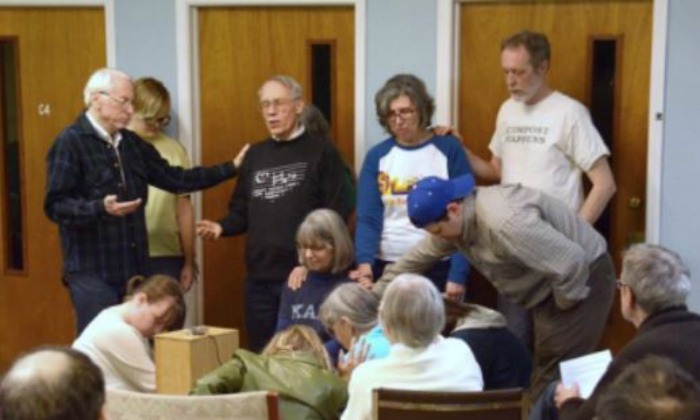
Photo: Members of Reba Place Fellowship in Evanston, Illinois pray together.
After a “slow conversation” that took three years, Reba Place Fellowship (RPF) in Evanston, Illinois, embraced a position that supports LGBT people who marry a person of the same sex or serve in leadership positions, and supports gay members who live celibate lives out of principle, as well as members who remain non-affirming out of conviction. While community members hold diverse opinions, in the end, no one who stayed until the end of the dialogue left as a result of the decision.
The fellowship, which began in 1957, is a group of families and single people who live in intentional community. Currently it has 50 adult members and 16 children. While RPF itself is not a “congregation” belonging to Mennonite Church USA, most of its members also belong to one of two MC USA congregations, Reba Place Church in Evanston and Living Water Community Church in Chicago.
RPF pastor Sally Schreiner Youngquist led the community in seeing the conversation as an opportunity to grow in their understanding of Scriptural authority, sexuality and hospitality toward the marginalized. While the process was demanding in terms of emotional energy and time, she says, the community decided that it was what God had given them to do.
RPF has previously navigated conversationabout women in leadership and marriage after divorce, and its members say they weren’t intimidated by this one. The Fellowship encourages deep commitment to one another, and years of relational history with each other allowed members to stay connected to each other in spite of disagreements over important matters. Finally, the church emphasizes a “radical discipleship,” which means that each member engages in practices designed to teach patience, perseverance, enemy love, forgiveness, simplicity and hospitality.
Youngquist describes the process for this decision: “About every three years RPF invites a small group of trusted outsiders to come do a ‘checkup’ of our community, tell to us what we’re doing well and what we need to work on. In our June 2011 visitation, Homosexuality* was named as a divisive topic among us needing open, honest, nuanced conversation without immediate intent to change policy (from the traditional stance).”
Tim Otto, a member of the visitation team from Church of the Sojourners in San Francisco reported to RPF: “Homosexuality came up a lot in conversations and in the [previsitation] surveys.… Unity comes from people with differences talking and hoping the Holy Spirit shows up.”
Otto calls himself “a gay and deeply committed Christian.”
RPF formed a dialogue steering committee and began discussions in small groups in January 2012. That fall, the Fellowship began a year of the Bible focus.

A year later, RPF divided into small dialogue groups, mixing people with differing perspectives andled by a designated facilitator, to read, study and discuss authors making a biblical case for the both affirming and traditional beliefs, looking at the particular Bible verses cited as speaking out against same-sex relations.
In later discussions, members heard from different people, including Otto, who advocated finding and modeling a third way—neither entirely traditional nor entirely affirming—to the broader Christian church.
RPF eventually created a working document released last July that everyone agreed to. It includes the following statement: “As RPF, we are not taking an official position to endorse either the ‘affirming’ or ‘traditional’ side of this controversial and disputable matter. Rather, we seek to create a space where those with differing perspectives can learn to honor, serve and encourage one another in our desire to find and follow God’s will.”
Is such a long process transferable to a congregation? In an April 18 email, Youngquist said she recommends “forming a dialogue steering committee with members who represent differing viewpoints to help a congregation determine a process which could fit their culture and schedule limitations.” She added that she hopes “congregations would enter such a process with a deep commitment to maintaining unity and the desire to listen well to the Spirit and one another without jumping prematurely to a conclusion.”
*From Youngquist: “We have since learned a preferred term for people with same-sex attractions is ‘sexual minorities.’ For a while we used the term LGBTQ, but we came to realize we were limited enough in our experience and scope of study not to try to encompass transgender people or the ambiguity of the definition of queer.”
For more information and resources on the RPF process, visit: https://orientedtofaith.com/rpf/.


Have a comment on this story? Write to the editors. Include your full name, city and state. Selected comments will be edited for publication in print or online.