


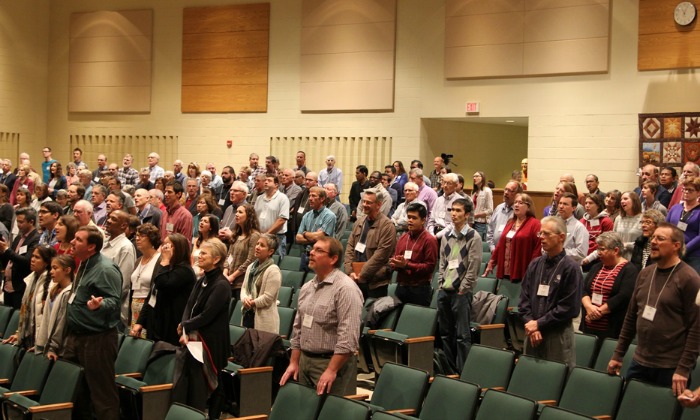
Photo: Members of Eastern District Conference and Franconia Mennonite Conference worship together during their Nov. 4-5 assembly at Dock Mennonite Academy, Souderton, Pennsylvania. Franconia Mennonite Conference photo.
In a countercultural move for Anabaptists, two conferences that split 169 years ago are beginning to test the possibility of a reunion.
Eastern District Conference and Franconia Mennonite Conference, which split in 1847, hosted a joint assembly Nov. 4-5 at Dock Mennonite Academy, Souderton, Pennsylvania. During the assembly, more than 240 delegates met in separate business sessions to discuss the proposed move toward a reconciliation process.
The proposal was approved by 96 percent of Franconia delegates and 100 percent of Eastern District delegates.
According to moderators John Goshow of Franconia and Rodger Schmell of Eastern District, this vote is the result of a process 20 years in the making, including five years of joint assemblies in which the conferences shared times of worship and fellowship. In addition, the conference moderators and conference ministers have been meeting every other month for the last six years.
“One could say that for the last 20 years we’ve been deliberately trying to do things together and keep each other informed,” says Goshow, who was just elected for a second three-year term as moderator. “We’ve been dating for quite a while now and we think it’s time to decide whether or not we want to get married, so to speak.”
Prior to the assembly, Goshow and Schmell sent a letter to conference delegates outlining the proposal and the rationale for exploring reconciliation.
Citing historian John Ruth’s account of the split in his book, Maintaining the Right Fellowship, the letter described the reasons for the split: “In 1847, the two conferences were trying to express the meaning of the church in two opposite practices of Communion: Franconia by requiring that it include acknowledgment of a lengthy code of rules and be limited to people of ‘like precious faith,’ Eastern by inviting Christians to approach the Lord’s Supper after consulting their private consciences.”
According to Ruth, on Oct. 7, 1847, a group favoring a more permissive approach to Communion walked out of a Franconia Conference Assembly. This group formed “The Eastern Conference of the Mennonite Church of North America,” which would later become Eastern District Conference. Prior to the merger to form Mennonite Church USA in 2001, Eastern District was part of the General Conference Mennonite Church, while Franconia was a member of the old Mennonite Church.
In 2012, the two conferences held two forums that allowed conference members to come and learn more about the rationale and reasons for the 1847 split.
“The reasons for the division were complex, so too will be any process we undertake toward reconciliation. Yet, in recent decades there has been a stirring of the Spirit for reconciliation throughout both conferences,” wrote Goshow and Schmell in their letter.
The affirmative vote by delegates launches the next phase of testing reconciliation. Together, the conferences will form a reference team representing the breadth and depth of each conference’s diversity. In January, the reference team will begin to meet with consultants David Brubaker and Roxy Kioko from Eastern Mennonite University, Harrisonburg, Va. Brubaker and Kioko will help lead a process of information gathering that will include focus groups, surveys and, potentially, individual interviews. The reference council hopes to refine recommendations for moving forward by summer 2017, in time for delegates to process the recommendation at the Fall 2017 assembly.
Although both Goshow and Schmell are excited and hopeful about the process, they are also realistic about some of the hard work that lies ahead. Delegates raised questions about how Eastern District will be represented, given its smaller size; what the conference will be named; and how the conferences will work to create a new organizational culture together. In addition, both conferences are in the midst of a search for a new conference minister, as Warren Tyson, Eastern District, and Ertell Whigham, Franconia, have both resigned from their long-term positions with the conferences.
Scott Roth is one individual who already embodies a model of collaboration between the two conferences. Roth serves as associate pastor at Perkiomenville (Pennsylvania) Mennonite Church, a Franconia Mennonite Conference congregation, and is currently serving as the interim conference minister for Eastern District.
Roth has seen the power of the two conferences coming together to collaborate in ministry, most notably with the Project Haven initiative in East Greenville, Pennsylvania. The community center was founded in a building owned by Franconia Mennonite Conference, but grew out of a vision for ministry among congregations in Eastern District Conference. Today, Project Haven works alongside community members to provide after school programs, a bike shop, community gathering space, student mentoring and more. Congregations from both Eastern District and Franconia conferences have supported the initiative with funds and volunteers.
“We can work together and to things for the kingdom in beautiful, brilliant ways. I know we have potential to do great things together,” said Roth, in a Nov. 21 phone interview.
Despite the potential, Roth also knows that organizational culture and traditions can be a big hurdle to organizations unifying.
“One of the real hurdles is our conference identities. Are we going to be ok with giving up our identities to create something new? As humans, can we identify with the kingdom of God and hold that as a priority versus a sense that, ‘I’ve always been a part of EDC or FMC’?” said Roth.
Despite the work that lies ahead, and a very real sense that they don’t know how the process might end, both Goshow and Schmell feel this is the right time to be having a conversation about reconciliation.
“There seems to be a sense of excitement and anticipation about this right now,” says Schmell. “I haven’t heard any nay saying at this point. For the most part, we’re just all waiting to see what happens with this process and we’re excited about it. The more we do things together the more natural it feels.”


Have a comment on this story? Write to the editors. Include your full name, city and state. Selected comments will be edited for publication in print or online.