


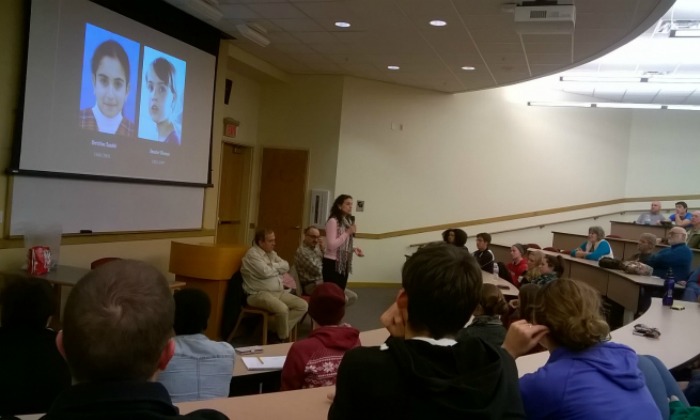
Photo: Attendees gathered in Centennial Hall at Bluffton (Ohio) University on Oct. 27 to hear from members of the Israeli-Palestinian reconciliation group, the Parents Circle Family Forum. Najwa Sa’adeh is speaking here. Photo by Paul Neufeld Weaver.
“After a while, you start to think and ask yourself questions. Will killing anyone bring her back? Will causing pain release this unbearable pain? Well, the answer is, Certainly not.”
These reflections on the loss of a daughter, Smadar, were spoken by Rami Elhanan, an Israeli from Jerusalem, as part of an Oct. 27 event at Bluffton (Ohio) University. Elhanan spoke alongside George and Najwa Sa’adeh, from Bethlehem (Palestine), at three events in the Midwest during late October. Both Ehanan and the Sa’adehs have lost children in the ongoing conflict in the Israel-Palestine region.
These events were arranged by Mennonite Church USA and the Indiana Center for Middle East Peace, and funded by Mennonite Central Committee Great Lakes, Central District Conference and the hosting organizations. The families, part of the Parents Circle Family Forum, which brings together Israeli and Palestinian parents who have lost children to advocate for peace, participated in a longer U.S. tour but made three stops in Mennonite communities: one at Bluffton, one at Anabaptist Mennonite Biblical Seminary in Elkhart, Indiana, on Oct. 28, and one at Emmaus Road Fellowship in Berne, Indiana, on Oct. 30.
During the events, the families shared their stories of grief and pain as well as their testimonies of reconciliation and their hopes for peace. George told of being in a car with his two daughters when Israeli soldiers opened fire. After the shooting, one daughter survived, and one daughter, Christine, did not.
“This is an organization [the Parents Circle Family Forum] we do not want any new members in. It is unique, but it is also built on sadness,” said George at the Bluffton event.
During the AMBS event, Nelson Kraybill, president of Mennonite World Conference, asked the participants about whether they supported a boycott, divest and sanctions approach to the conflict in Israel-Palestine.
“The Mennonite traditional approach has been more in the category of normalization. It’s been to build bridges with the other,” said Kraybill. “But we also then talked as a Mennonite people [about] a more BDS kind of confrontational way. Those voices are clear within our body. Do you have any counsel for us?”
Both George Sa’adeh and Elhanan spoke in support of BDS, with some cautions.
“Occupation is the essence of evil. It must be fought in any way possible,” said Elhanan. “Occupation is the reason we lost our children. I think it goes without saying that you should boycott the products of the settlements without thinking twice. In order to clap your hands, you need two hands. In order to make peace, you need a partner. It would be a mistake to push Israel into a corner.…The ordinary Israelis do not pay a price for BDS. They do not want to know what is happening 200 meters away behind the wall, and the Israeli media [are] cooperating with this. The Israelis need to understand that the occupation carries a price.”
Among the event planners was Jonathan Brenneman, a Mennonite Voluntary Service participant serving with Mennonite Church USA this year, helping equip Mennonite Church USA congregations consider the Israel-Palestine resolution that delegates will vote on at the 2017 assembly in Orlando next summer. In 2015, delegates voted to table a resolution on Israel-Palestine until 2017 but passed a statement of support for Israeli and Palestinian peacemakers, calling on the members of MC USA to study and educate themselves about the Israel-Palestine conflict and context.
“These events gave perspectives of both Israelis and Palestinians and also gave just a very human perspective of people who have lost loved ones and how they are trying to deal with it,” said Brenneman in a Nov. 3 interview. “Those are all things that really fit the mandate of the resolution from last summer to partner with Israeli and Palestinian peacemakers.”
Part of the challenge of making these events happen was securing visas for the speakers. Rami did not have problems securing a visa, due to the United States’ cooperative policies with Israel. The story was different for the Sa’adehs. Although they were initially granted visas to visit the United States, one month before the events, the United States put a four- to six-month hold on their visas. Members of the Parents Forum Circle contacted Brenneman and asked him to invite support from others in the United States. Brenneman spread the word to people in the United States who had participated in past Come and See Tours of the Israel-Palestine region and asked them to contact the U.S. Consulate in support of the Sa’adehs. More than 15 people sent letters, and just before the trip, the hold was removed from the Sa’adehs visas.
New resolution ready for public study
After six months of work by a three-person writing team, a revised resolution on Israel-Palestine, titled “Seeking Peace in Israel and Palestine,” is ready for study across the denomination. The resolution will be voted on by delegates at the 2017 assembly in Orlando next summer.
The writing team consisted of Rod Stafford, pastor of Portland Mennonite Church and a member of the Mennonite Palestine-Israel Network (Menno PIN), Lisa Shirch, peacebuilding research professor at Eastern Mennonite University, Harrisonburg, Virginia, and Andre Gingerich Stoner, director of interchurch relations for Mennonite Church USA.
The group also sought counsel from a 10-person reference committee that included conference leaders, pastors, scholars and activists with a variety of perspectives. The writing team also consulted with Palestinian Christians and Muslims, Israelis and Jewish Americans.
Brenneman said he hopes congregations and delegates will take seriously the resolution they passed in 2015 calling for study and engagement.
When asked how he hopes people will engage, he said, “Obviously read and study the [new] resolution. [B]ecome familiar with the Kairos Palestine document, which is written by Palestinian Christians, expressing their commitment to nonviolent love and calling on the international church to support them in that. We have a four-week Sunday school study guide to help churches engage in that. Seek opportunities to have speakers come to their congregations and their areas. There are other groups similar to the Parents Circle Family Forum doing tours that I can help coordinate with people. That’s part of my work.”
MC USA is also sponsoring several webinars about the conflict in Israel-Palestine in the lead-up to convention.
Listen to audio from the Oct. 28 event at AMBS.
https://soundcloud.com/followambs/2016-10-28-the-parent-circle-families-forum-israeli-and-palestinian-stories-of-peace


Have a comment on this story? Write to the editors. Include your full name, city and state. Selected comments will be edited for publication in print or online.