


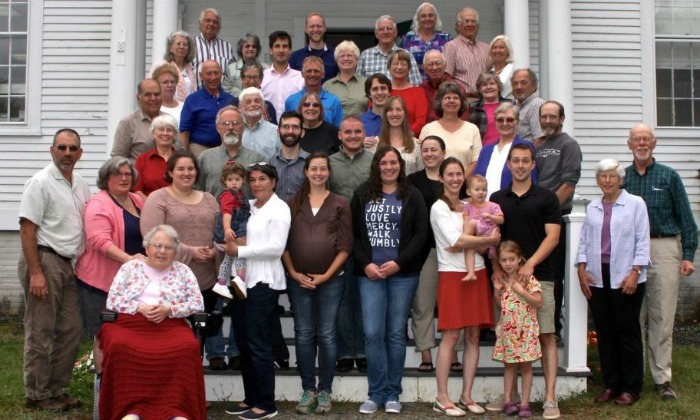
Photo: Participants at the Taftsville Chapel Mennonite Fellowship, Taftsville, Vt., in front of their building. Later this year, they will receive $10,000 toward solar panels from Mennonite Creation Care Network’s Pam De Young Net Zero Energy Fund. Photo provided.
Mennonite Creation Care Network (MCCN) awarded two congregations solar grants from the Pam De Young Net Zero Energy Fund following its October 31 application deadline. Taftsville Chapel Mennonite Fellowship, Taftsville, Vt., will receive $10,000, and Albuquerque Mennonite Church, Albuquerque, N.M., will receive $5,000 toward rooftop solar arrays.
The two congregations from opposite ends of the country are a refreshing contrast. One church has lovely snow photographs; the other talks of dust storms. One is in a forested rural community where a cluster of small towns has a joint population just over 3,000; the other is in the middle of a city of half a million people.
Both churches have ideal roof space for solar panels and will be able to supply all of their own electricity. Taftsville expects to produce approximately 12600 kWh per year with its 11.66-kilowatt system, and Albuquerque’s solar system will be about the same size.
The solar arrays will educate and benefit others beyond the worshippers who install them. Albuquerque’s building houses a childcare center, a neighborhood association and 12-step groups who will soon see “100% solar” posted by the light switches. The church’s involvement with Transition Cities will provide additional opportunities to share ideas.
Taftsville’s utility company enables solar owners to donate excess power to other customers of the same utility. The congregation plans to install enough panels to generate twice the energy their building consumes so that they can share with other nonprofits. One beneficiary will be Bethany Birches Camp, a nearby ministry that puts people in touch with creation.
“Without the grant from Mennonite Creation Care Network, we would have had to scale back and just cover our own needs,” Heather Wolfe, the congregation’s creation care liaison remarked.
Part of a larger plan
MCCN’s grant process requires congregations to evaluate their approach to creation care in all areas of

church life, from worship to community life to practicing eco-justice in the broader community. This involves answering a series of questions called the Greener Congregations Score Sheet.
Albuquerque’s review was extensive because they had been working on creation care for many years. Congregants sign a covenant each year that says, “Together we honor God the Creator by challenging one another to live as partners with the creation.” Because God’s creation is a source of passion and concern for so many members, it is mentioned in global and community prayers nearly every week. The congregation has both a Watershed Discipleship Group and a Zero Waste Committee.
A number of Albuquerque’s projects highlight their southwestern context. Installing cisterns and drought tolerant landscaping around the building is one example. Helping to designate Albuquerque a bee-friendly city is another. In the future, they hope to hold a pilgrimage to sites within their watershed, such as the headwaters of the Rio Grande and native lands where farmers are practicing centuries-old techniques of sustainable farming.
Creation care emerged as a key theme for the Taftsville congregation as they evaluated priorities during a recent transition time in preparation for a pastoral search. Filling out the Greener Congregation Score Sheet was new for them.
“Committees and members were highly engaged in this score sheet process. We generated a good mix of small and substantial changes,” said Wolfe.
The Taftsville group observed that they were already practicing eco-justice in a number of ways. They bought fair trade coffee, supported a ministry in Indonesia that traded health care for forest protection and helped local low-income people afford heating during the long northern winters. They’d also done an energy audit for their building and evaluated the costs and benefits of various upgrades.
Looking forward, the Taftsville congregation designed a creation care plan for the next year with a monthly task list. For example, this month, they are investing in LED light bulbs. In January, households complete a carbon footprint calculator. In March, they’ll work on MCCN’s Every Creature Singing curriculum. The list goes on.
Making a solar project affordable
Both churches relied on additional funding strategies beyond the MCCN grants they received.

Albuquerque created a limited liability company (LLC) and members of the church bought shares at $500.00 apiece. Shareholders will receive the 30% federal tax credit associated with a solar installation in return for becoming a member of the LLC. The money saved on electricity costs will be returned to investors over an eight-year period.
Completing the paperwork for the LLC was complicated, but Albuquerque had the benefit of advice from a neighboring church that funded their solar project this way.
“We would be glad to help others through the process, as others helped us” Sue Brown, a member of the LLC said. They also drew on the solar expertise of Nick King, pastor of Carlsbad Mennonite Church, Carlsbad, N.M. He is the proprietor of King Solar.
Taftsville is without a pastor at present, so dollars not needed for a salary were diverted to solar panels.
About the Pam De Young Net Zero Energy Fund
Russell De Young, a NASA scientist from Newport News, Va., began the fund in 2016. It is named in honor of his late wife, who loved the outdoors and cared gently for all around her.
You can read more about De Young in a feature article in the August issue of The Mennonite magazine.
Congregations interested in applying for a grant in 2017 can submit proposals between August 1 and October 31. Additional information is available at https://www.mennocreationcare.org/net-zero-energy-grants.


Have a comment on this story? Write to the editors. Include your full name, city and state. Selected comments will be edited for publication in print or online.