


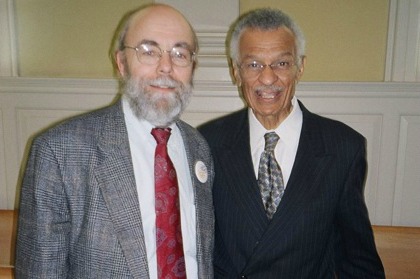
Photo: John Stoner and Rev. C.T. Vivian together in Atlanta in 2006. Photo provided.
Shortly before last Thanksgiving, John Stoner felt what he describes as a “stirring in his soul.” On his mind was the biblical call to resist empire; recent countrywide movements, including Black Lives Matter and Occupy Wall Street; the recent contentious presidential election; and the Water Protectors protesting the Dakota Access Pipeline at Standing Rock.
“I went from thinking of protecting waters to protecting all people,” said Stoner, a member of Akron (Pennsylvania) Mennonite Church.
Stoner wrote out a statement of sorts and titled it “A Public Call to Protect All People.” He sent this draft statement to several people, including retired Hesston (Kansas) College professor Tony Brown and longtime collaborator Berry Friesen, East Chestnut Street Mennonite Church, Lancaster, Pennsylvania. Both Brown and Friesen sent feedback and encouraged Stoner to continue to develop the statement.
Brown also put Stoner in touch with civil rights leader Reverend C.T. Vivian, Atlanta, Georgia.
“I saw this work as primarily a task and agenda for white churches to pick up, given our history of degradation, but at the same time I wanted connection and collaboration with people of color,” said Stoner.
After a short phone conversation, Vivian was on board and worked to help connect Stoner with others,

including Rev. Susan K. Smith, who is working with Vivian on writing his biography. Vivian and Smith gave feedback about the statement and helped Stoner get in touch with other leaders to invite them to sign on to the statement, including Professor Tony Campolo of Eastern University, Philadelphia, former President and First Lady Jimmy and Rosalyn Carter, Shane Claiborne, leader of the Simple Way Community in Philadelphia and Jim Wallis of the Sojourners network
The final statement, which the group hopes will attract people across partisan lines, reads: “As followers of Jesus ourselves—and with a fervent hope that other faith communities, secular groups, etc. might use this as a model—we feel led by God’s Spirit to call upon congregations and other assemblies to make the following public commitments in their communities:
- We will protect and support the worth and rights of all people, including marginalized persons who are targeted, discriminated against or singled out by hate crimes or state-sponsored/sanctioned violence;
- We will oppose the aspirations of those who seek U.S. global domination through the use of propaganda, inciting terror, military threats, regime change and war. We will support instead the practices of diplomacy and negotiation, which lead to peace.
- We will support a just economic order—one that is sustainable as a servant of the people amid the changes in climate that have already begun.
- To keep these promises, we will reach across lines of creed, class, ethnicity, race and party preference in a spirit of empathy and learning, seeking relationships of solidarity with other groups.”
The group published the call on five websites—$10.40 for Peace, the Baptist Peace Fellowship, the Fellowship of Reconciliation, the Peace and Justice Support Network of Mennonite Church USA and the website for the book If Not Empire, What?, authored by Stoner and Friesen.
In addition, the group published an implementation guide, inviting congregations and groups to sign on to the call and discuss ways to promote it and engage its action steps in their local communities.
“Rev. Vivian has said you cannot be a Christian and be racist and I thoroughly agree with that,” said Smith, in a Jan. 10 phone interview. “One of the things that has always bothered me and has been unearthed in my spirit as I work with Rev. Vivian is that Christianity has had great moments where it could have affected great social change at quicker rate, but people were afraid.”
Smith hopes that the statement will help white Christians be brave. “As followers of Jesus–your allegiance to Jesus the Christ mandates that you take a stand, and it might cost you, and that’s what it means to be Christian.”
John Paul Lederach, professor of international peacebuilding at the University of Notre Dame (South

Bend, Indiana) and an international peace practitioner, signed on to the statement because it fit with the “heart of his vocational call.”
“It’s the vocational distinctiveness of the Mennonite and Anabaptist tradition to embody a quality of love that reaches out to protect those who are vulnerable and is willing to offer love to those we feel threatened by,” said Lederach in a Jan. 13 phone interview. “Our moment has come. We need to be leading people to follow the primary example of Jesus in embodying love for those who are different and who we may perceive as enemies.”
Ted Grimsrud, senior professor of peace theology at Eastern Mennonite University, Harrisonburg, Virginia, also signed on to the statement in hopes it will encourage Christians to pay attention to the impact of empire.
“We have a responsibility now to draw on our Anabaptist tradition and the biblical themes of suspicion and even hostility toward the big empires. In the Bible, this would have been Babylon or Rome, but can we apply that to our current situation as Americans?” said Grimsrud in a Jan. 12 phone interview.
Hyun and Sue Park Hur, pastors of Mountain View Mennonite Church, Upland, California, and leaders of ReconciliAsian, an peace center in Los Angeles County, also signed on to the statement.
“We have been seriously contemplating how to view and respond to the political climate we are currently

in as followers of Jesus. How should we who believe that Jesus is the Prince of Peace engage others? How could we tangibly obey Jesus’ commandment to love God and our neighbors?” wrote the Hurs in a Jan. 12 email.
The Hurs emphasized that as the body of Christ on earth, the church is called to stand with those who are vulnerable and marginalized, and they hope this statement encourages congregations not only to make public statements but to take actions to support their neighbors as well.
The statement has been signed by 42 individuals beyond the statement’s originating committee.
You can find the statement and implementation guide online at www.pjsn.org.


Have a comment on this story? Write to the editors. Include your full name, city and state. Selected comments will be edited for publication in print or online.