


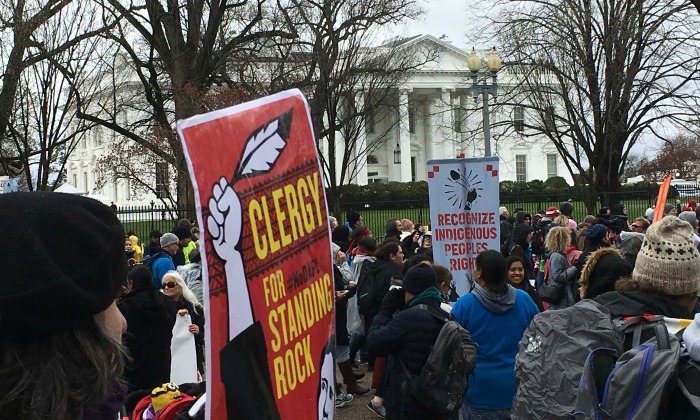
Photo: The March 10 Native Nations Rise march ended with a rally in front of the White House. Photo by Tammy Alexander/MCC Washington.
“I’m comfortable talking about issues, but now I need to march on issues. We don’t have the privilege of sitting and learning and reflecting and lamenting. This is actually a time where we as a church need to act.”
Erica Littlewolf, Indigenous Visioning Circle program administrator for Mennonite Central Committee (MCC) Central States, flew from Kansas to Washington, D.C., to join thousands of individuals who marched to the White House on March 10. Growing out of the movement begun by the Standing Rock Sioux tribe in North Dakota to protest the building of the Dakota Access Pipeline, the Native Nations Rise March drew Native Americans and allies from across the country to demand treaty rights and that the government dialogue with Native Americans.
In December 2016, the U.S. Army Corps of Engineers responded to long-term protesters at the Standing Rock Camp and announced it would deny the easement needed to complete the final stretch of the Dakota Access pipeline. However, on Jan. 24, President Donald Trump signed an executive order overturning this denial. Protesters were evicted from the camp on Feb. 22. The March began at the Army Corps of Engineers office and ended with a rally in front of the White House.
Staff from the MCC Washington office were also involved in the march and created a Facebook group to help Anabaptists attending the march connect. Although participants weren’t able to meet up at the march, due to larger-than-expected crowds, 27 individuals noted they were planning to attend.
Tammy Alexander, Senior Legislative Associate for Domestic Affairs with MCC Washington, said the march fit with MCC’s work on three levels: solidarity with Native Americans, work to address the Doctrine of Discovery,[1] and environmental justice work.
“This march provided some time also to think about why we were marching and the effects of the Dakota Access Pipeline on other Native American tribes around the country,” said Alexander in a March 14 phone interview. “And time to reflect on the disappointment that the struggle against DAPL has really been lost. But at the same time there was a recognition that it was an amazing time of solidarity and Native American groups coming together and then coming together with allies and environmental groups. We spent time talking about ways we can continue working together.”
“On the day of the march, I was reflecting on what it meant for those of us who were non-Native marching and holding messages of repentance, support and calls for justice,” she said. “That’s where we need to be. It really does come back to the work of dismantling the Doctrine of Discovery and using the power we have to stand with Native Americans today and struggle against the injustices they are facing.”
Joshua Grace, pastor of Circles of Hope Church in Philadelphia, attended the march along with three other members of the congregation. Grace emphasized that the fight for sustainable and clean water sources extends across the country.
“The extraction industry has taken a big jump in our area since the new executive administration has been in place,” said Grace in a March 17 phone interview. “One of the things I’ve been processing with people is that more and more people are believing that the war for water is on the way. I would say the war for water is already here. It’s not being fought by governments but by transnational corporations.”
Grace was especially moved by the rally in front of the White House that ended the march, which was led by Native American leaders, including both elders and young adults, who led the group in thanking the original inhabitants of the land in Washington, D.C., the Creator and all the people who attended the march.
“I’d say that listening to the First Peoples of this land is an invitation to live well as a follower of Jesus. For folks who have been living under settler colonialism for 500 years to say they actually have hope, that’s a hope that is beyond any one battle or any one pipeline and is a deep sense of responsibility. I want to feel that, too,” said Grace. “The struggle for water particularly is not just for us but for the people who are even still unborn, but we have to protect them.
On March 9, in preparation for the march, a service was held at the National Cathedral. Ruth Keidel Clemens, MCC U.S. program director, read the following prayer (adapted from an earlier prayer by KAIROS):
Creator, You loved creation into being.
Your goodness is present in the land and waters
in the creatures and peoples
You created.
You call us to be in right relation with all living things.
Be present today,
and every day,
where people stand in peaceful defense of your creation.
We recognize Your presence
where Indigenous peoples stand peaceably
in defense of land and waters.
May we be present
in witness and solidarity.
We recognize and repent
for the violence
that has marked relations
with Indigenous peoples on Turtle Island.
[1] A philosophical and legal framework dating back to the 15thcentury that gave Christian governments moral and legal rights to invade and seize indigenous lands and dominate indigenous peoples.


Have a comment on this story? Write to the editors. Include your full name, city and state. Selected comments will be edited for publication in print or online.