


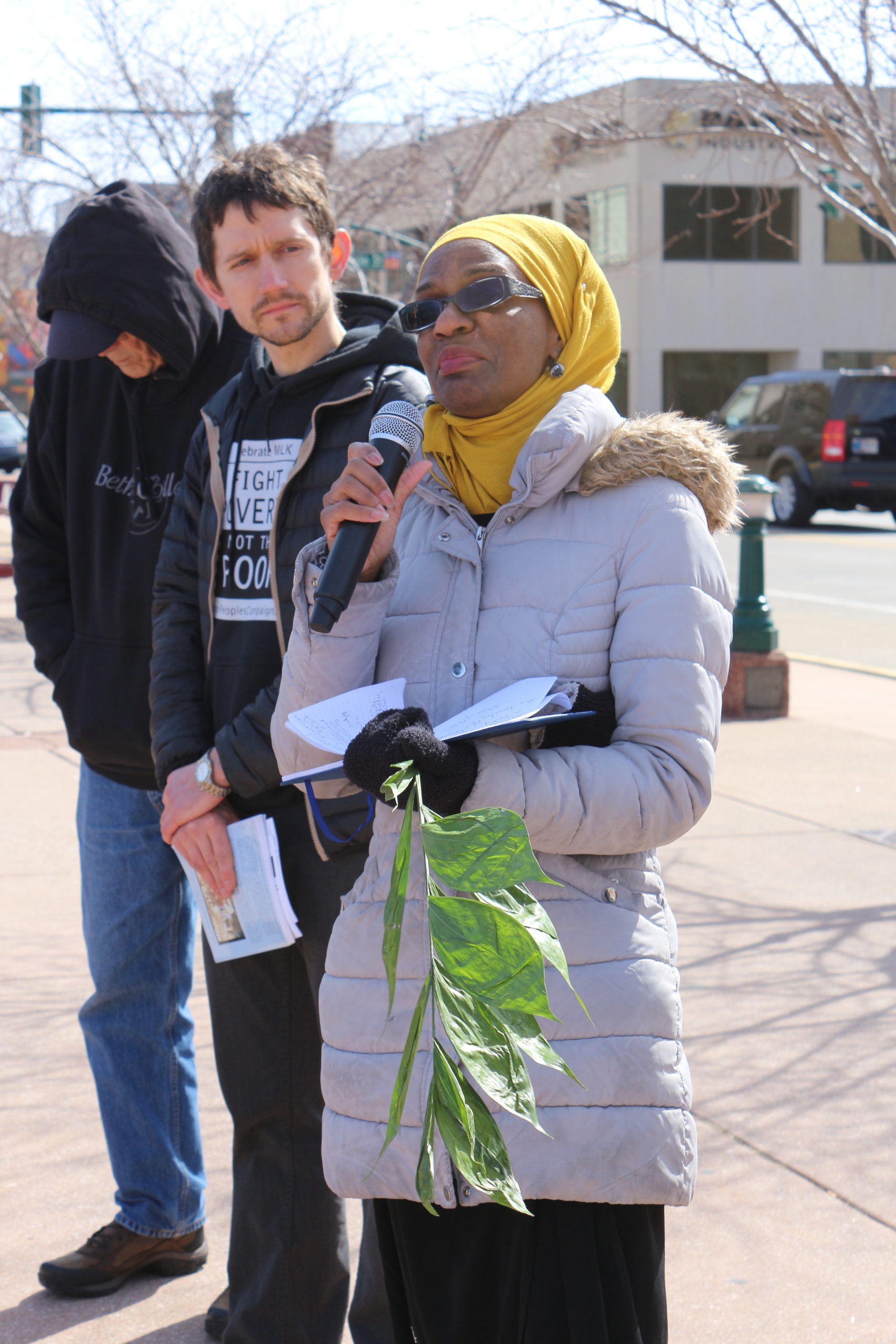
Photo: Ameenah Starks address the Palm Sunday Peace Parade in Elkhart, Indiana. Photo by Tiffany Grace.
This past Palm Sunday, March 25, marches for peace and justice initiated by Mennonites occurred in four U.S. communities. Two of the marches supported the Poor People’s Campaign, a revival of Martin Luther King Jr.’s final organizing initiative 50 years ago.

One of the marches that supported the Poor People’s Campaign, the Palm Sunday Peace Parade in Elkhart, Indiana, began at the peace garden at Hively Avenue Mennonite Church, where the group heard some introductory words and recited together a pledge of nonviolence. The parade participants received a handout that included the words of Zechariah 9:9-12.
After walking more than two and a half miles from the south end of Elkhart to the city center, about 60 people gathered to sing, pray, listen to speakers and hear announcements about opportunities for involvement.
“Just like Dr. King, Jesus knew that if we would die, death would not be the final answer,” said Jason Shenk, coordinator for the People’s History of Elkhart and a member of the committee for the Indiana Poor People’s Campaign.
“Jesus’ followers continued on, and Dr. King’s associates have carried on,” said Shenk. “People from every religious and moral tradition have carried on the work for justice, and we, with this campaign, invite everyone here and across the nation to join the unfinished business that remains for us today.”
Ameenah Starks, a Muslim participant in the parade, proclaimed the importance of joining together on common religious grounds toward our common goal and reminded the crowd that deep faith will carry us through these times, that trusting in God must be at the core of our endeavors.
Donald Brown, also involved in the Poor People’s Campaign, said: “I met so many amazing people. Backgrounds are totally different, but we all connect in that way, to help.” Brown also reminded those gathered at the plaza that Jesus was born poor and called us to follow his example of helping the poor. He went on to say: “We should continue that mission—not only what Jesus did but what Martin Luther King did with the Poor People’s Campaign. I think it really got to him when he was traveling the country and seeing cities: [poor] education and poverty and people barely even had shoes and couldn’t go to school, and you still see this to this day, and I think it’s our spiritual obligation to help out these people.”
Wendell Wiebe-Powell invited involvement in the Elkhart Advocates for Peace and Justice outreach in the public schools, providing alternative peace-oriented information to the intensive military recruitment of students. Parade participants were also invited to tune into a Poor People’s Campaign live stream broadcast in memory of the 50th anniversary of Martin Luther King Jr.’s assassination on April 4.
The 16th Palm Sunday Peace Parade in Pasadena, California, also supported the Poor People’s Campaign and involved more than 120 people representing more than 20 churches and community organizations. The Pasadena Palm Sunday Peace Parade had the blessing of the California Poor People’s Campaign organizing committee to consider our event an official event of the California Poor People’s Campaign.
Supporting the Poor People’s Campaign meant three things: (1) educating the participants about the campaign, (2) inviting people to a mass meeting to take place on April 29 in Los Angeles and (3) Inviting people to join the campaign of 40 days of direct action in Sacramento, beginning May 13.
Participants gathered at Reformation Church for singing and an explanation of the Poor People’s Campaign by Timothy Murphy, a member of the California Poor People’s Campaign organizing committee. Joe Bautista, the emcee for the parade, invited participants to join him on Good Friday in spending the night in a city park in solidarity with the homeless people of the city. (Two others later joined Bautista for this solidarity action on Good Friday night. Since sleeping in city parks in Pasadena is illegal, this action was an act of civil disobedience.)
The marchers left the church, led by a 12-foot Lady Wisdom puppet, and walked from an economically marginalized part of the city, then across the bridge over the 210 freeway that divides Pasadena along economic and ethnic lines, to an upscale mall in the city’s center.
In front of the mall, the participants sang and prayed for peace and justice and listened to five speakers address the four emphases of the Poor People’s Campaign through local and international initiatives. (1) Civil rights attorney Skip Hickambottom spoke about the efforts to make the Pasadena Police Department accountable for the actions of its officers. (2) Environmentalist Tom Brady informed the crowd about the campaign to convert Pasadena to operating on 100 percent green energy by 2035. (3) Allison Henry invited parade participants to join the campaign to establish rent control in Pasadena, which has seen skyrocketing rents in recent years and has a homelessness rate higher than the national average and the largest wealth disparity of any city in California. (4) Finally, Sue Park-Hur and Hyun Hur invited people to support their campaign for peace between the United States and North Korea.

The third annual Palm Sunday Peace Walk in State College, Pennsylvania, included more than 80 walkers representing more than 15 faith groups and Penn State student organizations. The event kicked off from University Baptist and Brethren Church with music and welcome, as well as a keynote message on walking for peace from Dr. Drew Hart, a professor at Messiah College and author of Trouble I’ve Seen: Changing the Way the Church Views Racism. Hart, an Anabaptist, also spoke at last July’s Mennonite Church USA Convention.
The walk took participants to five downtown congregations, highlighting struggles for justice and peace in the community and beyond. The stops addressed issues of racism, religious diversity and inclusion, our broken incarceration system, gun violence, and sexual abuse and assault. Each stop included the Palm Sunday Scripture read by a Penn State student, a reflection on that particular stop’s issue from a community leader, and a prayer of blessing and lament from a local faith leader.
The Palm Sunday Peace Parade in Harrisonburg, Virginia, featured a large peace dove in the wind, signs, singing and praying. The 30 participants represented three Mennonite congregations, including Immanuel Mennonite Church, Community Mennonite Church and Early Church.


Have a comment on this story? Write to the editors. Include your full name, city and state. Selected comments will be edited for publication in print or online.