


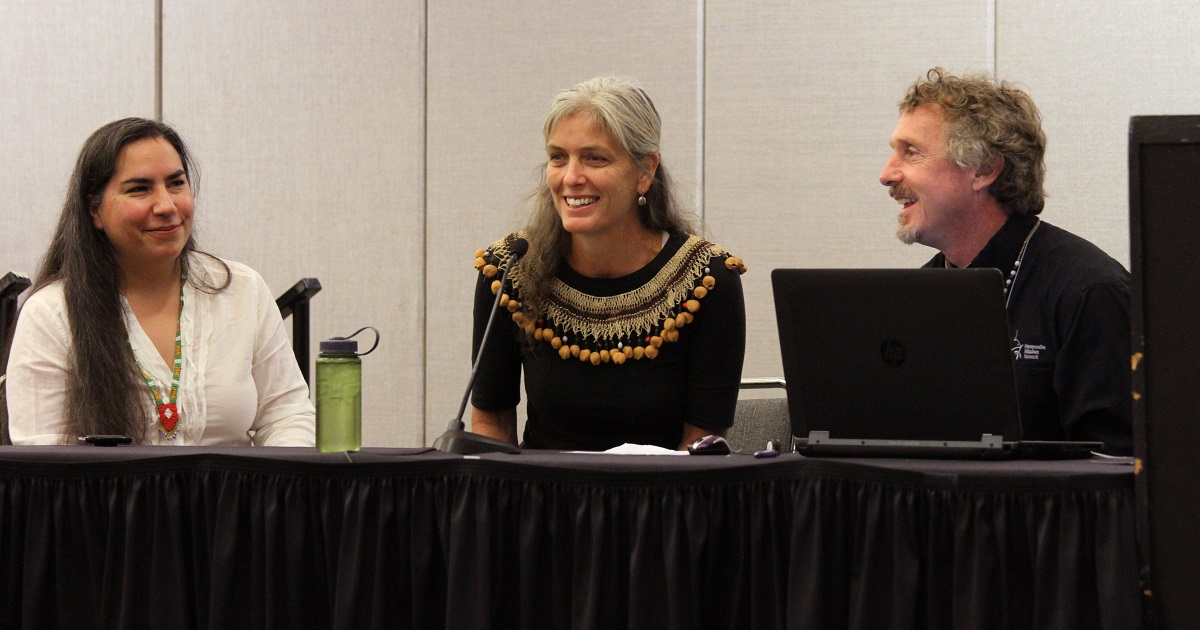
Photo: Sarah Augustine, left, Jane Ross Richer and Jerrell Ross Richer. Photo by Vada Snider.
Editor’s note: MennoCon19 includes hundreds of seminars, and we can only report on a few.
On Wednesday morning, Jerrell and Jane Ross Richer and Sarah Augustine led a seminar called “Speaking to the Systems and Walking with Indigenous People.” The Richers work half the year with the Cofán people of eastern Ecuador, while in the other half Jerrell teaches at Goshen (Indiana) College and Jane homeschools their four children. Augustine is co-founder of the Suriname Indigenous Health Fund and the Dismantling the Doctrine of Discovery Coalition.
Jane Ross Richer talked about an elder of the Cofán people who shared a dream he had of a man stabbing many dolphins. This group and many Indigenous people take dreams seriously, said Ross Richer, and they are important in Scripture. She noted that many interpret dolphins to represent humans. So who is stabbing them?
She told the story of Ruben, a Cofán boy who illustrates the struggles of this group in the face of the incursions of Western capitalism. He went away to a high school where graduates gain about a third-grade education and Indigenous people are often mistreated. Walking with Ruben eventually led him to going to live with foster parents who are Quichua and provide a loving environment.
Jerrell Ross Richer offered a broader context to their work, describing the many changes that have come to the small village of Zabalo in the Amazon rainforest. Oil companies and rubber tappers have brought in new, Western technologies and products that have changed the Cofán people’s way of life.
Ecuador, however, is one of the more progressive countries in Latin America and uses some of its income from oil exports to provide education and health care to its people. And the Cofán do own their land.
Ross Richer said their work there is guided by Acts 17:27-28, noting that they find God present among these people and go there to walk with them.
Augustine spoke about the impact of gold mining in Suriname, which has contaminated the river with mercury and cyanide. Mercury, she said, attacks the nervous system and has caused deformities in many children of the Indigenous people there who depend on the river for their food.
Unlike in Ecuador, the Indigenous people there have no rights, and corporations take their land. And according to the Doctrine of Discovery, Christians have the right to take land from Indigenous people. That doctrine was upheld by the U.S. Supreme Court in 2005, with Ruth Bader Ginsburg writing the majority opinion, said Augustine.
Her group, the Suriname Indigenous Health Fund, is negotiating with the mining company in Suriname about what it means for the local people. That organization emphasizes self-determination.
This issue occurs throughout the world, Augustine said. “The immigration issue in the United States is directly connected to land loss from resource extraction” in Central America. These people seek repair from the harm done to them.
Unfortunately, she noted, many church bodies, including Everence, the stewardship agency of Mennonite Church USA, support resource extraction in their retirement funds.
She encouraged attendees to say yes to confronting these issues. “All you have to know is the gospel of Christ.”


Have a comment on this story? Write to the editors. Include your full name, city and state. Selected comments will be edited for publication in print or online.