


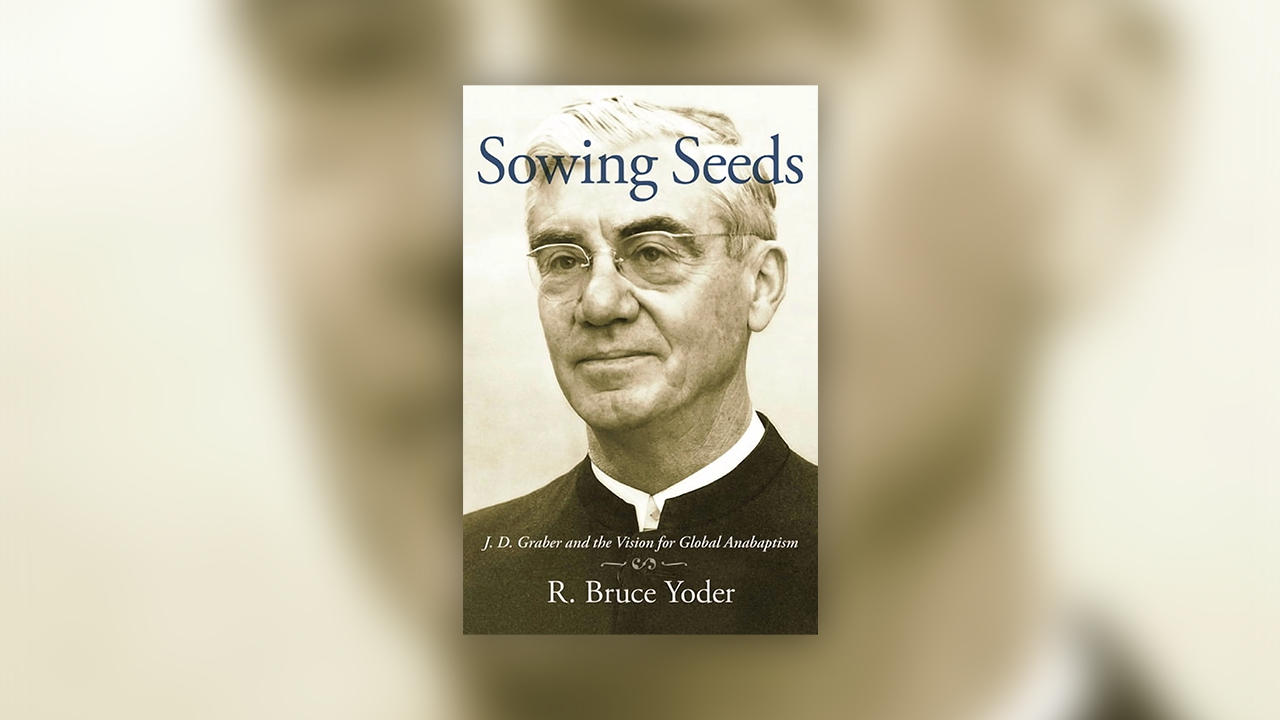
Sowing Seeds focuses on the life of J.D. Graber, an Iowa native and early 20th-century Mennonite missionary to India, who from the 1940s to the late 1960s served as executive secretary of the Indiana-based Mennonite Board of Missions and Charities. The author, R. Bruce Yoder, an American Mennonite missions scholar, presents Graber’s legacy as foundational for contemporary denominational institutions.
For readers interested in the history of Mennonite missions in India, the book’s first third is of particular relevance, with photographs illuminating J.D. and his spouse Minnie (Swartzendruber) Graber’s arrival in 1925, their prodigious Hindi language-learning as they acclimated to missionary culture and their wide-ranging work in Dhamtari, including administrative leadership of the Shantipur Leper Home and its 120-acre farm. The Grabers developed close friendships with Indian colleagues and came to sympathize with their friends’ antipathy to paternalist patterns of mission work.
In a setting where the Grabers’ Indigenous counterparts increasingly “saw North American missionaries as colonial agents and Christianity as a foreign religion that should be boycotted,” Mahatma Gandhi’s influence was profound. As Yoder tells it, J.D. Graber lauded Gandhi’s movement for political independence, labeling it “a good deal nearer Christianity than some of the imperialistic and capitalistic policies of our own country.” Increasingly viewing colonial life in India as unsustainable, the Grabers pushed for broad collaboration with local partners and, ultimately, for Indigenous control of religious institutions.
Among the strengths of this biography is the author’s focus on contextualizing missions history. In the years leading up to the Second World War, as well as the during the decolonization that took place through the 1940s, ’50s and ’60, J.D. Graber was among many Protestant leaders who, while firmly entrenched in broadly paternalistic Christian enterprises, also embraced secular frames (including tools of linguistics and anthropology) for developing sensitivities across religious and cultural borders.
Graber’s curiosity about the world primed him to promote increased local control of Mennonite endeavors. In 1944, the MBMC agency promoted him to its flagship post as executive secretary. In this role, as he and others expanded Mennonite Church missions beyond long-established bases in India and Argentina, Graber’s vision for a broader missions impetus prevailed. Throughout this postwar period, the author notes, “MBMC expanded its international footprint, adding Puerto Rico, China, Japan and Belgium . . . [soon followed by] England, France, Israel and Brazil.” In this way, Graber’s efforts contributed to the emerging global Anabaptist movement.
Assessing Graber’s influence, Yoder notes that at present, 66% of Anabaptists worldwide live in Africa, Asia and Latin America. This increase in global Anabaptism occurred, he points out, “not under the tutelage of North American or European missionaries but as the result of the mission engagement within . . . fast-growing churches [in the Global South].” The work of one American, Yoder acknowledges, was only one of many factors in this shift. Still, Graber’s lifework nudged U.S. Mennonite missionaries and their supporters to prioritize Indigenous expressions of faith.

Along the way, Graber honed a critique of American Mennonites as ethnocentric and insular. In the 1950s, writing in Gospel Herald, he chastised those who would “build fences” in the name of church purity and heritage: “What a travesty on the meaning of a New Testament church,” he wrote, “to have it made up of a group of self- satisfied and self-righteous people, loud and zealous in their profession of wholehearted Christian living and hesitating to allow their neighbors of a different cultural pattern to come in!” To counter such ethnocentrism, Graber advocated racial integration of Mennonite churches, foreshadowing the antiracist agendas of later generations of some Mennonite leaders.
This volume has some of the usual limitations of biographies. The author’s deep dive into one man’s life offers little comparison with other leaders of the same era. One wonders about parallels within the General Conference Mennonite Church, where mission leaders promoted transformational engagement across cultures. Even more, one wonders about the stories of midcentury Indigenous faith leaders in India and elsewhere who constitute Sowing Seeds’ backstory. In that sense, this historical work functions well, raising at least as many questions as it answers.


Have a comment on this story? Write to the editors. Include your full name, city and state. Selected comments will be edited for publication in print or online.