


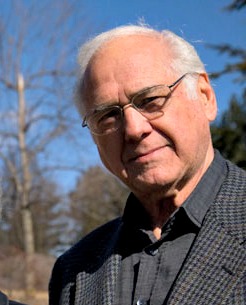
Dr. Myron S. Augsburger is President and Profess emeritus of Eastern Mennonite University in Harrisonburg, Virginia.
In reading the Martyr’s Mirror, I have often noted the statement by the accused Anabaptist, “Show it to me in the Scripture.” This was their stance both in faith and in faithfulness. Significantly, I remember John Howard Yoder saying in class in 1959, “The Anabaptists were the most ecumenical people of the Reformation for they would meet anyone anytime anywhere on the basis of Scripture.”
It is the conclusion of his statement that is striking: “on the basis of Scripture.”
But this statement of focus on the Scripture must be understood, for it was the Anabaptist quest to reach back beyond forms of the State Church to the original New Testament church. They were calling believers to identify with the Church as the ‘body of Christ’ as in its earliest form rather than to share in an institutionalized form of the church. Their appeal to Scripture was their quest for an authentic identification with insight from the Spirit. It should not be interpreted as a Biblicism that put the focus on the letter of Scripture, but rather respecting the Scripture as the one source for an identification of the true church.
Ecumenicity for Anabaptists was not a quest to find an artificial unity, but was a conversation to seek clarity for themselves and the larger Christian community on matters of what to believe. They took the matter of biblical interpretation seriously, beyond letter to the spirit of the word. In turn they called others to honesty in this hermeneutical task.
For example, one Reformer, Ottelinas of Lahr, criticized Michael Sattler for teaching that there is a ‘spirit of Scripture’ that is to be sought rather than simply to follow the letter of scripture (II Corinth.3). Discerning this spirit of Scripture is enhanced by the role of community in the hermeneutical process: hearing and testing one another’s views, praying together to find the mind of the Holy Spirit, seeking to think ‘with God’ rather than just to think about God.

We do not live our faith in a box, nor do we own the truths to which we are committed. It is God’s word that is authority and we should both know it well and witness to its truth.
This we need to do with modesty, seeking to understand others so that we can empathetically interpret the differences. Such conversation should take place over the Scripture and not simply be arguments from given denominational orientations. Each of us come to the Scripture with presuppositions and these should to be admitted and examined, above all with openness to the authority of the Word.
Our purpose in studies of Anabaptist Theology should not be so much defending our position as an attempt to enrich the larger or total Church in its mission in the world.
Acknowledging presuppositions means understanding that, first of all, we are called to be “new creatures in Christ,” and our focus is on the risen Jesus as central in our faith. As the new community which is “his body” in the world, we will now make him visible to others.
Let me now list a few areas on which ecumenical dialogue would, in my opinion, serve a meaningful purpose:
- Free church vs. Constantinianism: We should be discussing the meaning of being a Free Church vs. the current forms of Constantinianism as in the thinking of many Christians. Christ is building his Church and it is to be free in the world and not controlled by political and social movements. One key may be a rediscovery of the significance of the “believer’s church,” and of what it means to be in the world but not of the world. This means, especially in our time, to be free from the world’s obsession with power and wealth. A believer’s church is a call to personal discipleship, which is a decision to identify with Christ; a conversion that turns us from our way to walk with him as disciples. This conversion is the beginning of a new life, called a “new birth” by Jesus and heralded by 16th century Anabaptists as a work of the Spirit calling and transforming us to live as disciples of Jesus.
- Hermeneutics: We should engage discussion on hermeneutics, both as the Christology of interpretation and the challenge of moving from infallibility of words to emphasize an infallibility of meaning. Recognize the ultimate self-disclosure of God in the Incarnation we will move beyond a flat-book view of the Bible to see the ‘unfolding’ of a full revelation expressed in Jesus. His words to the two on the Emmaus road need to be taken seriously as a guide, “he unfolded to them in all the Scriptures the things concerning himself.” We need to recognize that words are symbols and that inerrancy is in the meaning of the word ‘symbols.’ We do not simply quote a proof text, but we seek by the guidance of the Spirit and community to discern its inerrant meaning in divine revelation. But with this, we need a renewal of biblical preaching and discussion, a return to sola scriptura.
- Reconciliation: We would do well to engage a discussion on reconciliation as a central theological motif. This will move our discussion beyond faith in the sacraments to mediate grace, or beyond doctrinal or creedal statements as mediating grace, and even beyond the emotionally ‘experience oriented’ aspects of faith. Rather, we will focus on what it means to walk in covenant with Christ. Our calling to be disciples of Jesus is to a relationship in his covenant of grace, and this is much more than a private emotional experience. As Carl F. H. Henry has said, “Christianity is personal but never private.” This covenant, in the love of Christ, will also seek to interface the social and the evangelical in the proclamation of the gospel with an emphasis that salvation is relational.
- Separation of church and state: We are confronted anew with a special need to emphasize the separation of church and state as we confess our loyalty to the Kingdom of God. While government itself is an order given by God, we must recognize, as Jean Lasarre has pointed out, that the God who ordains the role of government is still above the government. This means that our supreme loyalty is to God and our witness is to encourage governments to live up to the highest level of their own claims in justice, equity, human rights and well-being. We are called to maintain our integrity in society but we are not called to provide an ethic for government.
- Christology: We as believers with the Anabaptist perspective have an ethic that is Christological, that is, we are saved in relation with Jesus and our ethic is to behave in relation with Jesus. This is why Anabaptists are pacifists; this stance grows out of our commitment to follow Jesus as disciples. We believe this stance to be that of Kingdom members, while our government at best affirms a “Just War” position. And, as Ted Grimsrud expresses it, many within the Protestant Church hold the Just War position, and take one of two strands: “violence prevention” as in the Catholic Bishops letter in the 1980s with no exception for nuclear war; and the other strand being the “violence management” strand of Paul Ramsey and James Turner Johnson. Our witness as pacifists can call government to give careful attention to the principles of just war as preventing war, especially the principle of “last resort,” call for every effort at conversation that will seek to avoid war. This calls for conversation with Protestants who espouse the “just war” position, to take seriously the original intent of this position as seeking to prevent war. This understanding is other than a simple patriotism. Such dialogue is engaged by the late Glen Stassen in his Just Peace project. Committed to nonviolence, we should engage others in conversation over the Scripture.
- Covenant communities: We should engage the quest to rediscover the church as a covenant community and that beyond organization, or institution or denomination. We can be enriched by recognizing the meaning of Jesus’ words that “where two or three are gathered together in my name I am there in the midst of them.” Paul speaks of the church as the body of Christ and we need to recognize that as body gives visibility to the person, so the church is to make Christ visible to the world. The church as a community of the Spirit is called to follow holiness in all of life (Romans 12:1-2). This especially means living as “resident aliens” in the world, living by love as seen in the end of the same chapter (vv. 9-21) and the end of chapter 13, (vv. 8-14), that love is our lifestyle.
- Evangelism: We need to rethink the nature of evangelism to more properly engage in evangelistic work, for such is to be a witness of grace. Evangelism is never to be manipulation or coercion, but is seeking by life and word to make faith in Jesus a possibility for persons! Today, with social pluralism, we need a pattern of conversational evangelism. There are unique problems today of which we need to be aware. One is that in mission work we may be seen not as clarifying options for people, but simply as proselytizing. Another is that with our strong emphasis on service to others, we must be careful that humanitarian deeds not be seen as bait or as buying an entry. We are called to be ‘ambassadors for Christ’, inviting persons to him as saving Lord. This calls us to introduce the Kingdom of God now, as calling for our highest loyalty in life.
With our emphasis on the primacy of the Kingdom, we will of course engage discussions on eschatology. But this should mean emphasizing the present aspects of sharing in His kingdom as well as its future. This kingdom, in which we are members, our Lord will extend and complete and will then turn it over to the Father (I Corinth. 15:24). This is a supra-millennial approach, that his reign will include the universe and not just his globe. This consciousness will serve to enrich the church by the awareness that here we have no continuing city; as “strangers and pilgrims” we seek to fulfill the command of Jesus, “Occupy until I come.”
In August of 2003, I was quoted in Moody Monthly from a speech I gave in 1967 as follows: “If the future Kingdom is to have meaning for us, let us begin now to beat our swords into plowshares and our spears into pruning hooks and turn the gaze of the world toward Him who is to come. He will bring us not only into the full peace of God but into the very presence of God.”
Many issues the Anabaptists were promoting have been variously accepted by many of what we may call “believers churches” in our time, especially in the `Two Thirds World.’ From England, Stuart Murray has given us The Naked Anabaptist, a helpful book in broadening our understanding. In America, Dr. Timothy George has contributed a remarkable book, Theology of the Reformers, and similarly, Gregory Boyd in The Myth of a Christian Nation.
These are only a few examples, and the challenge for us is to be more open to such conversation across the spectrum of the Christian community, enriched by and also contributing to the thinking of other Christians. Without this dialogue we are often impacted by the thinking of others via mass media with little meaningful and responsible dialogue.
While we want to pass on the Anabaptist vision with integrity for the benefit of the next generation, we should not do this defensively as we want to share with other Christians beyond our circle. It has been my privilege to do this in such ecumenical missions, in evangelistic cooperation and in seminars in numerous high church settings.
Ecumenical conversation will help to move us beyond a mere ethnicity to share the universal nature of the gospel of Christ. If the church has a problem in conversing with others over our different views, we will have even greater problems in conversation across religious lines in our pluralistic society. It is time for informed discussion, to engage this responsibly, for as Peter says, “It is time for judgment to begin in the house of God.”
In such discussions we will be enriched by the way in which the Spirit has met other Christians as well as meeting us. We will learn of how he has been at work in their lives as we witness to his work in ours. And in such discussion, we will each find ourselves driven to our knees in reverence before the Lord of the Church.


Have a comment on this story? Write to the editors. Include your full name, city and state. Selected comments will be edited for publication in print or online.