


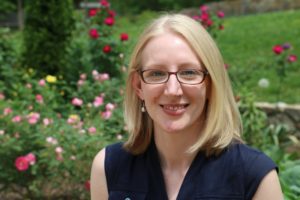
Dayna Olson-Getty is Associate Pastor at Community Mennonite Church in Harrisonburg, Virginia.
“Death is something that empires worry about. It’s not something resurrection people worry about.” – Rachel Held Evans
Labor with my first child was fast and fierce. Just two hours passed from the moment my water broke until my son was born. I was prepared for hard work, but nothing prepared me for the moment the pain became unbearable. I breathed through the bumpy ride to the hospital, dealt with confused and unprepared hospital staff and rocked and moaned my way through the early stages of labor.
But near the end, excruciating pain took over, plunging me into a desperate panic. I knew I couldn’t endure much longer, yet persisting was the only way out. Gripping my husband’s hand so hard it bruised, I cried out in desperation, “I CAN’T! I CAN’T!
Moments later, the doctor urged me to reach down and touch my son’s head as he began to emerge.
It was that touch–my fingertips on his soft, wet, almost-born head-that gave me the strength to persist, using every ounce of strength in my body to push my son into life.
Last week, as the Future Church Summit delegates labored together to envision the new life God is birthing among us, I remembered those long excruciating minutes near the end of labor. Birth educators call it “transition.” It’s the most intense period of labor when many mothers are overcome with fear and pain. But experienced labor attendants recognize it as a sign that birth is imminent.
I suspect many of us have felt the ecclesial equivalent of labor transition in the last several years. Many of us have doubted whether we could persist in this painful work of bearing in our communal body the new life that God is birthing among us. Many of us have cried out in desperation, overcome by fear that the pain sweeping over us is the agony of a dying church, rather than the painful contractions of a church in labor.
And in our case, it has been both. Even as we are laboring to give birth to God’s new life among us, we have also been laboring to put to death the ways of empire that have become entangled in our structures, practices and relationships. As people of the resurrection, we are called to die to using positions of power for our own self-protection and self-preservation while neglecting the flourishing of the most vulnerable. We are called to die to forms of unity that require the silencing of dissenting voices or the exclusion of marginalized bodies. We are called to die to anxiety-fueled attempts to manage and contain the unruly wind of the Spirit.
This work of birthing and dying that we have been doing together over the past several years has been particularly painful and difficult, but it’s not an unusual combination of tasks for the church. Clarence Jordan, one of the founders Koinonia Farm, an interracial Christian community that began in 1942 in rural Georgia, wrote about his experience of ecclesial leadership: “Koinonia is forever dying and forever living…This half-born condition is agonizing, and I could wish it otherwise, but there it is.”
The members of Clarence’s community survived ex-communication by their local congregations, violent attacks by the KKK, a crippling economic boycott and repeated legal maneuvers intended to uproot them. They suffered losses, but they persisted in a Jesus-centered life of peacemaking, economic sharing and interracial communal life throughout an era when nearly all white southern churches, including our own Virginia Mennonite Conference, adopted racial segregation as their official policy. Clarence and his community knew firsthand the agonizing struggle of dying to the ways of empire while also giving birth to the life of the Spirit.
Those of us who have attended births and deaths know that they require intense soul work as well as intense bodily labor. Birthing and dying are radical, unmanageable and life-altering transitions that call on our deepest wells of courage and persistence. They are moments of transformation that strip us of all external forms of power, leaving us vulnerable and naked, crying out, “I can’t! I can’t!”
But last week in the Orlando, we saw and touched the new life that is being born among us.
We sat face-to-face and spoke honestly and directly with each other in spite of our differences. We listened with empathy, respect and curiosity. We affirmed the hopes and dreams God has given us in common. Some among us spoke courageous and prophetic truths that would not have been welcome in the past. We were led by brothers and sisters in Christ whose bodies have previously been reason for their exclusion.
We told our collective history more honestly than we have before, naming the ways we have both nurtured goodness and perpetrated evil. We responded with lament and courage and hope to our need to make amends and seek repair. We began to imagine a more just and Spirit-guided distribution of power and to envision the risky and audacious calling of God to us in this time and place.
In this moment in our collective life as a church, the new life among us is only half-born and the powers of empire are digging in their feet and holding on for dear life.
But take heart, my weary friends. We have already endured through some of the most difficult stages of this labor and the new life of the Spirit has begun to emerge among us.
Before we lean into this difficult work again, breathe deeply and greet this new life with joy.
And be assured that the Spirit remains with us in our labor, no matter how long it continues, groaning and weeping and waiting with us as we struggle to give birth to the new life God is creating among us.
Did you attend the Future Church Summit? Do you have a reflection to share? E-mail us your thoughts about this gathering: [email protected].


Have a comment on this story? Write to the editors. Include your full name, city and state. Selected comments will be edited for publication in print or online.