


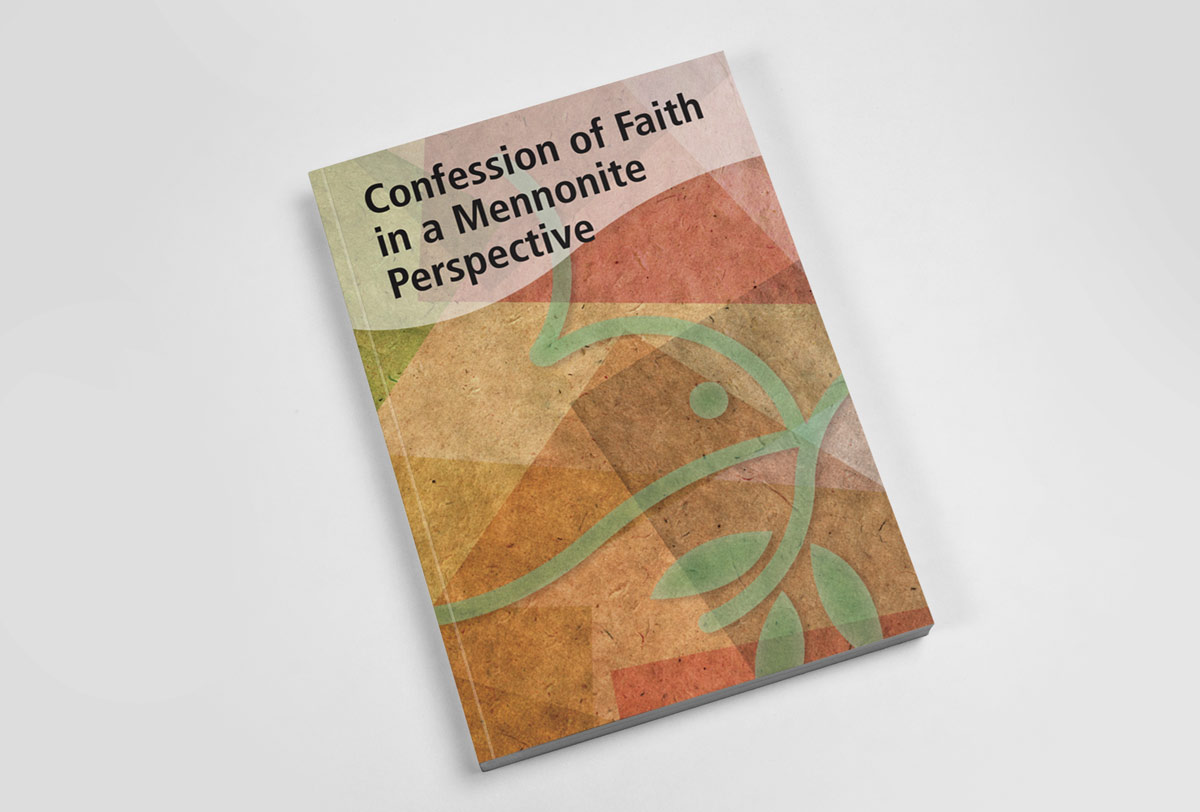
The Confession of Faith in a Mennonite Perspective was developed in 1995, and is the most recent systematic statement of belief for Mennonite Church USA. In its introduction, the writers identify six ways that confessions of faith serve the church, including: providing guidelines for interpretation of Scripture; providing guidance for belief and practice; build a foundation for unity within and among churches; offer outlines for instruction new church members or faith “inquirers”; give an updated interpretation of belief and practice “in the midst of changing times”: and help with discussing Mennonite belief and practice with other Christians or people from other faith traditions.
Over the course of the next several months, we will be releasing “roundtable posts”, featuring three members of Mennonite Church USA congregations reflecting on an article from the Confession of Faith. We’ll move through the articles in numerical order.
Today’s authors are reflecting on Article 1: God. Writers appear in alphabetical order. The views expressed do not necessarily represent the official positions of The Mennonite staff, the board for The Mennonite, Inc., or Mennonite Church USA.
 Michelle Armster is executive director for Mennonite Central Committee Central States. She attends Lorraine Avenue Mennonite Church in Wichita, Kansas.
Massacre in Orlando.
Flooding in Ghana.
State sanctioned murder of black and brown men.

Sexual misconduct and assault by leaders in the church.
Drought.
Where is God?
These contemporary realities of and concerns for the world were very present as I read this article. I interrogated the article to answer not only where is God, but to ask, is God present?
“We humbly recognize that God far surpasses human comprehension and understanding. We also gratefully acknowledge that God has spoken to humanity and related to us in many and various ways.”
These sentences stood out to me and seem to capture the expansive essence and the magnificent mystery of God. The expansive essence is recognized in the need for humility and gratitude on the part of humans: acknowledging that God surpasses our understanding and yet God is speaking to us and in our lives. The magnificent mystery is in the how. Not only in how, but also “in many and various ways.”
Omniscient.
Omnipresent.
I was also drawn to the words used to describe the character of God- awesome, enduring, compassion, perfect love, holy love, sovereign, mercy, grace, creator, righteous, forgiving, just, patient- and the list goes on. There are other words used that I also must acknowledge. However, I appreciate the both/and understanding of the character of God as opposed to either/or.
Last, as an African American woman, for me God as father is problematic. I believe God is not father. Creator: yes. Perfect parent: yes. Love: YES! The continued use of God as father limits and/or hinders many people’s capacity to recognize and experience the fullness of God.
So, where was and is God in Orlando, Ghana, the United States, and the church? I don’t know. But what I believe, today, is that the omnipresent God, which is in us, expects our responses to be love and loving.
 Nancy Heisey is associate dean and a professor of Bible and Religion at Eastern Mennonite Seminary in Harrisonburg, Virginia.
To be honest, I never read carefully Article 1 before I was asked to reflect on it for this conversation. As a student and teacher of the Bible, my most careful reading has been of Article 4, Scripture. I also recall a theology professor, when the Confession was being drafted, working us through Article 11, Baptism. But God? A given, right? The beginning of everything else we claim.
I recently asked someone who is deeply cognitively impaired what comes to mind when he hears the word “God.” Without hesitation, he answered, “Jesus.” Article 1 understands that foundationally Anabaptist response within the framework of its commitment to speak in a trinitarian form from the first paragraph. We are “joined to [God’s people] through the faithfulness of Jesus Christ and by confessing him to be Savior and Lord….” In the face of all we cannot know about God, “we believe that God has spoken above all in the only Son….”
Paragraph three offers a stunning list of words widely used among Christians (among Jews and Muslims as well) for and about God: glory, compassion, power, mercy, knowledge, care, grace, wrath, forgiveness, justice, patience, freedom, self-giving. All of these words are wrapped in the word “love.” The commentary insists that “according to Scripture, the love of God has a certain priority in relation to other divine attributes.” Article 1 cries out to us to meditate more fully on these words and this claim.
Based on my all-too-individual experience, two things are missing from this statement. First, it truncates the Shema’s and Jesus’s word to us by not including the divine command that we love God. Perhaps this gap reflects a call to learn about the ancient insistence of eastern theologians that Jesus became like us so that we might become like God, who is love.
Second, while Article 1 admits that “God far surpasses human comprehension and understanding,” it focuses on how God is revealed, mediated, and present in ways that lead to worship. Apart from one footnote from Job 37, this statement does not acknowledge that some of us encounter God who cannot be understood, in gut-wrenching and terrible ways.
 Josh Lundberg is a pastor at Kalona (Iowa) Mennonite Church.
What stands out to you in this article?
I am continually amazed at the awesomeness and unknowable bigness of our God. Recognizing him as the Creator and Designer of all things, I can only stand in awe of the magnitude of his unlimited power! And yet, it is this very God who surpasses human comprehension that desires a relationship with his created beings.
The incomprehensible God became knowable to man through his Son Jesus Christ who, as God, humbled himself and took on the limits of human flesh. Then, in a matchless act of love, God the Father pursued humanity and committed the ultimate sacrifice by freely giving his only and perfect son in order that a rebellious and proud humanity might be reconciled to him.
As humans, we cannot fathom the unselfishness, patience, humility, gentleness, and sacrificial love required of this supreme being in reaching down to save his creation: a creation that not only wholeheartedly rejects him as the creator, but also crucified and still mocks the son of the inexpressible God. This truly is amazing grace!
I am also impressed by the perfect, harmonious blend of seemingly opposite attributes: holiness and love, grace and wrath, sovereign power and humility, absolute knowledge and forgiveness, unlimited justice and continuing patience. Such transcendence moves me to echo the article, “To the one holy and everloving triune God be glory for ever and ever!”
How has this article informed your congregation and ministry, if at all?
This article reiterates in our minds the supremacy of the God we serve and challenges the church to walk in a way worthy of her calling by reflecting his character in our lives. Truly it requires a lifetime of learning to walk by the Spirit in order to reveal God’s magnificent character through our mouths, hands, and feet.
What questions, additions, other thoughts come to mind as you read this?
There is none more beautiful and worthy of our glory, our lives, our affection and our all than God. Soli Deo gloria!


Have a comment on this story? Write to the editors. Include your full name, city and state. Selected comments will be edited for publication in print or online.