


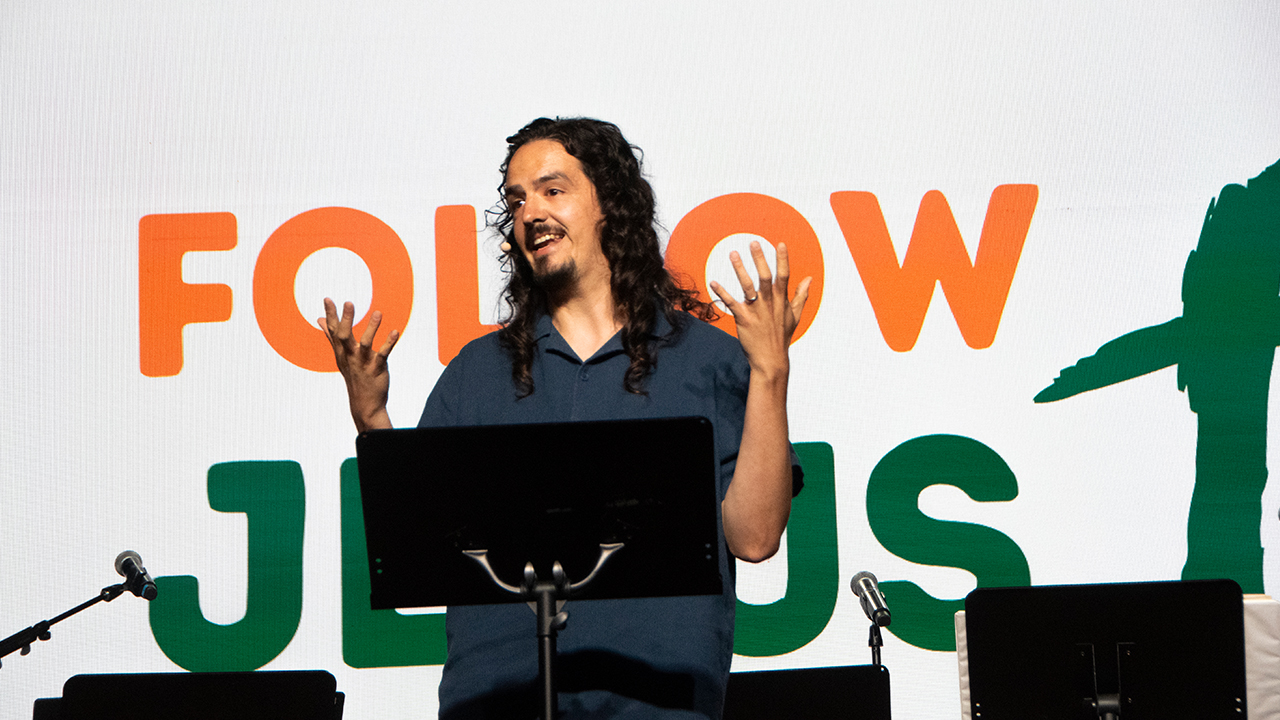
Frank admitted he was scared. Nervous about preaching to 1,600 people. Worried about migrant neighbors who’ve been snatched off the streets by armed men. Fearful about a future in which “things are only going to continue getting worse.”
But what truly terrifies him, he said on July 11 in his message on the fourth evening of the Mennonite Church USA convention in Greensboro, N.C., is “the cost of what it means to follow Jesus.”
Frank — who was identified only by his first name — is a member of Pasadena Mennonite Church in California. Originally from Guatemala, he works with grassroots social movements.
He’s a Mennonite convert who’s embraced the convention’s theme scripture of Luke 4:18: liberation for the oppressed.
Despite his many worries, Frank ended his speech by renouncing fear.
“We have nothing to fear,” he said. “Jesus has defeated every authority and ruler. Jesus is Lord. That’s it! Jesus is Lord.”

Frank grew up as a Christian but didn’t really understand what it meant until he went to Wheaton College, an evangelical school in Illinois, and “met Jesus” while reading the Bible “in a smelly dorm with Pop Tarts and way too much Mountain Dew.”
He was nurtured in faith by a Mennonite couple, Norm and Sharon Ewert, Wheaton professors who for decades have hosted a Menno Meal for students in their home.
“That was one of the first places that I started hearing that worshiping God and following Jesus is incompatible with worshiping and following any nation,” he said. “Not Trump or Obama or Bush — no, Jesus is Lord.”
Later in California, he “heard this voice in my head to go find the Mennonites” and ended up at Pasadena Mennonite Church, where he’s seen people actively following Jesus.
The congregation has sustained him in a difficult year, beginning with evacuating from the Eaton fire, which destroyed 9,000 buildings and claimed 18 lives in January. His family’s house didn’t burn, but many friends’ houses did.
Then came the crackdown on immigration.
“Most recently this current administration decided to make the LA region the epicenter of its war on migrants,” Frank said. “Three weeks ago, six neighbors were snatched off the streets by masked, armed men three blocks from my house.”
After listing some of the world’s injustices and tragedies, he said, with irony: “And so, in light of that extremely happy start to a sermon, I ask all of us what it means to follow Jesus in these times, not 500 years ago.”
The Anabaptists of 1525 — the heroes whose stories of torture and death are told in the Martyrs Mirror — “asked what it means to follow Jesus [in their time]. . . . We are not in a tradition of happiness and bubbliness, but a tradition that keeps above all things to follow Jesus. . . .
“It is a heavy burden to bear this tradition. I came to this tradition as a convert, and it’s because I was truly in love with Jesus.”
Frank said there is no way to water down the message of Luke 4:18 — liberation for the oppressed.
“We live in a world build on the oppression of others, and there will be a confrontation” with the powers of evil, he said.
He wonders if Mennonites will shy away from the confrontation.
“This is for us to discern, but there may be a possibility that the Mennonite Church in the United States is unwilling to put their skin on the line to confront a system that is brutally obliterating the planet,” he said.
He urged the crowd to take a stand against oppressive systems by supporting “someone who’s terrified to go out on the street right now” or “someone who’s afraid to be who they really are and express who God made them to be.”
We can face our fears knowing that “the path of the cross is the path Jesus already walked,” Frank said. “The point is, following Jesus is costly and scary, and that’s why we need each other.”



Have a comment on this story? Write to the editors. Include your full name, city and state. Selected comments will be edited for publication in print or online.