


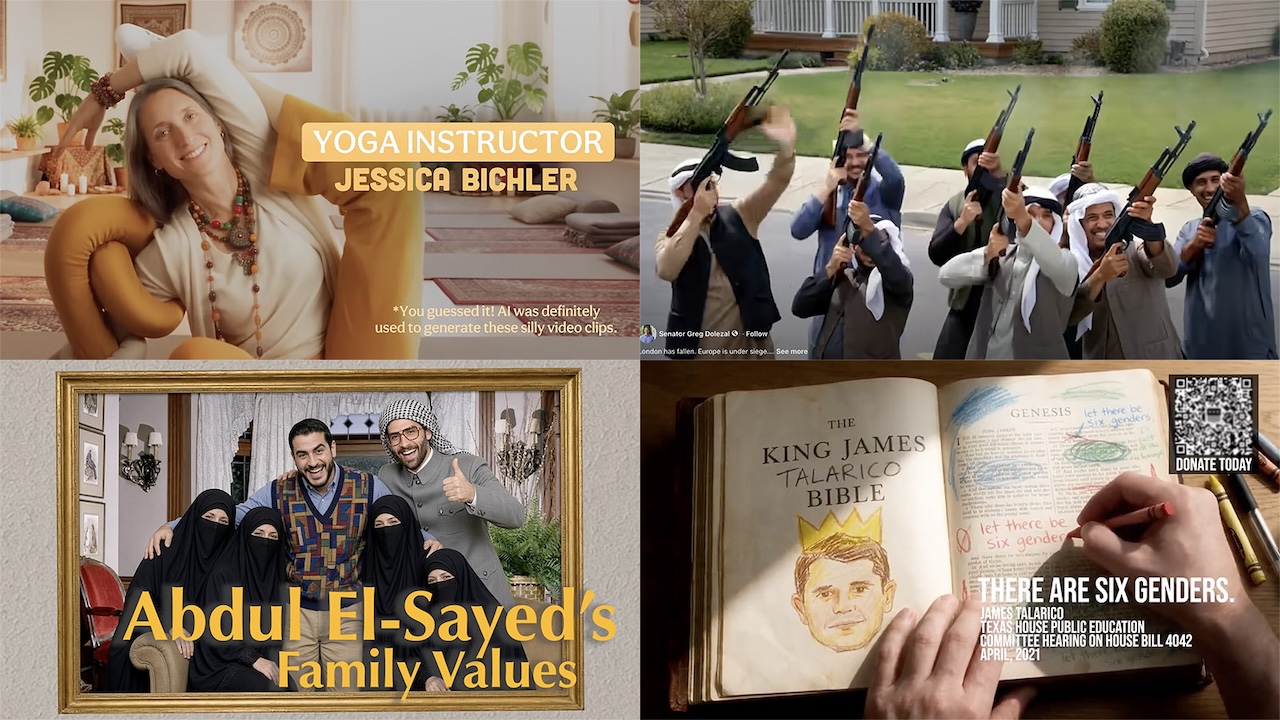
In a recent campaign ad for Ken Paxton, the Trump-endorsed Republican nominee for the U.S. Senate in Texas, his Democratic opponent James Talarico appears to sit at a desk while he scribbles on a Bible page.
“I always think of myself as a Christian who hates Christianity,” says the ad’s Talarico before adding that God was a “radical feminist” who “never asked people to worship him,” a reference to Talarico’s liberal Christian views, which have drawn criticism from political opponents.
The scene seems realistic and pulls quotes from Talarico’s speeches and his sermons at his Presbyterian church. Yet, it is not an actual clip of Talarico. It was created with artificial intelligence.
The 30-second clip, which has 2.6 million views on X since its release in September, is part of a flurry of AI-generated political ads airing on cable, streaming and digital platforms across the country ahead of the 2026 midterm elections. As AI content spreads online, political strategists have used the technology to create glossy campaign videos. According to a Wesleyan Media Project report released in September, 164 ads generated or enhanced by AI have been released this election cycle, costing $80 million.
In some key races, AI has been used to depict candidates’ religious views and convey religious messaging through campaign ads ranging from highly realistic to provocative and eccentric.
Layering catchy music, colorful images and provocative captions, the AI campaign ads can elicit strong emotional reactions, said Heidi Campbell, author of Digital Creatives and the Rethinking of Religious Authority and a communication professor at Texas A&M University.
“Political ads have always tried to get you to respond out of your gut to either like or not like a person,” she said, adding strategists now “use the features of AI to kind of get people to bypass thinking and focus on emotion.”
Talarico reacted to the ad in an interview with CNN, saying Texans were “sick of these AI ads trying to deceive voters, putting words in my mouth.”
The Paxton campaign did not respond to an RNS request for comment.
Attacks on candidates’ religious views or identity are a decades-old political strategy, said Isaac Sharp, a program manager at the Princeton Theological Seminary who specializes in religion and the ethical implications of AI. Recalling Barack Obama’s 2008 campaign controversy related to comments made by his spiritual adviser, Jeremiah A. Wright, about America, he added that AI is taking this tactic to another level.
“It seems with these videos, it’s possible to take a group of statements that somebody has made, pull them totally out of context, and almost instantly reconfigure them in a sleek production that can paint basically any picture that they want,” he said. “That is a new frontier.”
Campbell also explained the appeal of AI tools for producing campaign ads due to their efficiency in creating original content quickly, with minimal effort and fewer resources.
“It’s faster. You can do a lot more creative things,” she said. “It’s much more economical, and you can just do it in a much more very emotional, very attention-grabbing kind of way.”
In North Carolina, Republican state senate candidate Michael Lee ran an AI ad showing his Democratic challenger, Jessica Bichler, a yoga teacher, leading a practice in a brightly-lit studio. The background shows Buddha sculptures with Bichler’s campaign pins. “You guessed it! AI was definitely used to generate these silly video clips,” read the video captions as an AI effect morphs Bichler’s legs into noodle limbs.
The Wesleyan Media Project found most of the AI ads (80%) were paid for by conservative and Republican groups, and 11% were run by liberal and Democratic sponsors. The project told RNS it had not tracked how many AI-generated campaign ads mentioned religion.
In one ad, liked nearly 15,000 times on Facebook and promoting Greg Dolezal, a Republican Georgia state senator running for lieutenant governor, AI clips of schoolgirls wearing hijabs are followed by depictions of terrorists breaking into houses. Characters dressed in Pashtun clothing, worn by the Taliban in Afghanistan, bar a woman from driving and patrol a suburban Georgia street. The caption “Keep Georgia Sharia Free” shows up on screen at the end. The video doesn’t disclose the use of AI.
In fact, most ads (69%) reviewed by the Wesleyan Media Project didn’t disclose the use of AI tools. Only 31 states have laws regulating the use of AI-generated content in political advertising, usually referred to as “deepfakes,” “synthetic media” or “deceptive media” in bills, according to the National Conference of State Legislatures. California, Minnesota and Texas prohibit the publication of deepfakes of candidates in the lead-up to an election altogether.
The videos, which embed information and images, also raise fact-checking concerns, Sharp said.
“It’s always also been a challenge of distinguishing truth from unreality or fiction,” he said. “I don’t know if a fact checking exposé would even be a helpful strategy in trying to contain it.”


Have a comment on this story? Write to the editors. Include your full name, city and state. Selected comments will be edited for publication in print or online.