



Esther Vazquez has served as pastor in the Mennonite church for more than 12 years. If we left it at that and assumed that her story is similar to that of any other Mennonite pastor, we would not only fail to understand the unique gifts she gives us today but what Mennonite Church USA can and maybe will look like in the future.
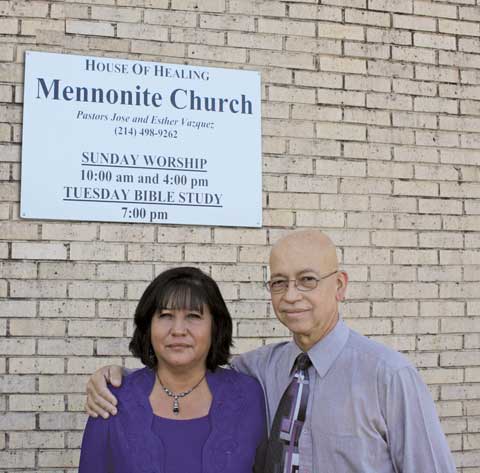 Esther is a fourth-generation Mexican-American living and serving in and around Dallas. With Pentecostal roots in her family, her father-in-law decided to plant a General Conference Mennonite Church congregation, which she joined. This is a perfect example of the hybrid found in the Latina Mennonite church: holding space for Pentecostal beliefs and experiences yet sharing the name Mennonite as part of its identity.
Once she embraced the title of Mennonite, she journeyed out to find other women outside her congregation, Caucasian women who through a Bible study taught her Anabaptist beliefs.
While in the ministry she has served on the boards of The Mennonite, Inc., and Western District Conference, on the Constituency Leaders Council, as co-moderator/secretary for the Mid-Texas Convention, as board member/treasurer for the Learning Leadership Institute, as director of women’s ministry for the Texas Mennonite Convention, as a participant in the Dallas-area church plant council and, most importantly to her, as pastor of three church plants, two of which are now full-fledged churches.
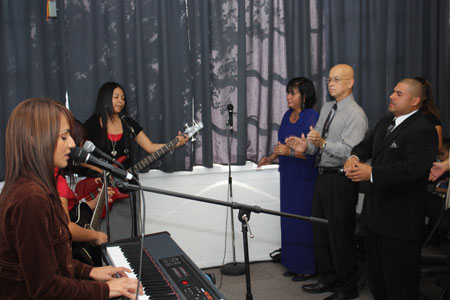
Esther and José during worship at the House of Healing Mennonite Church in Dallas. Photo by Everett J. Thomas
The area of possible contention in Esther as she explored her new Anabaptist beliefs 12 years ago was with the intersection between Esther’s Pentecostal experience—gifts of the Holy Spirit/speaking in tongues—and Mennonites’ views of the work of the Holy Spirit. This theological point, which depended greatly on these Caucasian women’s presentation, could either have ended Esther’s relationship with the Mennonite church or empowered her to be present to God’s work in her life and find acceptance of her full spiritual expression within a relatively conservative (among Anglos) Mennonite community. She did find acceptance, and we are grateful.
In addition to her family’s faith history, Esther connects with the common “Latina story” that informs the areas of Anabaptist theology (nonviolence/peace and anticlericalism/priesthood of all) that she emphasizes for her community. The Latina story, as I’m calling it, includes two themes: the acceptance of force in the family nucleus and the power of hierarchy. She has found these to be the core of the Anabaptist message that has touched the lives of countless Roman Catholic Latinos as well as Protestant Latinos in her ministry. Latinos have integrated an element of their culture to their faith that could bring some needed balance to the majority Mennonite expression of faith.

Esther came to Christ in the Pentecostal church as a young bride continually beaten by her then husband. Enough said, right? Fortunately she found peace through Jesucristo, but the message she received from church leaders did not reflect the kind of God she wanted to worship. She was told that God would save her and that she must tolerate her suffering as faithfulness to God, for God would not stand by her if she left her husband. Esther could not understand how her God would tolerate this, and so for a time she left God.
Since coming to a peace church, she has never heard anyone call this type of suffering surrender to God. Today she is a strong advocate for women, men and children against domestic violence, which is prevalent among Latinos. She has moved away from a martyr’s theology to a freedom from having to experience violence in any form, and from this new place speaks against it.
Views on the role of hierarchy within society and church have changed for both Mennonites and Latinos in history. One area they both have in common is that their historical responses come from a relationship with the Roman Catholic Church. Hierarchy can be created because of race, gender, financial status, education, ministerial experience or historical precedent.
Esther’s first Mennonite pastorate was as a co-pastor with two Caucasian women. They were both working on post-graduate degrees and held a place of superiority in Esther’s mind. According to the Mennonite pay system, these more educated women received more money for the same work Esther was doing. Esther only had a G.E.D. and later pursued Bible and seminary training. At this time, though, she cringed with embarrassment when it was her time to preach in front of these well-educated women with whom she served. At one point, one of the women asked that the pay that was above Esther’s be taken and divided among both women so that they had equal pay, which meant Esther was paid more and the other woman less. This lesson in humility and equality resulted in a transformation in Esther and her ministry that is felt to this day. Not only was she empowered and lifted out of the inferiority she had nestled in but she saw their intentional work in helping her find her voice, grow to be more of a servant as God had called her and later confront the hierarchy she saw in her other church planting roles.
This first church ultimately closed, but Esther’s work continued in other church plants. I mentioned the Anabaptist value of being separate from the world and that Latinos carry cultural baggage we need to leave behind. I asked if she thought our hierarchy served us or if we should discard it. Her response was immediate: It is an obstacle to our witness. She gave an example of being reprimanded by another Dallas pastor for asking his church’s musician to serve her church, though this would have in no way interfered with this musician’s local church’s commitments. The evidence of the hierarchy here is that this musician was this pastor’s property to be used to his wishes, and he was below his authority.
At the conference level, Esther sees how money and hierarchy go hand in hand. Many Latino pastors will not speak up for themselves and their churches against what they perceive to be the power in the conference because their livelihood is connected to the conference. Predominately immigrant churches are naturally dependent on the church conference and need empowering to find their new voice in a society foreign to them and to feel comfortable without fearing repercussions from speaking of their experience in the denominational system. At the same time, since most Spanish-speaking pastors are first-generation immigrants, finding a way to break with deep-seated cultural hierarchy is almost impossible. It may be the second and/or third generations that are able to assimilate the Anabaptist values of the priesthood of all and, more importantly, the servant leadership that Esther embodies uniquely in Dallas.
During this interview, Esther spoke from a sermon she was preparing for the following Sunday that touched on a unique contribution Latinos have to offer the predominately Anglo and aging Mennonite church: “The Spirit of the Lord is on me … to … provide for those who grieve in Zion—to bestow on them a crown of beauty instead of ashes, the oil of gladness instead of mourning, and a garment of praise” (Isaiah 61). It is in this celebration so characteristic of Latinos—their community and their worship—that the church is built up, freedom is proclaimed and the captives are released. Many Latino theologians in the United States speak of it in terms of “fiesta,” as a theological anthropology. This is not a “party,” as literally translated into English, but a celebration in which there is no distinction between religious and civil and where work and play are intermingled. It is in the spirit of receiving and responding instead of the autonomous values of the majority culture of doing and making. In other words, fiesta is a form of cultural resistance.
Considering Anglo Mennonite culture’s tendency to value work and service, I wonder how these two communities will learn to value their journey together. That may be left to my children’s generation. Then it will no longer be subject-object service work, but both groups will find value in work and play (both being understood as fiesta). Then we can rest and wait as well as we dig holes and prepare meals together.

Read more about Esther’s story here.


Have a comment on this story? Write to the editors. Include your full name, city and state. Selected comments will be edited for publication in print or online.