


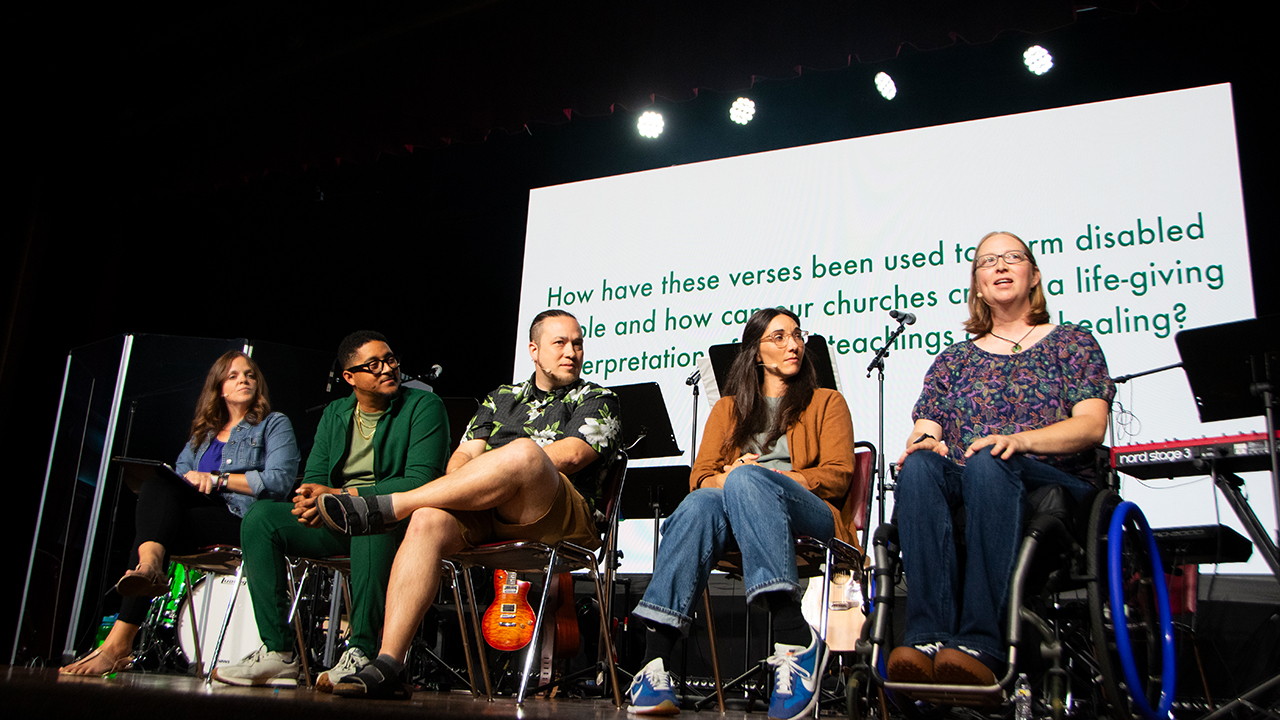
A worship service that focused on inclusion and respect for people with disabilities concluded with a chance for all to be anointed, because everyone feels pain and needs compassion.
“We’re saying to each other, we are hurting right now,” said Jon-Erik (J.E.) Misz, one of the speakers on July 10 during the third evening of the Mennonite Church USA convention in Greensboro, N.C.
“Often, disability and physical and spiritual pain can be so isolating,” he said. But during the ritual of anointing, “you will realize you are not alone.”
Hundreds of worshipers gathered at 10 stations to be anointed with oil and prayed for, if they wished. Many were teenagers from youth groups attending the convention from across the country.
Another speaker, Sarah Werner, described the anointing as “a reminder that God is with you and that you have a lot of people that care about you.”
After the ritual, worshipers sang: “From the waters of God’s mercy, we drink deeply and are made whole. . . . With the oil of God’s anointing, into service we are led.”
The evening featured three panelists, all with connections to Anabaptist Disabilities Network. Misz is a clinical social worker in Goshen, Ind. Werner leads Olentangy Wild Church in Columbus, Ohio, and has Ehlers-Danlos syndrome, which affects the body’s connective tissue. Katherine Dickson of Bluffton, Ohio, is a field associate with ADN and a staff member at Methodist Theological School.
Worship leaders Melissa Florer-Bixler and Caleb McClendon moderated the discussion, which addressed healing, accessibility, ableism and inclusion.
The scripture focus was Luke 4:18, where Jesus says God has sent him to “proclaim freedom for the prisoners, recovery of sight for the blind and to set the oppressed free.”
“When I read about letting the oppressed go free,” Dickson said, “in this context, it’s about doing the work in our churches, designing spaces that all can use, ensuring that the church building has a ramp . . . making sure that our spaces are OK for people who cry out in worship or move around and for people with the most severe disabilities to be brought into the center of community. This is what I think when I think of freedom.”
The panelists urged seeing people with disabilities as whole people, not projects to be fixed.
Werner said she has a lot of disabled friends who have been “targets of unwanted attempts to heal us or pray for our healing. That’s really hurtful. A lot of my friends avoid religious people at all costs because of this kind of harassment.”
“God created all of us to be diverse and unique, and disability is just a manifestation of God’s creation,” Werner said. “God created deaf people. God created people with limb differences. God created neurodivergent people.
“To pray to take those things away is sometimes to pray to take away something that is vital about ourselves.”
Panelists warned against defining people only by their disability — which is a basic definition of ableism. But ableism is everywhere and can take many other forms, Werner said — like assuming a person is too young to be hard of hearing, or refusing to believe that people can have invisible disabilities, or experiencing an injustice like being forced to go to work because an employer doesn’t grant sick leave.
Responding to the question of how “dismantling ableism helps to free all of us from injustice,” Misz reminded listeners of the reality of intersectionality — the connection between different forms of discrimination.
“These isms of ableism, sexism, racism are disabilities in themselves,” he said. “If we are able to dismantle these isms, there is real power in being able to see the beauty of all of God’s creation at work.”
Referring to Luke 4:18, Dickson said: “Our churches can offer life-giving interpretations of verses like these — not trying to fix people. . . . Let God do whatever healing is needed and let the church just ‘be the welcome mat, the open arms and the soft heart’ [a quote from the father of a child with Rett Syndrome]. That’s our assignment: to see the sacred people we are.”


Have a comment on this story? Write to the editors. Include your full name, city and state. Selected comments will be edited for publication in print or online.