


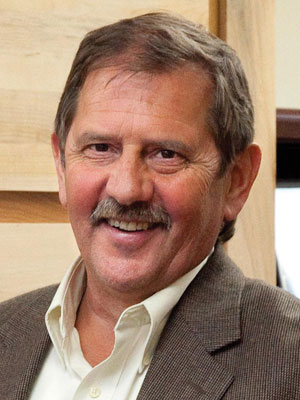
Everett J. Thomas is the editor emeritus of The Mennonite magazine.
Before leaving on that ill-fated whaling journey chronicled in Moby Dick, new shipmates Ishmael and Queequeg attended a Sunday morning service in a seamen’s chapel. The preacher, Father Mapple, climbed into the pulpit, which protruded from the wall halfway between the floor and ceiling. After climbing into the pulpit via a rope ladder, he pulled the ladder up into the pulpit with him, thereby remaining suspended between heaven and earth as he mediated God’s presence to the congregation.
“Can it be, then” Ishmael says, “that by that act of physical isolation, he signifies his spiritual withdrawal from the time, from all outward worldly ties and connexions?”
This analogy is appropriate for the church. We are first of all citizens of the kingdom of God. As the church, we must rise above and separate ourselves from the strivings and distractions of the world around us. Specifically, we can separate our spirits and rise above the cacophony caused by overheated national political discourse that contributes to the fracturing of our fellowship in the church. In doing so, we mediate God’s presence to a waiting world.
Holy dissociation: As we again prepare for Holy Week, we are reminded that Jesus modeled what Ishmael described as a “spiritual withdrawal from the time.” During the five days between what we now call Palm Sunday and Good Friday, Jesus’ responses and actions demonstrated a kind of holy dissociation. He was moving and acting on a profoundly different spiritual plane as he upset the tables of the money lenders in the Temple, washed his disciples’ feet before breaking bread with them, prayed in the Garden of Gethsemane and, finally on that Friday, refused to be conscripted into the politics of the week.
But what were those Jerusalem politics that week?
Local politics begin with the person in the story wielding the most political, military and civil power: Pontius Pilate.
So when Pilate saw that he could do nothing, but rather that a riot was beginning, he took some water and washed his hands before the crowd, saying, “I am innocent of this man’s blood; see to it yourselves.”— Matthew 27:24
In spite of his dramatic and public hand washing, Pontius Pilate shares responsibility for Jesus’ death. He held ultimate temporal power in Jerusalem at the time. There was no difference between handing down a death sentence—he alone had sole authority to order an execution—or telling a bloodthirsty mob it was their decision to have Jesus killed, all to avert a possible riot. Pilate’s histrionics with his hand washing are both disingenuous political theater and a cynical insult to the Jewish leaders and mob clamoring for Jesus’ death.
As a student and practitioner of what I hope has been responsible politics, I have long been intrigued by the church and state dynamics swirling in and around Jerusalem during the events we will soon commemorate during Holy Week. Paul, in his first letter to the Thessalonian church, says flatly that it was the Jews who killed Jesus. But as James Hamrick said in “Jesus Was a Jew” (January issue of The Mennonite): “When we speak about the Jewish world of the New Testament, we need to remember that few statements can describe all Jews at that time.”
While some Jews, formed into an angry mob, did demand Jesus’ death, it was Roman soldiers, commanded by Pilate, who nailed his hands to the cross and pierced his side. So what were the swirling politics of the day? There were at least three important currents:
An important but dangerous holiday: Four short days after Jesus rode triumphantly into Jerusalem on a donkey—suggesting the arrival of a new King David—Jewish festivities culminated in the observance of the Passover.
For a Roman ruler with limited troops to keep a militant peace, this was a dicey time of the year. His Jewish subjects, celebrating their ancestors’ great victory over Pharaoh with the original Passover in Egypt, might well begin to agitate for a similar kind of independence from the oppression of the Roman Empire. Although he did not live in the backwater town of Jerusalem, Pilate made a point of being there during this time to remind the restive population that he could summon troops from Herod anytime to use whatever means were necessary to keep Rome’s brutal order.
You’ve reached the end of our free magazine preview. For full access to this article and others like it, check out our online edition.


Have a comment on this story? Write to the editors. Include your full name, city and state. Selected comments will be edited for publication in print or online.