


A missing piece snapped into place, and I shattered, my body convulsed by sobs.
When I felt ready, I sat up and took a pen and paper and wrote a tear-stained, incoherent letter to Daddy, who has been dead for nearly three decades. Cancer at 34. I was 4.
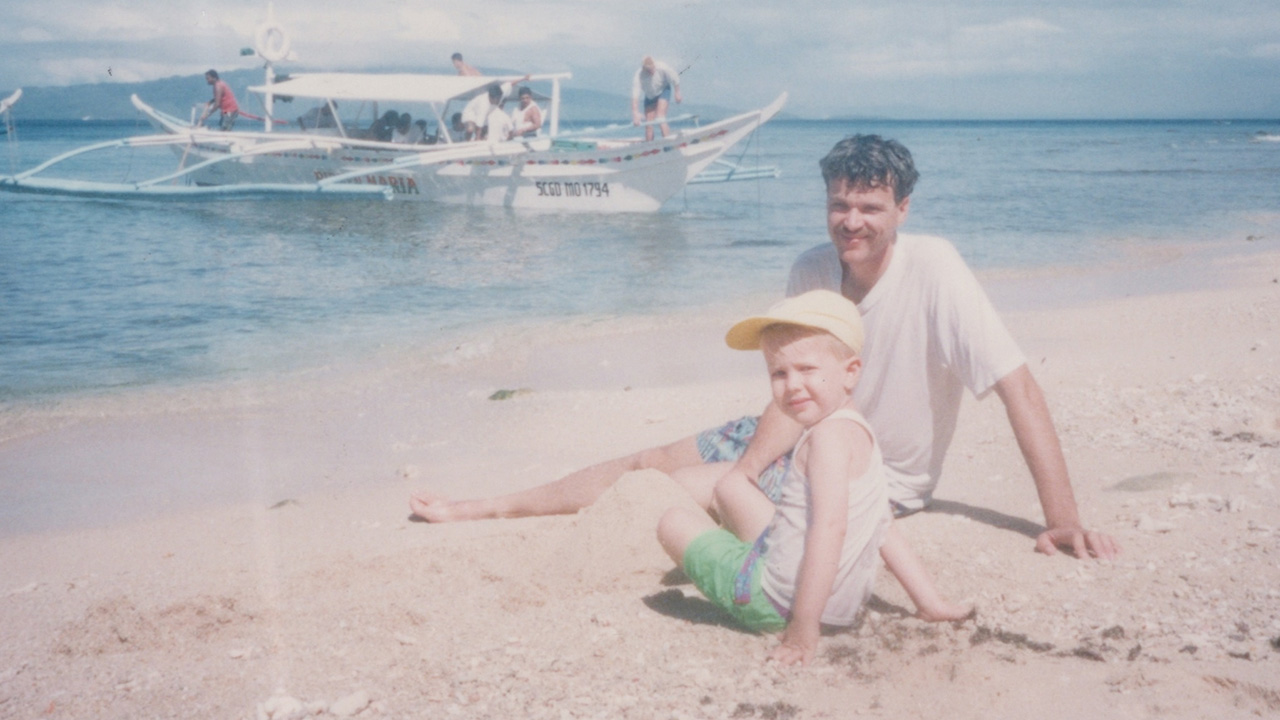
I had been watching a home video my mom filmed in the Philippines when our family was serving with Mennonite Central Committee. In the video, I’m sitting in a chair clamped to a table watching Daddy put together a Lego set, as this was adorable.
There are things that matter to a child who doesn’t remember his father’s face (which in pictures looks so much like mine that relatives still call me Mike), hands (that in the video dance like mine when I tell stories) or voice (Minnesota accent sounding foreign to my Kansan ears). Memories, stories, evidence of Daddy matters.
I had forgotten we’d played with Legos together.
Previously, my memories of playing with Legos were isolated: me in my room on the pink carpet. Alone.

So, to process my grief, I wrote a letter to daddy telling him about my loneliness when he was gone. With so few memories of my own, stories are all I have. Words shape my reality.
I called my mom to ask about her memories of my obsession with Legos. She was eager to talk.
“I have a very distinct memory. You loved symmetry, and I thought that was so interesting. If we placed blocks out of symmetry, you would always fix it and place them where you thought they went. And you always had stories to go with your Legos. You could say what they were all doing.”
Both are still true. To me, pieces should fit together logically and fit into a coherent story.
I asked, “Do you remember that I used to spend all my money on Legos? We bought them in the mall in the Philippines.”
“I don’t remember that, but that’s the only place you could go to get foreign-made toys. They were expensive.”
Back in Kansas, I remember spending $50 — months of allowance money, which I, as a rule, hoarded — on my favorite Lego set. A secondhand castle complete with knights, trapdoors, ghosts and parapets.
“Where did your Legos end up?” Mom asked.
I loaned them to a family friend for her boys. Then they disappeared into her kindergarten classrooms, scattered over the face of Chicago into the pockets of 6-year-olds — who, I hope, now enjoy them as much as I did. Fragments of Babel, never to be reconstructed.
I do have a positive memory of playing with Legos — in community. As a teacher, I was tasked with assisting in an art class. The first day, I went straight for the Legos along with a couple of kids who had been banned from Legos in their regular classrooms because they “couldn’t handle it.” If their creations broke, the boys would, too.
But in art class, I intended to practice falling apart and putting back together. So, we did. Day after day. Week after week, we had the same conversation.
“Are you ready?”
“No.”
“I’m going to break it.”
“Don’t break it.”
“When it breaks, what are we going to do?”
“Put it back together again.”
“Are we going to get upset?”
“No.”
By the end, the Legos could fall apart by themselves. We didn’t need to join them. In real life, it’s a lesson I’m still learning.
After watching the video, I decided I wanted to reconstruct Babel. My favorite $50 set now sells for $400 on eBay. Rebuilding Babel is expensive, but I did purchase, for $25.07, the set Daddy made with me in the home video.
Like me, the set was released into the world in 1992. Forty-four pieces and a minifigure. It’s called Beach Bandit.
I didn’t open it right away. I waited until my birthday. Today (as I write this), I turn 34, and I feel like a kid getting ready to put the Legos together. I’ll probably break down while I build it, even if the pieces fit together in perfect symmetry.
I know I can’t go back in time to rebuild childhood cities and tower dreams. A Lego set will not resurrect my father. That’s God’s job. We are left with bricks and tears.
But there is a way to live in the rubble, to make sense of a world in which little boys lose their daddies.
In the next year, I’m going to take time to reflect on grief, telling stories that honor my father’s legacy.
I’m taking a class at Anabaptist Mennonite Biblical Seminary called Doing Theology from an Anabaptist Perspective. I plan to examine the faith of my father. I have some sermons and writings but few memories of the man.
That’s where you come in. To this day, I meet people who tell me my daddy changed their lives. If you remember Mike Jay Hofkamp and have stories to share, please reach out. I would love a story, no matter how insignificant and small. The little details are the most humanizing, and I cherish them in a special way — how he gardened vertically, ate cold leftovers for breakfast, drank too much in college.
These stories remind me he lived an embodied life, just a man filled with the Spirit, following Jesus.
If you can help me honor his legacy, please reach out. My email is [email protected].


Have a comment on this story? Write to the editors. Include your full name, city and state. Selected comments will be edited for publication in print or online.