


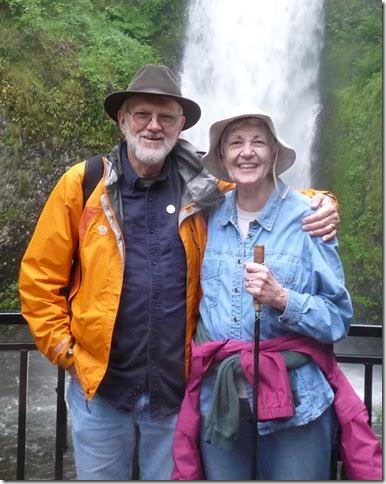
Photo: Jack and Linda Knox live in Douglas, Ariz., and are members of Shalom Mennonite Church. This piece is adapted from a sermon Jack gave at Shalom Mennonite in May. It is on the Kansas City 2015 theme scripture.
The story of Cleopas walking to Emmaus in Luke 24:13-25 began a tradition—a tradition of Christians telling their stories to each other and to others. There’s a huge difference between knowing about Jesus and knowing Jesus.
We can talk about Jesus without saying a word about ourselves. But we cannot talk about knowing Jesus without also talking about ourselves and Jesus’ impact on us.
Unfortunately, this tradition has fallen on hard times.
It’s easy to talk about what we think we know about Jesus and about what we believe Jesus wants us to do. And it’s especially easy to talk about what we believe Jesus wants others to do.
But it’s often difficult to talk about the impact that Jesus has on us—difficult to talk about how trusting Jesus enriches our lives.
For in our world, faith has become a private and personal matter, and far too many of us tend to be unwilling to share our stories for fear of offending people or for fear that they will think we are bragging—or for fear of some other way they may react.

But like Cleopas and his companion, all who follow Jesus have come face to face with him at some point.
We all have a story to tell and we don’t have to have the Bible memorized and don’t have to be seminary graduates to tell it. All we have to do is talk about how we came to know Jesus—and about how he found us when we were lost. Or about what it feels like to be forgiven and welcomed home and filled with purpose.
So, here is part of my story: As a child I was taught the importance of self-control and hard work.
I was taught that “big boys” don’t cry and that “real men” don’t let their feelings interfere with school, work, career or anything else.
I was told that when the going gets tough, the tough get going.
I was told that I was talented and highly intelligent and that I could do anything I decided to do as long as I didn’t let the ups and downs of life pull me off course.
I was told that God would never give me more than I could handle.
At home and at church the same message came through loud and clear: it was my responsibility and mine alone to deal with life’s ups and downs and to make something of myself. No one ever said exactly what would happen if I failed to do this, but I assumed that it would be humiliating and unbearable.
As an adolescent, that clichéd wisdom failed me. There’s nothing to be gained at this late date by talking about the details of those years. I’ll simply say that I was repeatedly bullied, assaulted and publically humiliated—by adults as well as by my peers. And that was not the worst part. The worst part was what I did to myself.
I was terrified during those years.
When the going got tough, I didn’t have the slightest idea about how to get going. I had no idea about how to handle what I was handed.
So I convinced myself that I had failed to do what I was supposed to do and that there was something terribly wrong with me. I understand now how an adolescent could think like that, but the worst part was that I hung onto that view of myself for more than 30 years.
I let that sense of failure define how I saw myself and let it lead me into periods of anguish and self-doubt and alcohol abuse.
I would like to say that I finally had a dramatic experience that transformed me.
I didn’t. But I was transformed I was transformed slowly and surely transformed by Christ’s love that came to me through my wonderful wife, Linda and through people at Austin (Texas) Mennonite Church and at Salem (Ore.) Mennonite Church, and especially through Sister Jo, who was my spiritual director for several years.
She helped me see that most of that clichéd wisdom I learned as a child wasn’t wisdom at all— especially the stuff about handling life’s difficulties all by myself.
Life can hand us all kinds of terrible things. We all experience things we cannot handle on our own. We all need help sometime—from others and especially from Christ.
For well over 30 years, I beat myself up for failing to handle what life handed me as an adolescent.
And I failed to see Christ walking beside me all that time.
Despite the fact that I believed that I was unlovable, I began realizing that I was loved after all. I didn’t find Jesus. He found me and he transformed me.
Cleopas and his companion are not the only people who walked hopelessly down one of life’s frightening roads without recognizing Jesus walking right beside them. No matter what we believe, things happen in life that challenge and shatter our understanding of God.
We are left heading home or somewhere else looking for a place to hide where we can lick our wounds and nurse our cynicism and turn our backs on life, God and each other.
But while walking that path, sometimes something wonderful happens.
Jesus appears beside us. We don’t always let ourselves recognize him—at least not immediately.
Like the stranger that Cleopas and his companion met on the road to Emmaus he often looks too ordinary to be our Lord. Yet somehow he gets inside our conversation and hears what we have to say and recognizes our despair and the hopelessness.
But he doesn’t reject us and he doesn’t feel sorry for us.
Instead, he tells us that there is more going on than meets the eye. He reveals to us that our problems belong to a larger picture— and to some deeper mystery.
And when we let ourselves see Jesus walking beside us, then we have a story to tell. We have a story of new life.
I was lost for a long time, but now I’m found. That’s worth telling people. Your story is worth telling, too. How can we not tell them?


Have a comment on this story? Write to the editors. Include your full name, city and state. Selected comments will be edited for publication in print or online.