


Dawn Araujo-Hawkins is a member of Rainbow Mennonite Church in Kansas City, Kan. She is a staff writer based at the Global Sisters Report headquarters in Kansas City, Mo. Before that she was a freelance religion reporter and worked as the editorial assistant at Sojourners magazine. She has a journalism degree from Ball State University and a master’s in religion from Cincinnati Christian University.
He has told you, O mortal, what is good; and what does the Lord require of you but to do justice, and to love kindness, and to walk humbly with your God? —Micah 6:8
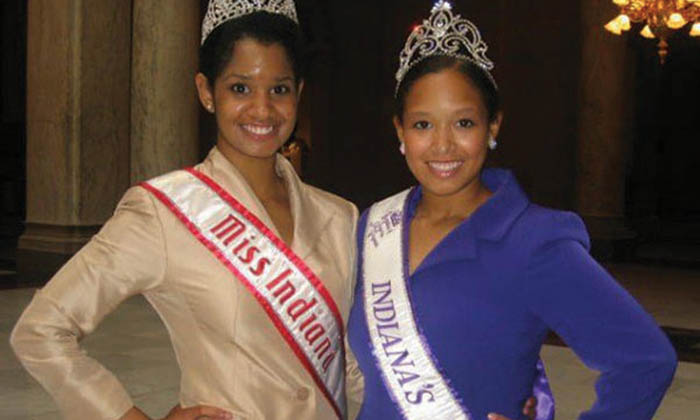
People are sometimes surprised to learn I was once a pageant girl. To a good portion of the people I’ve known (outside the pageant world, that is) beauty pageants are associated with an inherent vapidity that I—a social justice-loving feminist and seminary-educated journalist— just do not possess.
“It’s a good thing you’ve moved past that stage,” they’ll say, laughing and rolling their eyes. I always get the feeling that what I’m supposed to do next is disavow my shameful past, to slam pageants as this archaic culture I was lucky to escape.
But here’s the thing: I still love pageants. Not only that, I attribute the vast majority of my personal and professional growth to pageants. It is with the utmost certainty that I say I would not be the journalist or activist I am today if my 9-year-old self had not decided she wanted to be Miss Indiana.
Ruth Harder, pastor at Rainbow Mennonite Church in Kansas City, Kan., asked me to reflect on what

International in 2011. Photo provided.
pageants taught me about the prophet Micah’s exhortation to act justly, love mercy and walk humbly with my God. I told my sister (also a pageant girl) about this, and we both had the same reaction: What didn’t pageants teach us about justice, mercy and humility? I could probably write a book about this, but Ruth also asked me to be brief, so here’s the Cliff’s Notes version of how pageants have informed what Micah 6:8 means to me.
Act justly
As a young girl, I don’t think anything overtly tested my sense of integrity like pageants. I know I just sang the glory of pageants, so it may sound like I’m backtracking here, but bear with me. I promise I’m not changing my tune.
The essential purpose of a pageant is for an organization to pick someone to be its public face. The organization says these are our values, and then women and girls who think they epitomize those values partake in a variety of competitions to prove they are indeed what the organization wants. Pretty simple.
However, in some instances, a woman just wants to win a crown, so she will lie about all kinds of things just to seem like the “right” girl. One of the most conspicuous (albeit largely benign) examples of this is when contestants take a few weeks of voice or dance lessons just so they can do a pageant with a talent competition. In more dramatic instances, women fabricate paperwork or outright lie about life experiences.
I learned early on I was not interested in pretending to be someone I wasn’t just to win a crown. I remember that even as a 15-year-old, I refused to give politically correct answers in pageant interviews—once schooling a panel of judges on #blackgirlmagic when they wanted me to bemoan my own identity.
Having to routinely stand up for what I believed in as an adolescent—even when it meant risking my chances of success—primed me for social justice advocacy as an adult. Any time I’ve led a protest or joined in an act of civil disobedience, I’ve drawn on my pageant experiences.

You’ve reached the end of our free magazine preview. For full access to this article and others like it, check out our online edition.


Have a comment on this story? Write to the editors. Include your full name, city and state. Selected comments will be edited for publication in print or online.