


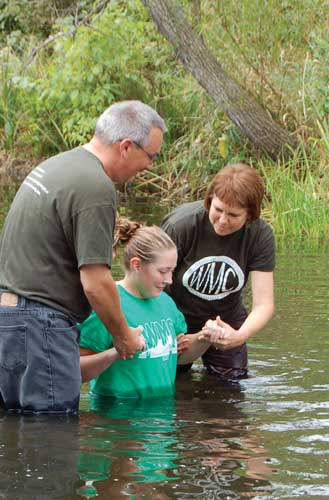
The typical age of baptism and how we respond to infant baptism has changed over the years.
Mennonite youth at Pittsburgh 2011 heard that now is the time for them to make a mature decision and request baptism upon their return to their home congregations after convention. “Don’t wait for a perfect moment,” said speaker Brenda Matthews on July 8. “Life is not perfect.” While most can agree there is no “perfect” time, is there an ideal time for an adult believer’s baptism? How do congregations encourage baptism among young people and new members—and at what age?
Age 13 and 14 is the average age for baptism at Lindale Mennonite Church in Linville, Va., says pastor Duane Yoder. While many individuals receive Jesus into their lives before baptism, says Yoder, “baptism is a public declaration that says, ‘I am making an adult decision before this body.’ ”

To Yoder, ages 12 and 13 seems young for baptism. “[Those ages are] at the bottom edge of something we could call an adult decision,” he says.
“It’s difficult to talk about committing yourself to the Lord if you haven’t come up against some adult issues,” he says. He names mature thoughts, puberty, sexuality and adult relationships as some examples.
Yoder grew up in a Mennonite church where the baptism instruction class seemed mandated, and he felt strong pressure to move forward with baptism after the class. He chose baptism at age 14 but says he came to an authentic faith several years later.
Those experiences inform his position that he will only baptize individuals that choose to join the baptismal instruction class for themselves. Those individuals also must articulate their testimony to the church.
In more than 30 years of pastoral ministry, Yoder has only occasionally experienced some pressure from parents to baptize their younger children with the hope that baptism will prevent teenage rebellion.
“I never found that to be the case,” he says with a laugh.
Am I ready for baptism?
Both Yoder and Heidi Regier Kreider, pastor of Bethel College Mennonite Church, North Newton, Kan., spoke of young adult and older adults choosing baptism, as well as some youth waiting until they are older.
“People are really owning their faith, taking it seriously and not just saying the right words to get through the sequence with everyone else,” she says. “This challenges the whole church to take their baptism more seriously and not just go through the motions.”
Churches with more members new to Mennonite Church USA may have a higher average age for baptism.
Jon Brown of Church Without Walls in Elkhart, Ind., says the average age at his church is 25. However, his congregation baptizes youth and young adults who understand baptism’s significance and then the church walks with them on their faith journey.
“Most, if not all the members of our congregation, are from an urban setting and were not raised in the Mennonite church,” Brown says.
John Rempel of Associated Mennonite Biblical Seminary in Elkhart describes a common pattern found mostly in traditional Anglo Mennonite churches in which church leaders encourage early teenagers who express love for Jesus to join some kind of instruction class. At the end of that class, the individuals decide whether or not to move forward with baptism. Baptism remains separated by time from an initial declaration of faith.
Speaking out of 14 years of experience in New York City, Rempel says he observes a different trend in many African-American and Hispanic churches, where baptism follows soon after one becomes a Christian.
Samuel Lopez, pastor of New Holland (Pa.) Spanish Mennonite Church, says that baptism follows as a separate event for many Hispanic individuals due to the fact that a majority grew up in the Catholic Church and experienced baptism as infants.
“It is a strong practice in the Hispanic Mennonite congregations to teach the new believers about baptism and in that context they share about church membership,” he says. “We value very much adult baptism as a sign of commitment to Christ and the local church.”
As far as the average age of baptism, Rempel says that 40 years ago, the former Mennonite Church custom was to baptize children as young as 11 and 12, while in the General Conference tradition, the age tended to be older.
Now, Rempel observes late high school as the average age of baptism in Mennonite Church USA churches from both backgrounds.
Regier Kreider says the average age at Bethel College Mennonite is around 16. While Lopez observes the baptism of many Hispanic adults, he says that the average age of baptism in Hispanic churches remains around 12 or 13.
“I recently baptized nine people in Trenton, N.J. Seven of them were young people, about the age of 17,” Lopez says.
Another shift Rempel sees is the connection between baptism and church membership—which remains stronger now than 20 years ago—when some congregations baptized individuals without encouraging them to join the local church as a member.
“Conservative and liberal people reacted against that,” he says. “I have the sense that the two are more connected now.”
This is the case for Yoder, Lopez and Regier Kreider’s churches, which associate baptism with church membership.
“Not that they are the same thing, but baptism is the sign of accepting God’s grace and choosing to follow Jesus, and that is expressed in a community of believers,” Regier Kreider says.
On the Sunday of baptism, most Mennonite churches ask individuals to give a faith testimony (either written or oral) to the congregation. Regier Kreider’s church prints the faith statement in the bulletin on the Sunday of the baptism after the pastors and deacons process the statement.
Rempel describes two hopes he has for Mennonite Church USA regarding baptism. First he names the testimony before baptism.
“I’m thrilled by someone who maybe doesn’t have all the questions answered but can see that Christ is a living part of their life,” Rempel says. “At the same time, I am saddened by generic comments about becoming a part of a community or about God.”
He says he hopes for clearer, more joyful statements such as, “Christ is the center point of my life” or, “He’s found me.”
Second, Rempel encourages Mennonites to include the date of an individual’s baptism in his or her obituary or in a tribute at a funeral.
“When you read an obituary, the things that are named are often achievements in our everyday life,” he says, “I appeal to people to give appropriate prominence to the spiritual claims, including the time of baptism of the loved one.”
Mennonites and infant baptism
Mennonite churches also welcome adults coming from other denominations more than in the past, says Rempel. Even if these adults were baptized as infants, more and more churches accept them if they offer a personal confession of faith.
The traditional stance was that people had to get baptized again, but that remains less the case now, he says. At the same time, many Mennonite congregations remain clear that believer’s baptism is normative.
Lindale and Bethel College churches accept members from other denominations who were baptized as infants but reaffirm their faith. Regier Kreider remembers a Lutheran couple at her former Mennonite congregation who both said their baptism remained alive in their current faith, but the wanted to join the church.
“It would have been artificial for them to be rebaptized,” she says.
Yoder offers a similar viewpoint. “To [require rebaptism] is saying that someone else’s tradition is invalid,” Yoder says. “I don’t think we want to posture ourselves as saying our tradition is the only valid one.”
Early Anabaptists were more concerned with the separation between church and state and less about baptism, says Yoder.
Also, infant baptism functions less like it did in the past, when denominations were indiscriminate and baptized whole groups of people.
“Now many churches will only do so if one parent is an active Christian,” Rempel says. While it’s not an adult baptism, many infant baptism practices have evolved over centuries.
Anna Groff is associate editor of The Mennonite. Baptism is the theme of the fall issue of Vision: A Journal for Church and Theology. To order, write IMS, 3003 Benham Ave., Elkhart IN 46517-1999; bngingerich@ambs.edu.


Have a comment on this story? Write to the editors. Include your full name, city and state. Selected comments will be edited for publication in print or online.