


HESSTON, Kan. — Rural congregations are highly attuned to the seasons. While fields lie fallow and winter wheat slumbers, representatives from Midwestern Mennonite Church USA conferences gathered in Kansas for a look at the gifts and challenges unique to such churches.
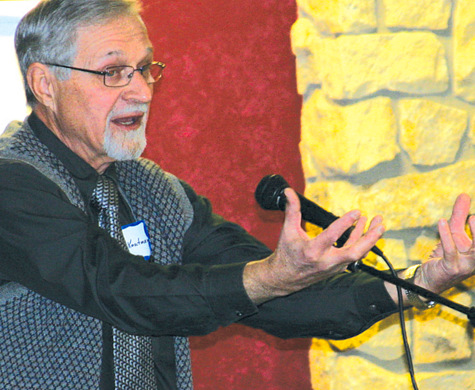
Anabaptist Mennonite Biblical Seminary—Kansas Center hosted a rural ministry course Jan. 20-22 capped by a seminar by S. Roy Kaufman on “The Mission of a Rural Congregation” Jan. 24 at Whitestone Mennonite Church. Co-sponsors were Central Plains, South Central and Western District conferences.
Kaufman is the author of Healing God’s Earth: Rural Community in the Context of Urban Civilization, published in 2013. He grew up in a rural community and pastored for four decades in Iowa, Illinois, Saskatchewan and South Dakota churches. He defined rural congregations as churches located out in the country or in towns of 10,000 people or less.
“That doesn’t mean they are farmers, but their lives are shaped by agrarian life,” he said.
While an urban church brings people together from different places into something new, Kaufman said the mission of a rural church is different.
“We’re not pulling people out of their cultural context, we are bringing Christ’s presence to bear in those communities,” he said. He encouraged followers of Christ to confront cultural shortcomings such as ethnocentrism and intolerance, conflicts over land, greed, jealousy and other forms of economic injustice.

The mission of the church, Kaufman said, is to strengthen the resistance to repressive systems — to subvert the surrounding dominant culture. He cited Jesus calling followers to carry a Roman soldier’s load an extra mile or offer the tunic as well when someone takes their cloak.
However, there are limits to how much change is possible. Conservative groups tend to resist change. With a nod to the Amish, Kaufman said change should always be analyzed by how it will affect the community as a whole.
“If you come into your congregation and say ‘we don’t need that zwieback and borscht,’ you are in trouble,” he said. “I don’t think we can destroy our ethnic heritage without doing violence to the basis of the community.”
He compared tending a congregation to tending a field. A hot and dry climate requires different practices than one that is more temperate with regular rains. Ignoring one’s setting is directly linked to survival.
Most rural churches have aging and declining populations and little ethnic diversity. Kaufman said success often needs to be defined in terms of spiritual fulfilment, not growing attendance and multiculturalism.
“My sense in the end is that institutional preservation drains away mission and strength,” he said. “Congregations will instead be revitalized if they invest themselves in the preservation of their community” — to maintain the community as a whole.
Community stories
Three pastors offered case studies about ministerial experiences in their congregations.
Jeff Blackburn, pastor of Greensburg Mennonite Church, spoke about how the congregation “entered an uncharted season” after a tornado leveled the church and most of the town in 2007. More than 60 percent of the church’s members had to rebuild their homes as well.
However, he said, the church’s bigger story of revitalization happened earlier. Greensburg Mennonite merged multiple congregations with different cultures of polity and structure. There were divisions, and pastors rarely stayed longer than two to four years.
Congregational dialogue in the 1990s brought problems out into the open. The entire body was involved in even little decisions, and money was slowly added to the budget for missions and outreach.
This summer, Blackburn will have served 20 years as pastor.
“Slightly more than half of the congregation is now ‘not Mennonite,’ ” Blackburn said, noting most of the new people attending don’t have a church background. “I’ve been teaching a 20- to 30-year-olds Sunday school class with 20 people or so, and that’s a big deal for a rural church.”
Brett Klingenberg, pastor of First Mennonite Church in Beatrice, Neb., said his congregation is a tight-knit community.
“We have lots of family, lots of people related to each other,” he said. “That’s good, but it can be a problem.”
An insular nature was a roadblock to outsiders, so a conference minister pitched the idea of “Shepherd Groups,” which were implemented in 1976. Today, the church has six groups of about 20 family units each.
Deacons randomly assign new groups every two years, so it is a good entry point for new people. The groups meet on the second Sunday of every month and are there to help when a member is sick and needs meals, has a funeral or moves.
“It’s mandatory,” Klingenberg said. “You don’t have a choice, and I’ve never heard of anyone opting out. . . . The family cliquishness has become a non-issue.”
Shawn Nolt, pastor of Salem Mennonite Church in Shickley, Neb., said rural people prioritize passing on things of value — farms, houses, trucks, businesses and heirlooms, but also faith and discipleship.
“Not just passing them on, but how to take care of them and the community,” he said.
For Salem, this means focusing on children, and trying not to get caught up in nostalgia for the old days, when there were more people living in the community with bigger families.
Salem averages about 92 people on a Sunday and places a high value on youth ministries, with involvement both in the church and in the community. This can mean there are sometimes 10 volunteers for 12 children.
“As our adults invest their lives in children’s ministry, they are becoming part of the children’s lives,” Nolt said. It’s something kids notice and remember.
Other workshops included extended sessions on the case studies, rural spirituality and local food systems. The Jan. 24 presentation drew 75 participants from 17 congregations in Kansas, Nebraska and Oklahoma.



Have a comment on this story? Write to the editors. Include your full name, city and state. Selected comments will be edited for publication in print or online.