


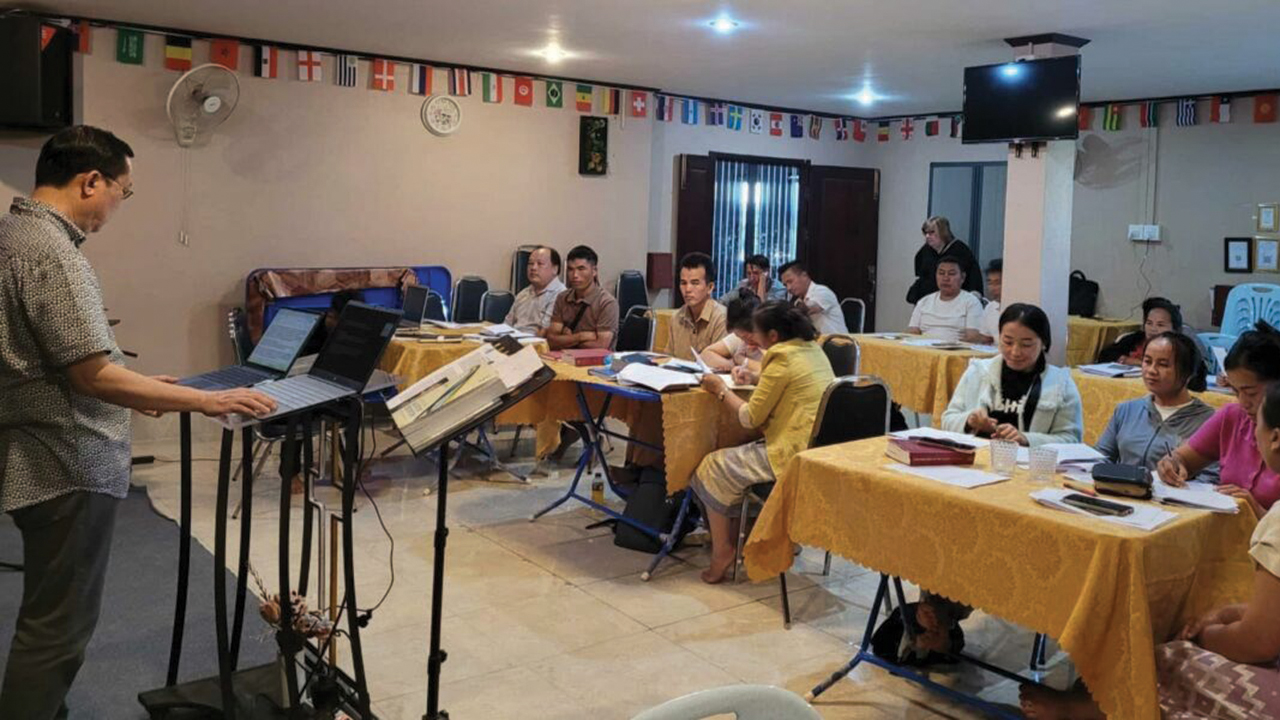
When Memee Yang scanned the room during a Compassionate Care seminar for Hmong couples in Southeast Asia last March, she noticed the women sat on one side of the room, the men on the other.
(The specific country is not disclosed due to ministry sensitivity.)
Yang asked the women: “Who is your partner? Come and sit next to each other, so I can see who your partner is.”
She recalled: “The women said, ‘We’ve never sat in the church with our husbands before. We are not comfortable with that.’ ”
Having grown up in a traditional Hmong family herself, Yang wasn’t surprised.
The Hmong, an ethnic group originally from southern China, have endured persecution, war and displacement since the 18th century. Today, their largest populations live in southwest China, Southeast Asia (Laos, Thailand, Vietnam) and the U.S.

In traditional Hmong culture, Yang said, wives learn to submit and obey, even walking behind their husbands in public to avoid bringing shame.
Christianity, as introduced to the Hmong people by missionaries in the 1950s, largely reinforced this sexist hierarchy, using the biblical story of creation as “proof” that women are the cause of sin and created to serve men. In many churches, women are barred from teaching or decision-making.
As mission associates with Mennonite Mission Network, Yang and her husband, Jonah, share a message with Hmong Christians: God created men and women equally in the divine image, with shared dignity and worth.
In Genesis 2, Jonah Yang explained, “The woman is formed from the man’s side, not to imply hierarchy but shared identity and equality.”
This vision challenges deeply rooted norms in many Hmong churches, requiring respectful communication.
The Yangs developed Compassionate Care workshops that blend Bible study, storytelling and practices of mutual care and respect. The curriculum is based on the Sister Care program, designed for women’s healing and empowerment, developed by Carolyn Heggen and Rhoda Keener for Mennonite Women USA. The Compassionate Care material adds lessons to help men heal and grow alongside their wives.
Couples aren’t together for the entire program.
“Sometimes, men and women have difficulty opening up in front of each other,” Memee Yang said, “but, when we separate them and bring them back together, they talk.”
The Yangs, based in North Branch, Minn., balance preparing for international mission trips with Memee leading Bible studies and Jonah pursuing a master of divinity degree through Anabaptist Mennonite Biblical Seminary.
In 2025, they made two trips to Southeast Asia, accompanied by David Miller, a teaching associate at AMBS. There, they debuted the co-ed workshop. The response was encouraging.
Men with somber faces returned after breakout sessions smiling at their wives. One woman said her husband apologized for not knowing how to love her properly and vowed to love her as Christ loves the church. Another happily reported her husband now helps in the kitchen. Memee Yang said, “You don’t see a [Hmong] man who cooks with his wife or does the dishes.”
Not everyone embraces the message. One group was especially resistant. At the end of the retreat, a pastor stood up and told the group, “Memee said you can cry, but in the Bible, it says do not cry.” She felt disheartened but accepts people’s choices: “God does not force us, and we don’t force people.”
In October the Yangs led two Compassionate Care workshops, including one for 41 church leaders. They received invitations to return and are planning two trips for 2026, if funding allows. The October trip was primarily sponsored by the Schowalter Foundation with additional funds from Mennonite Women USA and Emmanuel Mennonite Church in Lauderdale, Minn.



Have a comment on this story? Write to the editors. Include your full name, city and state. Selected comments will be edited for publication in print or online.