


Watching the birds tells me it is berry picking time because they are first to find the ripe fruit.
Abundant berries met us this past Sunday at Wild Church on the land where we gather, wander and wonder. It’s mid-July, and the currants and raspberries are in their prime right now. Strawberries are winding down, but mulberries, blueberries, blackberries and elderberries are coming soon.
Theology (the study of God and God’s relationship to the world) and ecology (the study of relationships between living beings) always intersect in our Wild Church contemplation and conversation. This month’s bounty of berries invited us to engage with the theology and ecology of abundance.
In Robin Wall Kimmerer’s new book, The Serviceberry: Abundance and Reciprocity in the Natural World, she describes how as a society we usually view the economy (a system of production, distribution and consumption of goods and services) through a lens of scarcity (limited resources that are bought and sold). This can result in perception of insufficiency and fear of loss, a mindset and emotional state that may foster an atmosphere of competition and feed an attitude of anxiety. This type of economic structure and resulting fallout do not feel like the kin-dom God calls us to inhabit.
Indeed, Jesus said, “My kingdom is not of this world” (John 18:36, ESV). A chapter earlier, Jesus prays to God for his followers: “I do not ask that you take them out of the world, but that you keep them from the evil one. They are not of the world, just as I am not of the world” (John 17:15-16). I love this! It reinforces for me that my faith is not an escape plan. It encourages me because Jesus knows firsthand the challenges of life in human form and has interceded to God on our behalf and has not left us alone. We have the Holy Spirit to help us face the challenges of our time that we are called to stay in.
In the Lord’s Prayer, we pray as Jesus taught us, that God’s kin-dom come, God’s will be done on earth as it is in heaven. Again, there is a call to in-break here, now heaven on earth. For this we need a new economic model. Rather than something new, the answer may actually be the most ancient and universal economy there is: nature’s economy.

The berries we are enjoying need to trade nectar with pollinators in order to fruit. Berries soak up freely given sun, rain and soil nutrients and freely give that fruit to us and other animals, who, in turn, spread seeds so that the plant can travel without legs across the landscape. When I enjoy the gift of a just-picked, fresh berry, that blesses me. I feel thankful, and I want to share some with others. In nature’s economy, which sometimes referred to as “ecological economics,” there is cooperation, gratitude, reciprocity, interconnection, and relationships. It is an economy of abundance. As the back jacket of The Serviceberry says, “All flourishing is mutual.” I think nature’s economy gives us a glimpse of God’s intent for us, a way of living in the world but not of the corrupt, unjust system that has come to be.
Earlier in the book of John, Jesus says, “The thief comes only to steal and kill and destroy. I came that they may have life and have it abundantly” (John 10:10). I am watching the birds eating in the berry bushes and am reminded of the Sermon on the Mount. Jesus says, “Look at the birds of the air: they neither sow nor reap nor gather into barns, and yet your heavenly Father feeds them.”
How is the scarcity mindset of this world a thief that steals, kills, and destroys my fruitfulness? Do I trust that not hoarding my wealth will lead to mutual flourishing and the abundant life Jesus promises? The abundant berries we pick freely, eat gratefully and share generously speak to us deliciously of this truth, evidence that a theology inspired by ecology can point us to an economy better aligned with God’s kin-dom.
RECIPE
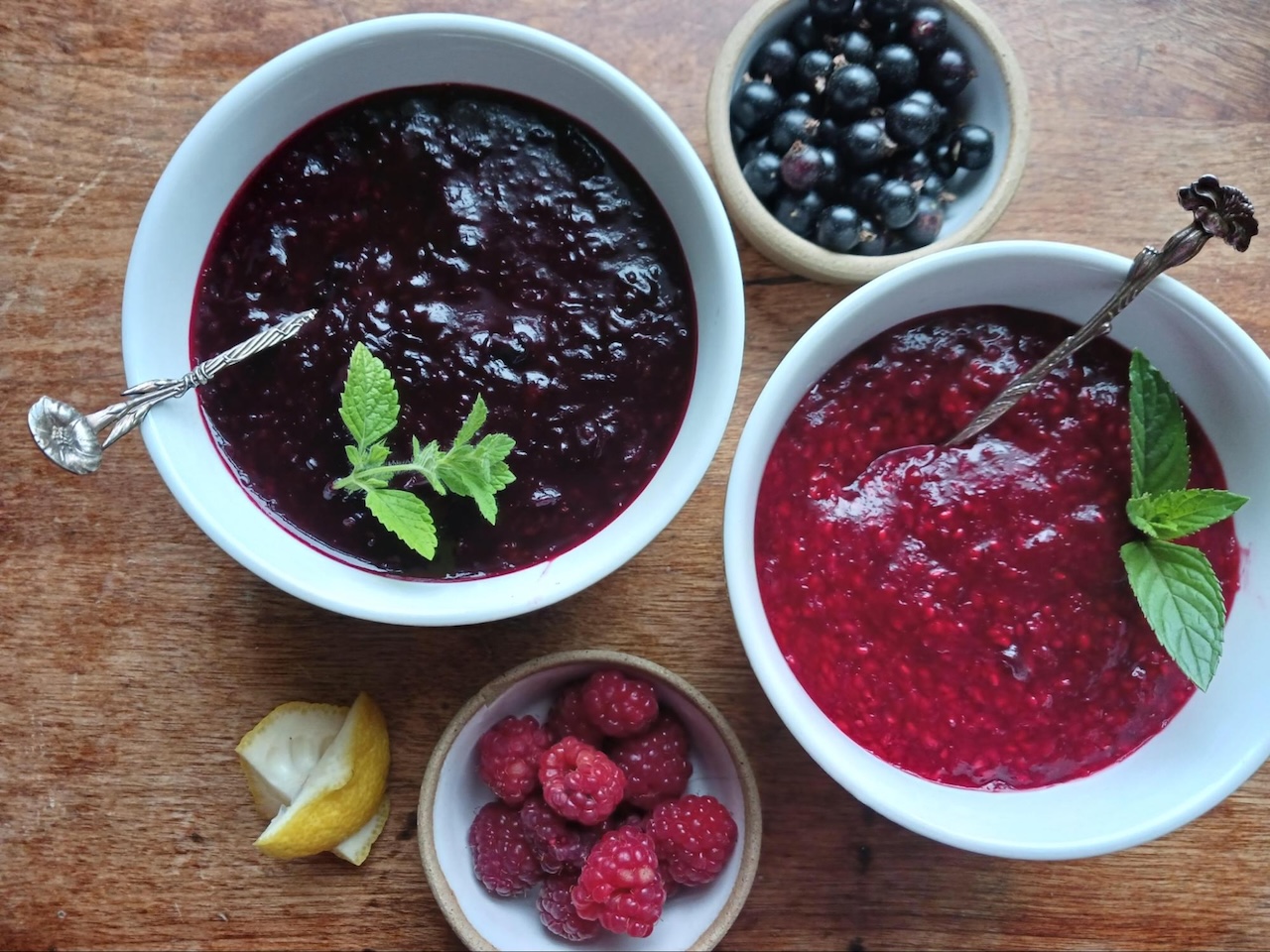
Swedish Berry Soup
Bärkräm is a classic Scandinavian soup that bursts with berry flavor. Use any berry that is in season, or combine several. This can be enjoyed as dessert, breakfast or snack.
Ingredients:
- 3 cups berries, any kind (fresh or frozen)
- 2 cups water
- ¼ – ½ cup sugar or other sweetener (more or less to taste, depending on berry sweetness)
- 1 tablespoons cornstarch
- 1 tablespoons lemon juice
- Optional flavors: cinnamon, clove
- Optional garnishes: fresh berries, mint or lemon balm
Instructions
- Wash berries and put them into a saucepan along with the water and sugar. If you wish, add a dash of cinnamon and clove. Bring to a boil and simmer until berries begin to break apart, about 5 minutes.
- Optional step (I always skip this, but still I offer the option): You may purée some or all of the soup with a blender at this stage. If you’d like to remove seeds, straining using a food mill will result in a smooth consistency.
- In a small bowl, whisk together the cornstarch and lemon juice. Add this into the hot soup and continue to cook over low heat, stirring constantly, another minute. Remove from heat.
- Chill if you are serving it cold in summer, or the soup can be eaten warm in winter. Enjoy it many ways: as is, with a dollop of yogurt, whipped cream or ice cream, or granola. Add leftovers to a smoothie, or put over waffles.



Have a comment on this story? Write to the editors. Include your full name, city and state. Selected comments will be edited for publication in print or online.