


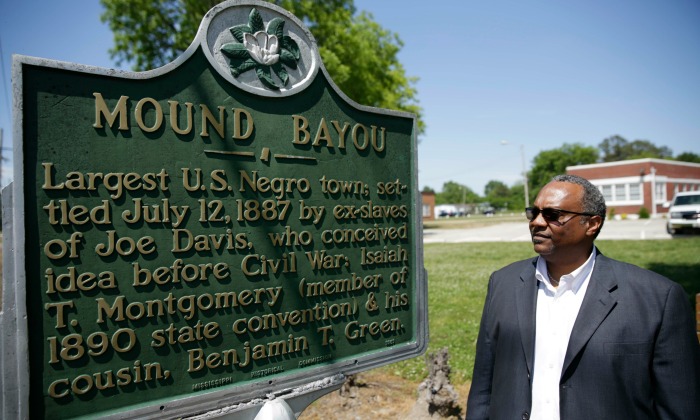
Photo: Mound Bayou, Mississippi, Mayor Darryl Johnson. Photo by Paul Hunt.
Mayor Darryl Johnson is standing in the center of Mound Bayou, Mississippi, pointing to the Taborian Hospital, where he was born — a hospital that was the first medical institution with equipment entirely owned by a black hospital in the south as well as the first hospital to host an entirely black staff.
Mound Bayou, on the National Register of Historic Places, was founded by freed slaves after the Civil War with no assistance from other communities — an accomplishment recognized by residents and historians alike as both very significant and extremely difficult.
The present-day floods that struck Mound Bayou in March are seen as as another challenge heaped on the deep layers of challenges the city has faced since its founders, which include four of Johnson’s great-grandparents, came into a wilderness to create a self-sufficient community.
“The flooding is the worst I’ve ever seen in Mound Bayou,” said Johnson, who also acknowledges it’s not always easy to help people here. “Our people are survivors because of all the adversity we’ve had. We’ve had to face racism as a city. Historically, we were left out. The federal government and state government left us alone to do our own thing. And so our people have become resilient and they have a spirit of self-help.”
Now, Johnson said, Mound Bayou is learning how to receive help from others. “But it’s always a challenge,” he said. “There is a trust issue.”
Volunteers from Mennonite Disaster Service (MDS) are among those who have been working alongside residents in Mound Bayou as they muck out their homes. “I’ve always been impressed with the work of the Mennonites,” Johnson said.
In the past two months, residents have had a difficult time bringing themselves to apply for funds from the Federal Emergency Management Agency (FEMA), he explained. “They don’t want to jump through hoops only to get denied. They look at their own history and they don’t want to be denied — again.”
Even assessing the damage calls into question the credibility of outsiders, he added. Johnson said Mound Bayou has a population of 2,000 — no matter what the official census reports. As federal and state government assessments began after the flood, many Mound Bayou residents were reported as homeless, a label Johnson believes is false, and a label that could ultimately lead to less federal or state aid for the city.
“A lot of people moved in with friends or cousins. I believe you could legally say only a few of them were homeless. They were staying in their own homes.”
In fact, Johnson believes people in Mound Bayou are quietly, yet fearfully, living in homes with a growing mold problem. “I believe a deeper search is showing that. People are afraid to stay in houses with mold.”
Even as volunteers work inside Mound Bayou homes, Johnson continues to have conversations with MDS about additional needs. Johnson hopes more volunteers will come over the summer, into the fall. “The help you could give, it will be greater than anything you can ever see.”


Have a comment on this story? Write to the editors. Include your full name, city and state. Selected comments will be edited for publication in print or online.