


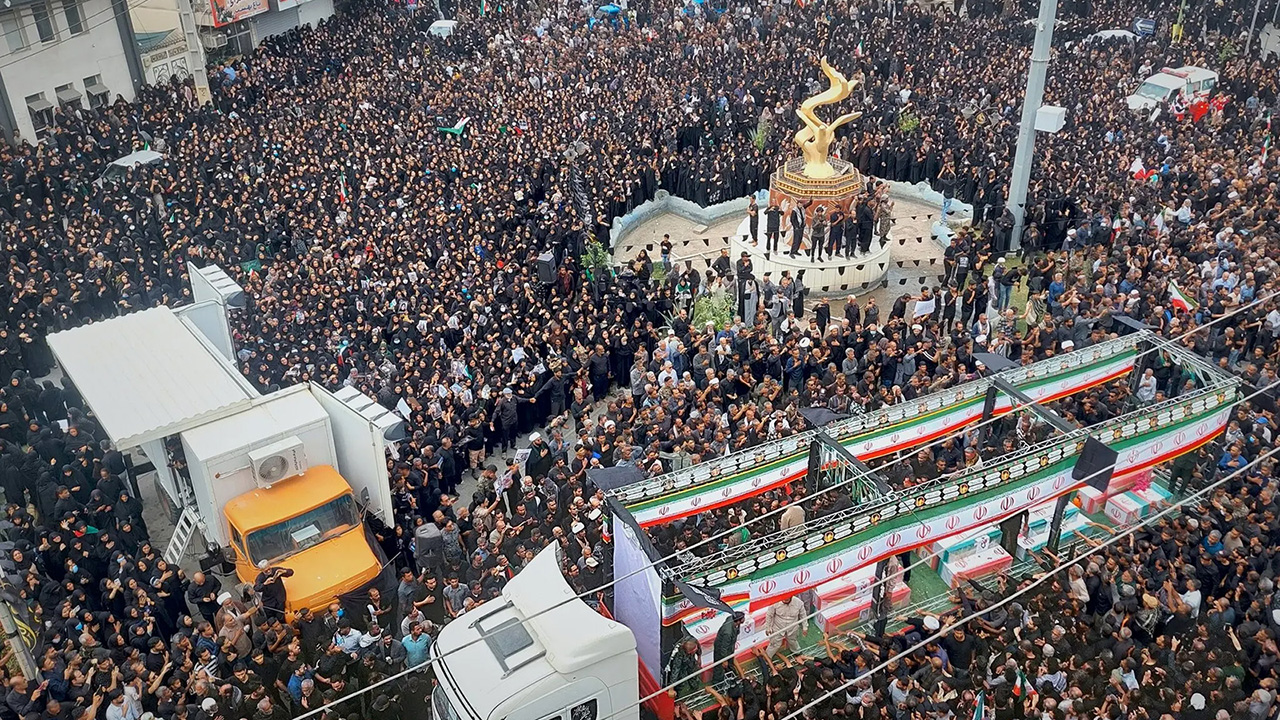
In a small town in southern Iran on Feb. 28, the first day of the U.S.-Israeli attacks, more children were killed in a single strike on a girls school than all the American kids who died in the past two years in school shootings.
In the United States, we don’t just remember school shootings, we ritualize them. We remember the ages, the classrooms, the faces, names. We build memorials, hold vigils, replay the details until grief hardens into a kind of national muscle memory. We are told, correctly, that each child is an entire universe, and that to lose one is to tear a hole in the world.
Take that instinct, the one that insists a child’s death must never be reduced to a statistic, and hold it up against this: In Minab, near the Strait of Hormuz, a girls school was bombed, leaving 165 children dead. Yet most Americans cannot name the town where it happened, much less the name of a single one of those girls.
That is because modern war depends on a hierarchy of grief, on training people to treat foreign children as an abstraction, a number, an unfortunate “incident” to be denied, obscured or investigated at leisure.
If our own children are sacred individuals whose names must be spoken aloud, read from rolls of the dead, why not these girls? Because the machinery of empire runs on geographic, cultural and psychological distance, a distance is carefully engineered.
The numbers will be debated. Investigations will be promised. Statements will be drafted with the careful grammar of evasion. Officials will “review the incident.” Analysts will parse what went wrong. The public will be asked — once again — to let time wash blood from language.

But before the talking points harden and the headlines move on, we should remain with the only fact that matters: Children were killed in their classroom, and they were killed with violence made possible, materially and politically, by American power.
Americans know what the aftermath of a school massacre looks like. We know how quickly a nation can recite names, how fiercely it can insist that the dead be remembered as more than a statistic. That is precisely why this comparison cuts so deep: Every name from Sandy Hook is etched into the American moral record, while the names of those Iranian schoolgirls are already disappearing into the fog of “geopolitics,” as though war is a weather pattern and children are debris.
Once, mass graves were treated as the signature horror of Third World dictatorships — the kind of atrocity Americans were taught to associate with distant tyrants and broken states. Now, mass graves are part of the U.S.-Israeli moral ledger, defended with the language of precision and necessity, laundered through press briefings and talking points.
There is almost nothing more American than school shootings — our uniquely normalized national trauma — and there is almost nothing more American and Israeli than exporting the logic of classroom slaughter beyond our borders. At home, we cannot stop bullets from entering schools. Abroad, we help deliver death from the sky and insist the world call it order.
What would you feel if your children or grandchildren were blown apart by American bombs, and the country that paid for it treated your grief as background noise? What would you become if your daughter’s name never made it into anyone’s mouth, never made it onto a memorial, never earned even the dignity of being remembered?
Children are not collateral. They are not regrettable side effects of grand strategy. They are not footnotes in policy debates. They are amanah — a trust.
In the Islamic tradition, the Prophet Muhammad forbade the killing of women and children, even in war. Early Muslim jurists elaborated strict prohibitions against targeting noncombatants, insisting that the sanctity of innocent life does not dissolve when borders are crossed. The Quran declares that when someone kills a single innocent soul, it is as though they have killed all of humanity.
Nor is this principle uniquely Muslim. Most faith traditions insist that children must be shielded from the violence of adults. International law codifies that consensus.
The modern war machine dulls these truths. It speaks in the language of inevitability and “precision.” It promises investigations, expresses regret and then moves on. The victims do not move on. Their desks remain empty. Their mothers’ arms remain empty. Their futures remain empty.
If we cannot feel the death of a child in Iran with the same moral clarity as the death of a child in the United States, then something in us has been deformed. Faith communities have a responsibility to resist selective compassion, to insist on names when systems prefer numbers, to refuse the comforting lie that “complexity” absolves conscience.
The measure of our moral community is not how fiercely we protect our own children. It is whether we recognize that they are all our children.
Omar Suleiman is a scholar and activist for human rights. He is the founder and president of the Yaqeen Institute for Islamic Research and an adjunct professor of Islamic Studies at Southern Methodist University.


Have a comment on this story? Write to the editors. Include your full name, city and state. Selected comments will be edited for publication in print or online.