


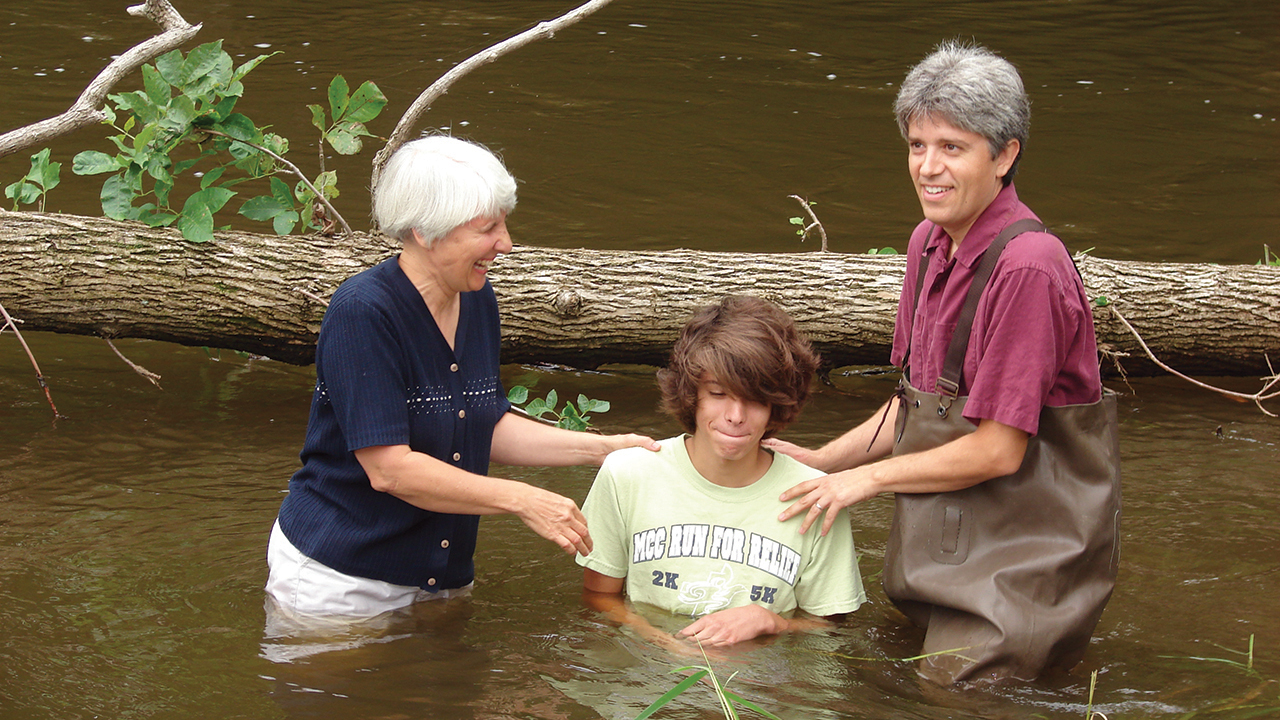
As pastor of my home home congregation, Benton Mennonite Church in Goshen, Ind., I started baptizing people in the Elkhart River. A member told me the health department did not recommend full body contact with the river. That started a journey for us. I read the Bible differently, noticing the importance of rivers. I became a community scientist, leading a group in our congregation in testing the water.
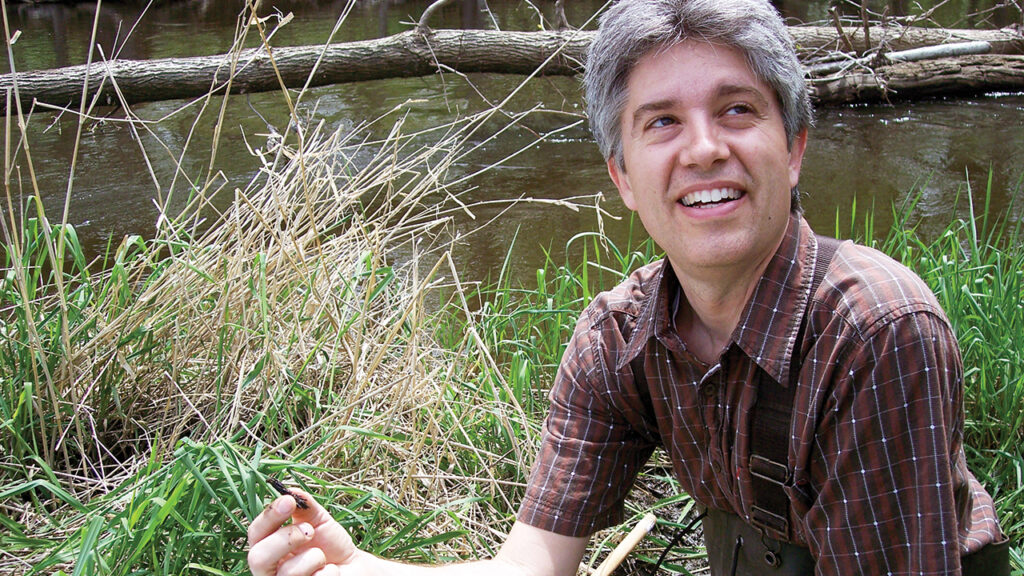
While the group focused on manure, the reason for the warning, we also learned to know the creatures who inhabit the river bottom — creatures who had been mostly invisible to me. We would poke dip nets into the river muck to confirm that the river was supporting a thriving community of creatures.
The caddisfly larvae became my favorite creature. They build a little home around themselves out of stones and twigs. They felt like neighbors to me. Then I came to see them as brothers and sisters. Finally, I saw them as fellow worshipers, witness to our baptisms. Before I started baptizing, I didn’t even know they existed.
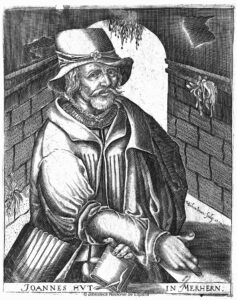
As I assessed our baptismal practice, I read one of the earliest Anabaptist essays on baptism — “On the Mystery of Baptism,” by the South German bookbinder Hans Hut, written in 1526. There I discovered the “gospel of all creatures.”
While Hut first encountered this idea from his mentor, the revolutionary reformer Thomas Müntzer, other South German Anabaptists, including Pilgram Marpeck, continued to use the phrase. I find Hut’s essay the most fruitful for our times.
The phrase “gospel of all creatures” comes from the Great Commission in the longer ending of Mark 16. Jesus commands the disciples to preach the gospel “to every creature” (KJV). In the German version Hut was reading, this could also be translated as gospel of all creatures.
We find similar phrasing in Colossians 1:23, just after a passage that tells us “in Christ all beings in heaven and on earth were created . . . and in [Christ] all beings hold together . . . and through him God was pleased to reconcile to himself all beings, whether on earth or in heaven, by making peace through the blood of his cross.” (I’ve translated the Greek panta as “all beings” rather than “all things.”)
This is a radical teaching — that all beings are in Christ, created in Christ, held together in Christ, reconciled through Christ and his blood on the cross. What can this mean? It at least means that Christ is fully present not just with all creatures but also in all creatures. While we are accustomed to seeing the cross as affecting human relationship to God, this says the cross affects all creation’s relationship to God.
I put this together with how Hans Hut summarized the gospel of all creatures: “The gospel of all creatures is about nothing other than simply Christ the crucified one. But not only Christ the Head was crucified, but rather Christ in all his members. This Christ is what is preached and taught by all creatures. The whole Christ suffers in all members.”
The modern world mostly sees God as outside of us, absent from creation though present in our souls. The natural world functions mostly on its own, with God perhaps intervening periodically.
This theological problem is at the heart of our environmental problem. We see the earth, air, water and our fellow creatures as resources for profit-making rather than as members of Christ and gifts of God. We call them “natural resources.” We may even see our fellow humans as resources for profit, as when we talk about human resources.
If we are to overcome the problems of racism, sexism and environmental degradation, we must see our fellow creatures, including humans, as subjects to love rather than as objects to exploit.
In the midst of social and ecological crises, I am inspired by the gospel of all creatures to see God’s self-giving and ongoing presence to, and in, all creatures. The gospel is found in creation, not just in scripture.
From my reading of Colossians 1 and Hans Hut, I have come to see Christ as deeply incarnated in all beings. This is called panentheism: God is in all beings. It is not pantheism, the belief that God is all beings and all beings are God. I see God in all beings but more than all beings.
The Christian way to describe this is deep incarnation. As John 1 says, the Word became flesh. Christ’s incarnation is found not only in the body of Jesus, or in solidarity with humans, but in all beings.
My primary image of God is a mother with the cosmos in her womb. The mother and fetus are not the same, but the fetus is both separate from and wholly in the mother. And, as we know from our evolutionary and cosmological context, the world is in motion, giving birth to new forms of life as old ones disappear. God is creatively engaging all these creatures in love and justice.
Another mark of the gospel of all creatures, which offers a corrective to us today, is the recognition that suffering is part of existence. We emphasize avoiding pain — and I understand that desire. But to exist is to suffer. To create is to suffer. The creatures suffer, and Christ is with them and with us in our suffering. The cross and the resurrection engage us, transforming suffering into new life.
In his book God After Darwin: A Theology of Evolution, John Haught’s approach to suffering is remarkably similar to the gospel of all creatures. He notes that the evolutionary process is filled with contingency, waste, death and pain. But what if God is not just a God of order and design but also of novelty — what Mennonite theologian Gordon Kaufman called “serendipitous creativity”? What if God is more interested in adventure than in the status quo? Haught argues that “God’s power and action in relation to the world takes the form of persuasive love rather than coercive force.”
You don’t need to believe in deep incarnation to acknowledge that we need a new way of relating to the creation — a way that lovingly sees all creatures as God’s beloved. They too experience suffering, and they too experience the relationship with God envisioned in Psalm 148: They praise God. God has access to their inner lives in a way that makes praise possible, just as God has access to our inner lives.
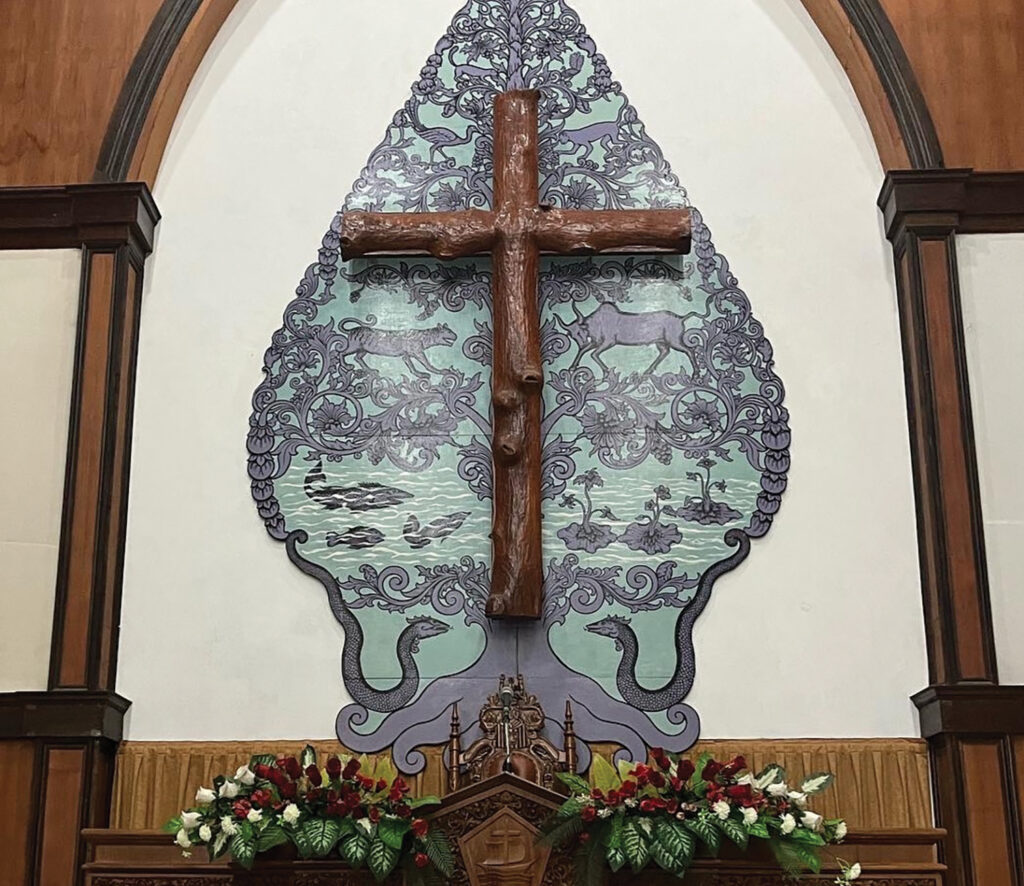
Now I offer another image of this relationship, taken from the front of the Jepara Mennonite congregation in Indonesia, with a cross surrounded by creatures. Like Hans Hut’s medieval mysticism, this is an expression of mysticism in the Anabaptist tradition: The synod that the Jepara congregation belongs to was founded by the Javanese mystic Ibrahim Tunggul Wulung.
He converted from Islam because he saw Jesus as a liberator, in spite of having learned about Jesus from Dutch Mennonite colonists. He believed Christianity could authentically connect with Javanese mysticism.
My conviction that God is radically with us comes from my own mystical experiences. Most of us say we experience the presence of God in nature. While riding bike on the Pumpkinvine Nature Trail, I stopped at a bench and sat in awe of the swaying branches of the trees. Suddenly I felt a sense of unity — that I was part of God, and God was part of me, and we were one with all the cosmos.
God is at work even among the critters on the river bottom and in the soil community of microbes, worms, insects and arthropods that take the death in the earth and resurrect it to life. God might be especially at work in these simple processes that bring life.
To me, this is the most hopeful part of the gospel of all creatures: It is not all up to us. To disagree with a popular saying, God does have hands besides ours: paws and beaks, roots and branches to bring about God’s purposes. It is not all up to us, though we have our part.
The Spirit of Life, who is also the breath of life, is profoundly alive and at work in all beings. This is a planet for life. And for all our machinations toward death, life prevails.
Douglas Day Kaufman is executive director of Anabaptist Climate Collaborative. He has served as a congregational and conference pastor in Mennonite Church USA.

Have a comment on this story? Write to the editors. Include your full name, city and state. Selected comments will be edited for publication in print or online.