


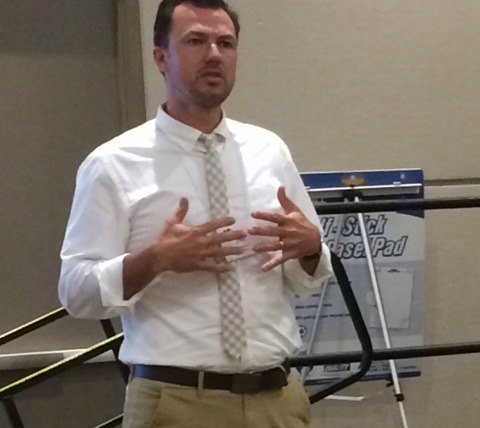
Photo: Josh Packhard speaking at the Mennonite Church USA convention in Orlando on July 5. Photo by Gordon Houser.
Many have heard of the “nones,” those who, when filling out a questionnaire about their religious affiliation, check the box marked “none.” But who are the “dones”?
Unlike the nones, said sociologist Josh Packhard in his seminar Wednesday afternoon, the dones are people who are highly engaged in their faith but have left the church. There are 30.5 million of them in the United States, said Packhard in his seminar, “Understanding the ‘Dones’: The Key to a More Vibrant Church,” on July 5.
Packhard, who calls himself an engaged sociologist of religion, co-wrote the book Church Refugees, based on research he carried out, which included extended interviews with 100 or so individuals. This book was one of the inspiration’s behind the Future Church Summit. Listen to Glen Guyton reflect on this inspiration in a conversation with Malinda Berry.
Packhard, who grew up Lutheran and attends a Lutheran congregation, said, “The church has an important role to play in the world.”
He pointed to studies showing the decline of trust in institutions, including the church, while individual belief in God has remained strong. The percentage of those who say religion is very important in their lives has also remained steady over the past 40 years, at between 55 and 60 percent.
While the dones have left the church, they have kept their faith. These are generally people who are highly engaged in their faith, well-trained and very involved in their church before they left. Packhard says majority are in their 40s, with an average annual income of $40,000-$50,000.
Why then do they leave? He note four categories of reasons they are often dissatisfied:
- They want community, not judgment. Relationships are important.
- They want to be active in the church, but feel stifled by bureaucracy. Churches often have too many rules that discourage innovation.
- They want conversation, not doctrine. One said, “It is in relationships and conversations that I find God.” Belonging precedes believing and activity.
- They want to be involved in ministry, not morality. One asked, “Why aren’t pastors disciplined for neglecting the poor?”
Packhard noted four strategies for either attracting dones or keeping people who are in church but ready to leave, of which there are an estimated 7.5 million, he said.
- Invite participation…but with limits.
- Be truly relational…but don’t compromise your beliefs.
- Undermine bureaucracy…but don’t abandon structure.
- Impact your community…and be impacted by your community.
Packhard said his impression is that Mennonites already invite participation and have a good opportunity to welcome dones. They are “potential allies,” he said, who can make our churches more vibrant.


Have a comment on this story? Write to the editors. Include your full name, city and state. Selected comments will be edited for publication in print or online.