


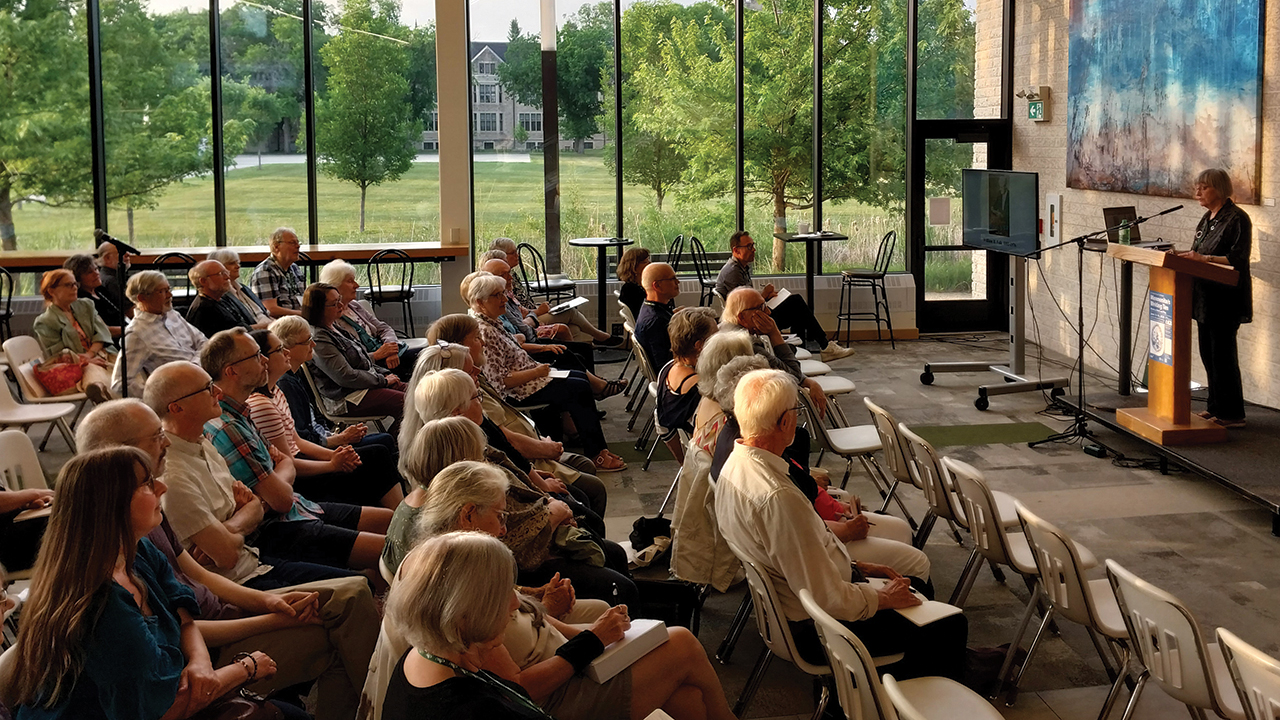
A keynote, like a tuning fork, is “to strike a chord we all keep coming back to,” said Magdalene Redekop in her keynote address at the Mennonite/s Writing Conference.
Yet the conference, held June 12-15, featured three keynote addresses, all striking different pitches — with chords and even some dissonant notes — through which to consider the complex field of Mennonite/s Writing.
The Mennonite/s Writing Conference drew 110 people to Canadian Mennonite University in Winnipeg, Man. Attendance increased to 175 for public evening events. The conference was simultaneously a literary festival, with authors reading from their works of poetry, fiction or nonfiction, and an academic seminar, where scholars presented papers on Mennonite writing and thought.
The term “Mennonite/s Writing” is deliberately broad, encompassing Mennonites who write, writers who are or have been Mennonites, and writing produced by or about Mennonites.
Concurrent sessions offered presentations on a variety of topics, including scholarly papers on Miriam Toews’ Women Talking and the paintings of Henry Pauls, multimedia collaborations of hymn-writing and fraktur, readings from memoirs and poetry collections, plays and panel discussions.
Mennonite/s Writing conferences have been held semi-regularly for 35 years, alternating between Canada and the United States. The first took place in 1990 at Conrad Grebel University College in Waterloo, Ont. The focus was on literature by Canadian Mennonites, some of whom had received grants for their writing from the Canadian government.

More recently, there has been a move by Canadian and U.S. scholars and writers to expand the definition of Mennonite writing, which has tended to focus on literary texts and narratives from the late-20th century and beyond.
Robert Zacharias, whose book In Search of a Mennonite Imagination: Key Texts in Mennonite Literary Criticism was launched by CMU Press at the 2025 conference, compiled articles and criticism to consider how Mennonites have thought about literature over a period of 156 years. Zacharias also unveiled Distant Reading, Mennonite Writing, a searchable online database of over 4,000 writers and works.
Presenters offered new and broader ways to consider Mennonite/s Writing.
“It’s helpful to be a writer if you’re going to be an activist,” said Shirley Hershey Showalter, a panelist on “Words That Divide and Unify: Mennonites and the Language of Grassroots Political Engagement.”
Showalter, a retired Goshen College professor and president, is a co-founder of Grandmas for Love, a group of mostly older women who advocate for education in Lititz, Pa. Showalter has written letters to Pennsylvania officials and representatives, requesting equitable funding for public schools. She saw parallels between the political turmoil of the 16th century, out of which Anabaptism emerged, and current turmoil in the U.S.
Maxwell Kennel, director of Pandora Press, called upon writers to perform literary criticism of Mennonite theological and historical writings. He also announced that Pandora Press is now open for literary submissions.
In “Homecoming: Making Room for Queer Stories on the MennoLit Shelf,” panelists shared their journeys as Mennonite LGBTQ+ writers.
Panelist Casey Plett assumed that being Mennonite “would not go with being trans” but instead found the opposite. “Secularism felt insulting,” she said, and her Mennonite heritage provided spiritual resources to help navigate her trans identity.
Building a writing community brought panelist K.R. Byggdin special joy. There are “so many forces to keep people isolated,” Byggdin said. It’s important “to share information and not to gatekeep” in order to “keep the door open for people behind me.”
This sentiment was echoed by Julia Spicher Kasdorf in the second keynote address. “Will you commit to Mennonite/s Writing as a practice and a conversation, not a canon of texts or identities?” she asked. “Elders, when you downsize, will you pass your books on to emerging writers and scholars?”
Kasdorf also reflected on a tension inherent in Mennonite/s Writing. Quoting from a 2017 essay by Sofia Samatar, a writer of Somali Muslim and Swiss-German Mennonite back-
ground, Kasdorf reminded the audience that the word Mennonite is simultaneously “faith and ethnicity, church and culture . . . carried both in the soul and the skin.”
Different writers understand being Mennonite differently. Some see it as a faith group, others as an ethnicity. Kasdorf noted that Plain Mennonite and Anabaptist writers approach writing differently and hold separate conferences from Mennonite/s Writing.
Yet Mennonite identity may not be the most important thing about us, writer and veterinarian David Waltner-Toews said in the final keynote address. In his studies, he has noticed that life seems to resist classification: 40% to 50% of human DNA jumps around, activating different parts of our genome. “We’re unstable patchwork at the core,” he said.
What binds us may be the rhythms of our bodies in the larger music of the universe. Waltner-Toews closed with a reading of his poem, “The Time of Our Lives,” in which the poet reflects while digging up a pine stump: “As the roots lift free, I am dug in/rooted,” and the earthworms and beetles climb up the shovel toward him, singing: “Welcome home.”
Eileen Kinch is digital editor of Anabaptist World. At the conference, she suggested that Mennonite news writing, especially print newspapers such as The Budget and Die Mennonitische Post, with subscriptions of about 20,000 and 10,000 respectively, are thriving examples of Anabaptist and Mennonite writing. Mennonite news writing nurtures community bonds and encourages faithfulness.



Have a comment on this story? Write to the editors. Include your full name, city and state. Selected comments will be edited for publication in print or online.