


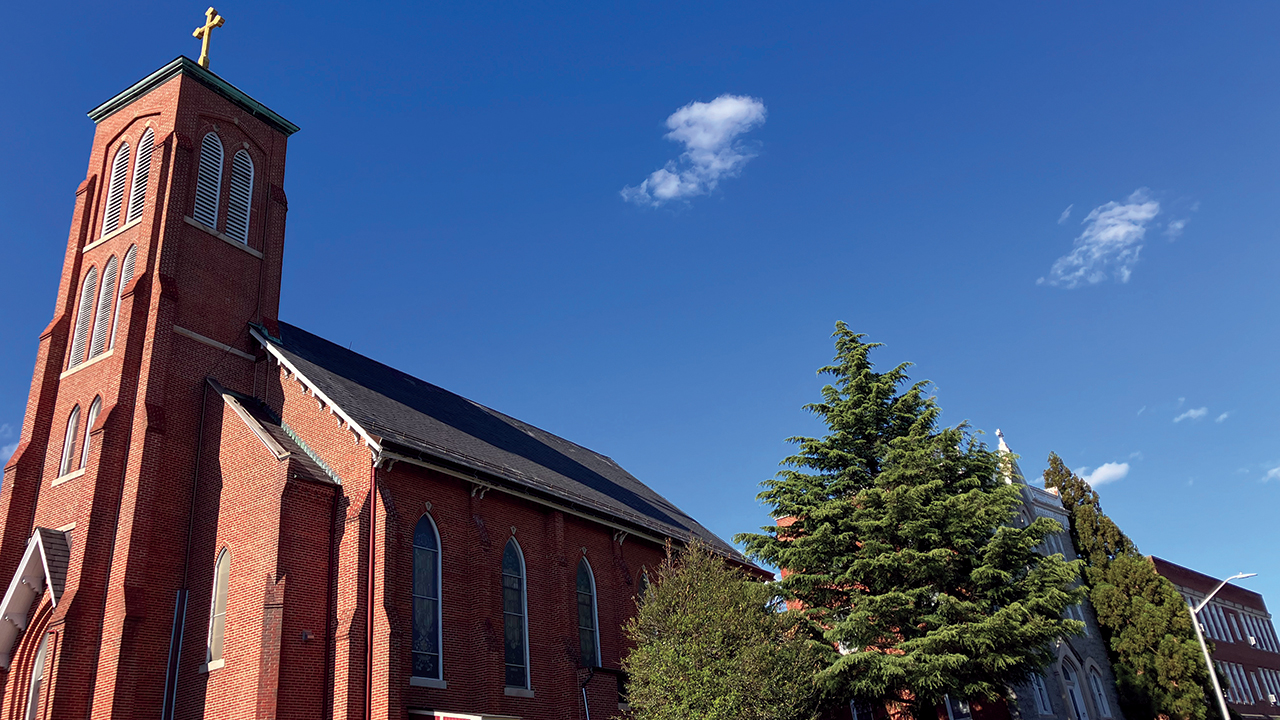
A minor Reformation has come to Baltimore, where a Mennonite church purchased a Catholic church and school in April.
More than a real estate deal, Hampden Mennonite Church’s move into the former St. Thomas Aquinas Church and School represents a growing openness among conservative Anabaptists to engage with neighbors in urban settings while maintaining traditional Anabaptist separation from the world.
Hampden Mennonite Pastor Nathan Zook said the transaction’s timing was not intentional, but when the congregation started talking about the possibility of buying the building “we had just done a 13-Sunday adult class on 500 years of Anabaptism. This seemed very symbolic for us.”
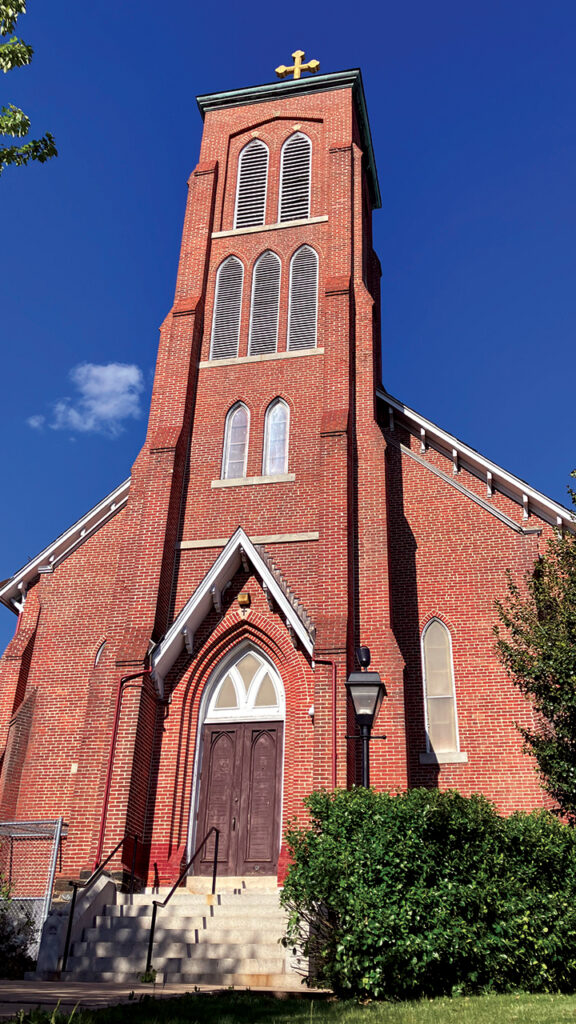
Purchased for $1.8 million, the 1.2-acre complex includes a roughly four-story church, school, rectory and convent. Designed by famed local architect George Frederick, the church was completed in 1871 after four years of construction at a cost of $20,000.
The congregation is a member of Keystone Mennonite Fellowship and plans to take over the church and rectory. The congregation’s Hampden Christian School is a separate entity and will move into the school and convent after about $700,000 in improvements such as installation of fire sprinklers, an elevator, central air conditioning and additional restrooms and classroom walls.
“With the church we’re just waiting for our occupancy permit to move services over whenever we get that,” said Zook in early May. “The school is looking more like January to get occupancy because of the work they’re doing. . . .

“The last mass was held in December 2024, so the church is really up to code. When the Catholic church moved out, they took with them all the altars, the shrines, the stations of the cross. So we are now doing some repainting and replastering and things — kind of cosmetic.”
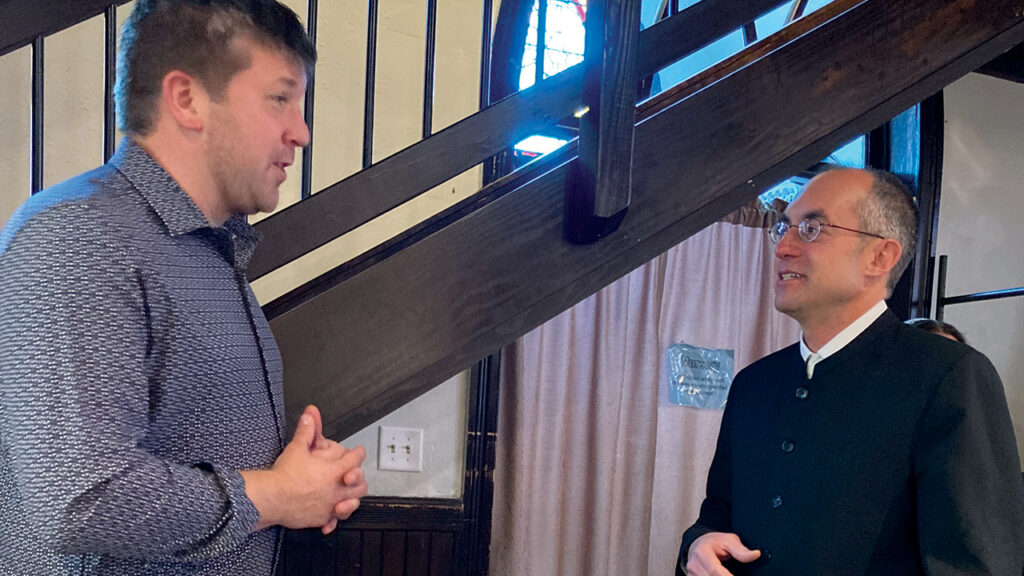
The school is a project of Urban Mennonite Ministries, a nonprofit organization that started in 2011 in Baltimore when some families moved to the city with a vision to start a school, which became Hampden Christian School. UMM executive director Laverne Eberly said it began with a daycare and five students.
“Daycare wasn’t part of the original vision, but everyone knows daycare is expensive,” he said. “Over the years that built up, and now we’re serving about 90 children — about half up to 4 years old in daycare and the other half in the school.
“Because the focus was on being self-sustaining, the focus was on middle- to upper-class families, with financial assistance available for lower- income people. Our waiting list is longer than our enrollment.”
UMM added a second entity in 2020 in Williamsport, Pa., when Newbury Christian Church reached out to start a daycare. New Growth Learning now serves 25 children in daycare, with plans to add kindergarten classes when a teacher is found.
The organization provides networking and staff development, along with helping schools get up and running. UMM’s board includes representation from Keystone along with Beachy Amish Mennonites and Hope Mennonite Fellowship, a conference with about 10 congregations.
“We’ve had some [involvement] from Mid-Atlantic Mennonite Fellowship and Biblical Mennonite Alliance,” Eberly said. “Some of the other areas we’re looking at are Midwest Mennonite Fellowship. The Beachy Amish Mennonites have a played a significant role in providing staff. . . . Some of our teachers volunteer, and after a couple of years we like to give our teachers a wage.”
About a quarter of school students are Mennonite, while the rest come from the surrounding community, and all daycare children are from outside Anabaptist circles.
“There’s no system of belief you have to ascribe to,” he said about families enrolling in the daycare or school.
“. . . We are open about our beliefs as conservative Mennonites/Anabaptists — the traditional stand on marriage as one man and one woman for life — but we are very open to other beliefs being part of our school.
“In the past there were single parents and a lesbian couple who sent their child to us. We are open about our beliefs, and that doesn’t seem to push people away in a very progressive city. . . . I would say 70 to 80% of the churches are pride flag-flying people, and they accept us in the community. While standing firm on what we believe, we aren’t judging people.”
Both Eberly and Zook weren’t sure what the reception would be to Mennonites taking over a Catholic church and school, but the response thus far has been gratitude that the property will still serve religious functions.
“I found a document published by the archdiocese showing the building was desanctified and would not be used any more for Catholic weddings or funerals. The exact wording was ‘we now relegate the building to profane but not sordid use.’ So now we Anabaptists are promoted from [historical] heretics to ‘profane,’ ” Zook joked. “But no, we’ve been hearing really good feedback from neighbors that it will continue as a religious church and school. The other bidder was going to use it as corporate office space, and that was not in line with what the community was excited about.”
While icons and altars are gone, other aspects of Catholicism remain below the high vaulted ceilings, which facilitate excellent acoustics for a cappella singing. Confessionals can be used during worship by nursing mothers. The rectory will house church offices on the first floor, with the potential to house visitors above.
The tower contains a large bell that neighbors hope will continue to ring four times a day. Stained-glass windows are acceptable because they feature geometric patterns and no people.
Eberly grew up in the Eastern Pennsylvania Mennonite Church, a conference with the usual conservative Anabaptist aversion to steeples and stained-glass windows. He said the Hampden congregation accepts the ornamentation as part of the building’s history.
“The simplicity of worship still remains in a very elaborate piece of beautiful architecture,” he said. “There’s a general excitement about it. I don’t know that we would build something like that, but we will enjoy it.”
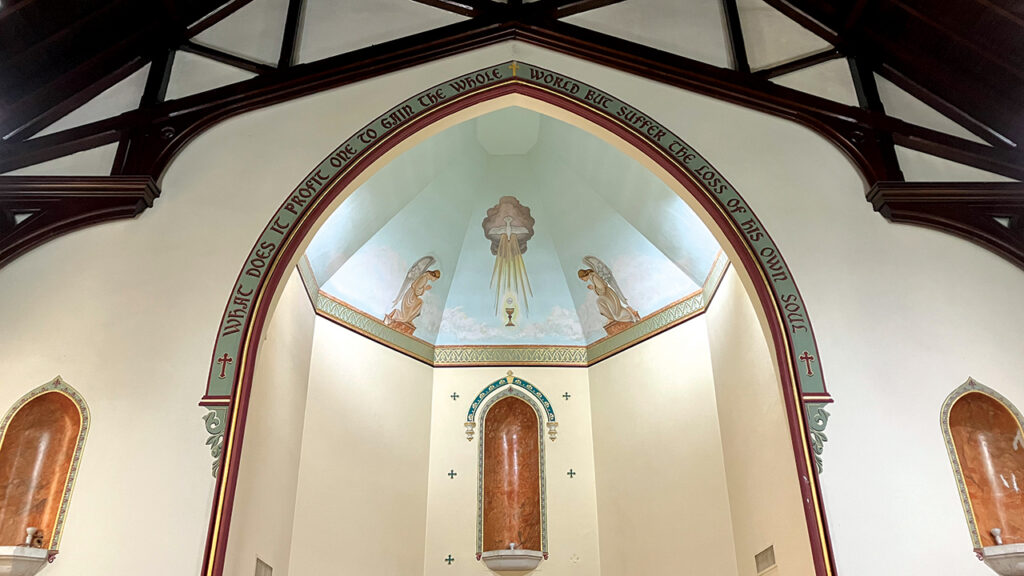
The main change the church will make is to remove a prominent portrayal at the front of the church of angels worshiping the Eucharist — an elaborate chalice and communion wafer that Catholics believe is the real bodily presence of Jesus Christ.
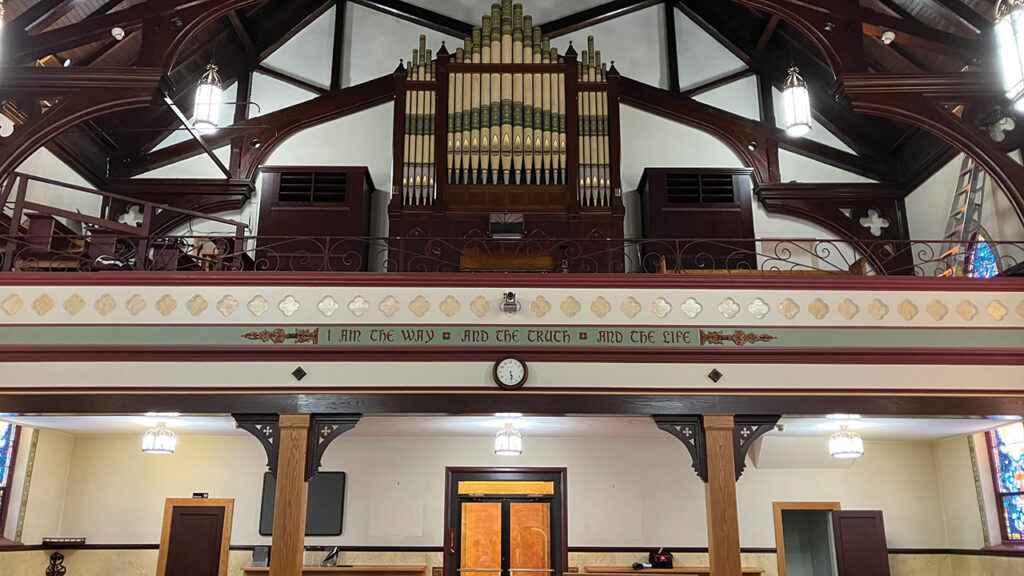
Zook said the pipe organ in the balcony at the back of the church works.
“The four things we asked to keep were the bell, pews, windows and pipe organ, more for historic preservation,” he said. “We won’t be using the organ in structured worship services. That’s been an ongoing conviction in our congregation for years, but they are OK with it being there to look at. . . . A lot of people in the congregation do instrumental music in their homes, but not in the worship services.”
The prayer kneelers built into the pews will also stay.
“We’ve always done kneeling prayer facing the rear of the congregation,” Zook said. “Now this has kneelers in front, so we’re talking about reorienting ourselves. . . . It’s a good change for us, with visitors who don’t attend regularly, or people with knee issues. We can also be heard better, instead of someone praying into the seat cushion.”
And visitors do come. Eberly recognizes a shift in the last 30 to 50 years to more openness to building connections with non-Mennonite communities and even nonbelievers.
“When our ancestors moved to America, my interpretation is we were in survival mode,” he said. “We left urban areas and persecution . . . and became a very closed community.
. . . In the last 50 years there has been a movement of urban ministries — typically groups wanting to escape some of the control and restriction of conservative groups and move in the name of mission. They would often not last long and lose their conservative identity.”
When he gives UMM presentations, he still hears concerns about people losing their conservative beliefs in the city. But if they come to visit, they see in Baltimore and Williamsport that the churches are still distinctively conservative.
“There’s a shift in our young people wanting to reach out to our communities and I include myself in that,” Eberly added. “. . . It’s done so much good for my family. My 12-year-old boy knows the names of everyone in our neighborhood. It’s done wonders for them to build relationships with people very different than we are. . . . If we are supposed to reach the world to make disciples like the Great Commission states, I also feel we can do that right here at home. “
Zook agrees. He’s lived in places like Washington and Baltimore his entire life, and his day job is teaching international relations as a political science professor at a college in the D.C. area.
“I was an urbanite before I was a Mennonite,” he said. “. . . We don’t see our way of life as being a detraction from ministry or a hindrance to outreach. It’s almost an attraction. It’s something people are yearning for. Maybe they won’t quite join themselves, but they are intrigued by it.
“They find us online, and they’ve been coming to start worshiping with us. We don’t feel we need to change who we are. We feel the light of Christ will shine through.”



Have a comment on this story? Write to the editors. Include your full name, city and state. Selected comments will be edited for publication in print or online.