


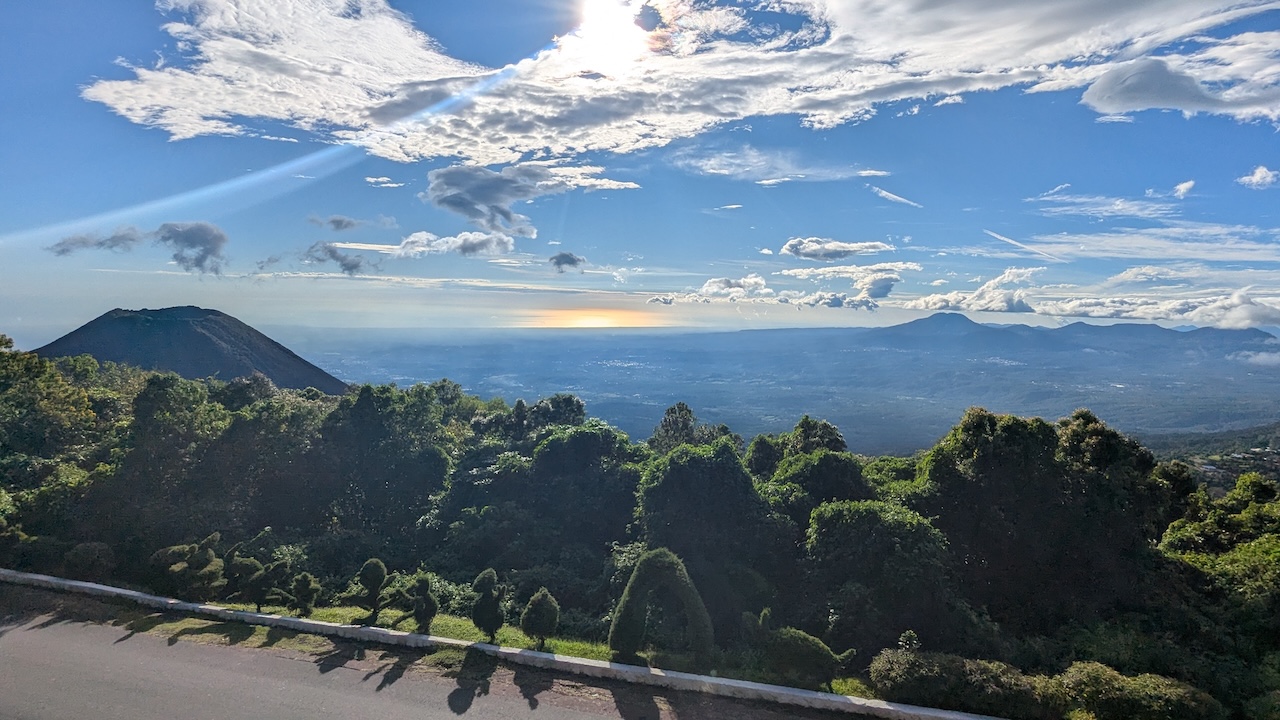
I have been in El Salvador for the past week. It is my first time in this beautiful and colorful country. There are things that give it a sense of familiarity for me — so much so, that it almost feels like home. However, Salvadoran people face their own struggles that set them apart from other Central American countries, and even other Latin American countries, making this small Pacific-facing nation unique in many ways.
I have been meeting primarily with Quakers in this country, although I haven’t exclusively talked to Christian pacifists. I have gathered some insights about how Salvadorans feel about their government and the state of their nation. Here are some facts about El Salvador.
1. Bukele
Nayib Bukele is the current president of El Salvador, although this is already his second term. Many claim this is unconstitutional, despite amendments made to the constitution back in 2021. Yet Bukele is a young and charismatic leader that, according to some folks I talked to, “knows how to take care of his image.” One young person informed me that while Bukele plans to make cuts to government staff and the education budget, he has distracted from the negative publicity by ordering that Christmas bonuses be given out early. “People were happy to receive the money early, but what’s going to happen in December when Christmas expenses arrive and the bonus is gone?” The young Salvadoran said, “People think that he is doing this for them, but he always does something like this to distract from his bad actions.”
2. The Bukele factor
It is true that there is a “newer” sense of security and safety felt among Salvadorans. Some would attribute this to President Bukele’s efforts of strong policing and high numbers of arrests and incarcerations of anyone breaking or being accused of breaking any law. This they call “the Bukele factor.” However, two young people that I talked to posed the question: “At what cost?” One of them said that impoverished folk are at a higher risk of being arrested and incarcerated with no due process. The young people’s Quaker meeting provides services to kids suffering from extreme poverty. “Sometimes these kids have one or two parents in jail. It leads some of the young girls into prostitution since they have no other means to support themselves.” So, the immediate sense of “security and safety” may come at the sacrifice of the next generation.
3. Incarceration rates
Along with the Bukele factor, there is a worrisome statistic in El Salvador: nearly 1.7 percent of its population is incarcerated. The country also runs the biggest mega-prision in the Americas: “The Center for Terrorism Confinement, to give it its full name . . . with a capacity of 40,000 inmates.” This is also where the United States has been sending prisoners to be held; many are without a trial or due process because they are suspected of being gang members or undocumented immigrants. Unsurprisingly, this is what Bukele has done in El Salvador to his own people: “In 2022, Bukele, with the support of lawmakers, declared a state of emergency which allowed the government to temporarily suspend constitutional rights, including the right to legal defense provided by the state. The measure was intended to last 30 days but has been extended dozens of times and continues to this day.”
4. The dollar
El Salvador adopted the U.S. dollar as its official currency back in 2001. Before then, the country had the Colon since 1892. The switch became complete in 2004, and the U.S. dollar has become the only used currency in the country. However, in 2021 president Bukele made Bitcoin legal tender in El Salvador, thus becoming the first country in the world to adopt a cryptocurrency as coin. Despite the perceived stability and modernization that these economic moves might seem to bring, there are downsides, such as not having control of the country’s national tender to adjust inflation and interest rates due to country-specific circumstances, such as hurricanes and earthquakes. Salvadorans that I talked to don’t seem to think that having the U.S. dollar as currency has benefited them and perceive life as more expensive than in other countries in Latin America.

5. A way out
One of the devoted, tithe-giving, community-engaged, hardworking, home-owning and well-traveled Christians that I talked to said she had started looking for a way to possibly emigrate elsewhere. “You used to fear the gangs, yes, but now you fear the government. They can take anyone, for any reason or no reason. And there are less good jobs, even in the government there won’t be good jobs left. They are taking away the benefits and making everything by contract and paying half of the salaries that they should,” she told me. I don’t think that she would have talked about leaving her beautiful country, her community, her roots and what she had built and worked so hard for, even if the gangs were so rampant. However, the sense that she not only cannot trust her own government, but that she fears it, is one that I don’t wish to identify with.



Have a comment on this story? Write to the editors. Include your full name, city and state. Selected comments will be edited for publication in print or online.