


You are the salt of the earth, but if salt has lost its taste, how can its saltiness be restored? It is no longer good for anything but is thrown out and trampled under foot. You are the light of the world. A city built on a hill cannot be hid. People do not light a lamp and put it under the bushel basket; rather, they put it on the lampstand, and it gives light to all in the house. (Matthew 5:13-15, NRSV)
Light is a metaphor that we use every day: “Light at the end of the tunnel,” “I saw the light,” “you light up my life,” “the light of reason.” And more subtly: a “bright idea” or a “dimwit,” “a shining example” and “a shady character,” “a glowing review” and “hazy plans.” Light is so important that we’ve structured our lives and our thinking around it. But what do we do with salt?
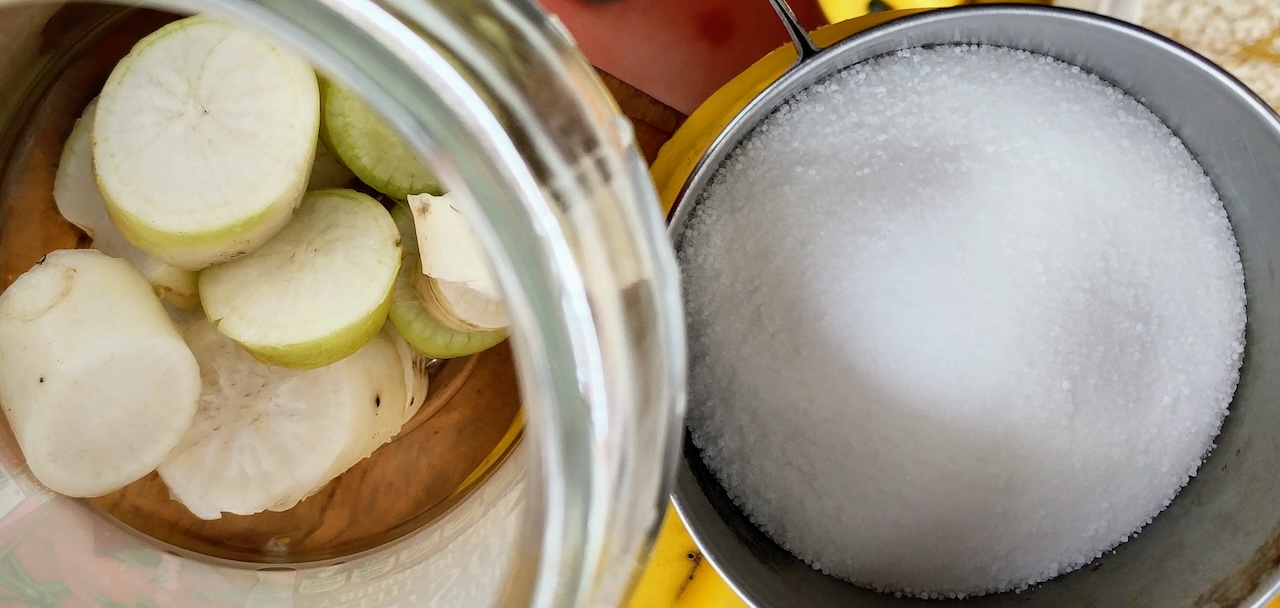
Salt had many uses in first-century Palestine, many of the same uses it has today: flavoring, preserving, disinfecting – and salt was also used in ceremonial offerings and exchanged like currency.
Salt is the springboard of many useful chemical processes. It raises the boiling temperature of water so we can cook things faster. It lowers the freezing point of water, so we use it to make ice cream and melt ice and snow on roads and sidewalks.
Salt draws moisture out of foods, so we use it as a preservative. Through the same process of osmosis, salt works as a disinfectant by pulling moisture (and the germs living in it) away from a wound, countertop or sore throat, or by simply killing bacteria by sucking all the moisture out of their cells. (If you’re thinking of slugs, you’re right.)
All of this chemistry boils salt down to its essence because salt is a catalyst. When Jesus calls his friends the salt of the earth, and when we choose to read these words today, we are reminded that we are change agents in this world. And winter in (most of) North America begs for change.

Your shoulders are always in your ears and your back is sore from tensing against the cold. Your coat is perpetually dirty from brushing against your filthy car, and your boots are covered in salt slush residue. Your lips and hands are constantly cracking, and your hair is a static-y mess under your hat. You don’t go outside as much, so you’re missing Vitamin D and surrounded by germs.
Under heavy coats, bound by scarves and mittens, vision impaired by hats and icy windshields, winter has us shut in and stiff. Engaging the world becomes a monumental task as our bodies get clunky and achy.
We are in desperate need of a catalyst.
A hot bath with Epsom salts and a crystalized salt lamp would be nice comfort, too. Comfort is needed in all seasons – especially winter.
Are you feeling like salt? Like light? We ask the Holy One to be present to us this winter in light, warmth and catalysing chemistry. And in the salty people who keep showing up to be the hands and feet of Christ in this world.
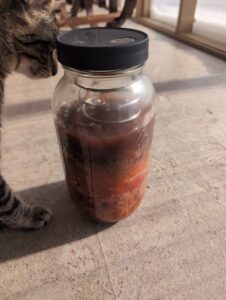
One of the amazing things salt does is keep our harvest edible (even when we lived without electricity or plumbing) for years. Seriously. This is some three-year-old kraut, which my kitty Palmer is checking out (see right).
Sandor Katz is the wise fermenter I turn to. Check out his Wild Fermentation book. You can actually flip through it for free on archive.org.
Recipe: Kimchi
Here’s my Kimchi 101.
Kimchi is a Korean fermentation that can be as spicy as you want. It ferments quickly, and we keep it on the shelf (not even refrigerated) for years at a time if we’ve made a particularly big batch. You can play around with the ingredients, but here’s a basic formula:
4-5 cups cabbage (napa, bok choi or whatever you can get), chopped
1-2 cups daikon and other radish, chopped
1 tablespoon ginger, chopped
1 tablespoon garlic, chopped
1 tablespoon red chili (ideally fresh, but could be paste, frozen, dry, powder)
¼ cup salt, mixed in one quart water
2 teaspoons salt, mixed in two cups of water

Instructions
- Wash your hands well, and rinse even better. You don’t want soap or lotion in your ferment.
- Chop cabbage by hand or use a food processor to slice as thick as it can slice.
- Mix ¼ cup salt in one quart of water and add chopped cabbage. Soak chopped cabbage for a few hours, or even overnight.
- Drain cabbage and add the other ingredients (radishes chopped similar to cabbage, the others finely chopped).
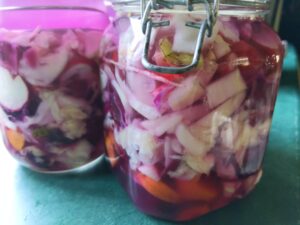
- Stuff into a quart jar if it will fit, or move up to a larger jar. This can be an old (clean) pickle or spaghetti sauce jar, or it can be an actual fermentation crock. We recommend wide-mouth jars with the breathing lid and press coil (pictured).
- Mix two teaspoons of salt into two cups of water.
- Pour salted water just over the top of the veggies. This is why they should be shoved down with something like the coil.
- Wait. You can taste after a couple days if you’re curious. If you’re really nervous about fermenting, you could put this in the fridge after a week, but we don’t bother.
- I’ve included dried fruit, nuts, green tomatoes, red onions, green onions, lemon, cumin and mustard seeds in kimchi, and it’s been great! If you like caraway or fennel seeds, those are popular in ferments.
- If you have never fermented before, keep in mind that anything you shouldn’t eat will be disgusting to you. This isn’t like salmonella. Fermenting veggies is one of the safest kitchen experiments. The most likely disappointment is that you’ll make something simply too salty. Then you can add more water, and/or rinse.



Have a comment on this story? Write to the editors. Include your full name, city and state. Selected comments will be edited for publication in print or online.