


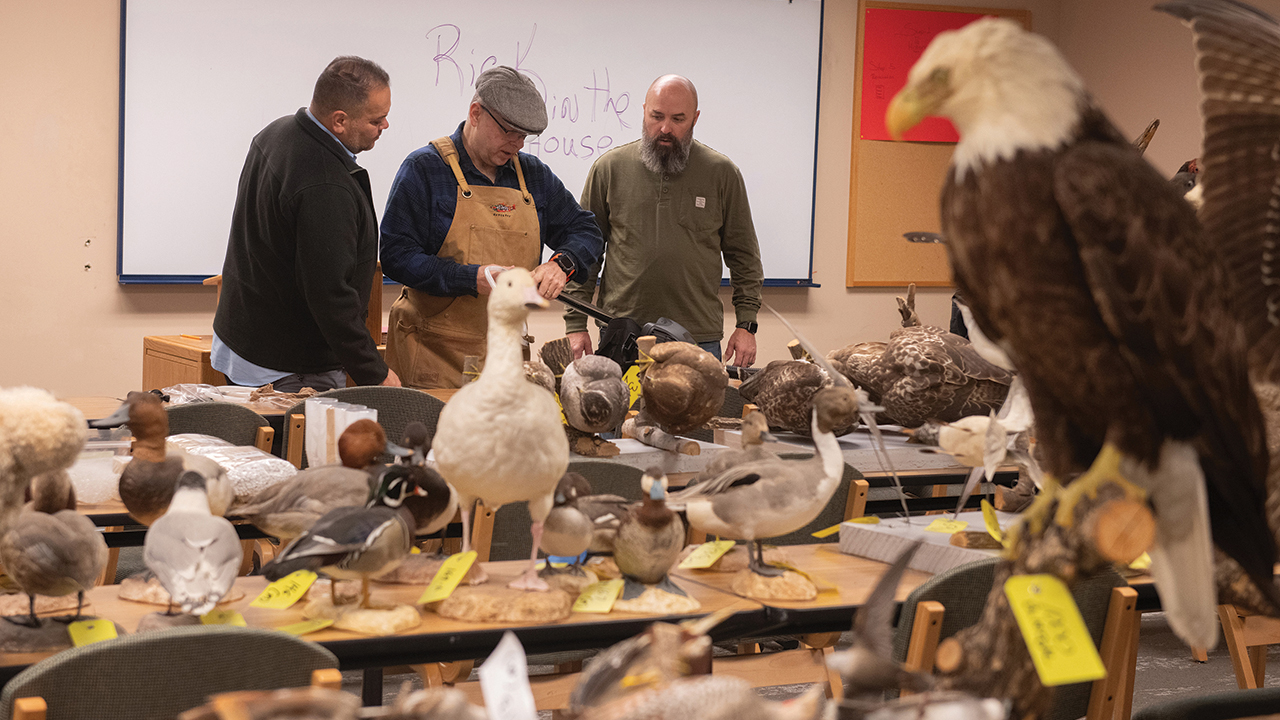
While the restoration of Hesston College’s J.D. Charles Hall of Science and Arts moved ahead after a May 9 fire, the fate of feathered friends in the building remained uncertain.
The specimens were part of an exhibit prepared from 1948 to 1956 by Richard H. Schmidt, a Mennonite taxidermist from Goessel, Kan., for the Maurice Yoder Memorial Museum in Charles Hall.
The collection was not exposed to the fire, but chemical smoke damage coupled with arsenic used in preservation 70 years ago resulted in 260 specimens with an unknown future.
After several failed attempts to connect with a taxidermist willing to take on a project of cleaning and restoring over 200 birds, the college was at a loss.
Numerous inquiries from community members as to the collection’s fate made its value apparent, but the college was running out of options.
Moving forward on a wing and a prayer, Ben Miller, director of campus facilities, connected with Wes Becker, president of the Kansas Association of Taxidermy and owner of M&W Taxidermy in Mount Hope, Kan.

After learning that renowned taxidermist Richard H. Schmidt had created the collection, Becker came to Hesston to see it for himself.
“I was pretty amazed with the variety of birds,” he said. “The quality of the work, even today, is as good as 90% out there. It’s top-quality work for sure.”
Becker secured additional support from another industry expert, Rick Krane, a museum conservation and wildlife art specialist from New Hampshire. By early December, they were working to restore every bird.
Krane called the collection irreplaceable.
“Older, cohesive avian collections that haven’t been broken up, damaged or lost to time are disappearing,” he said. “Maybe a couple dozen remain in any real continuity.”
Becker admired “the variety of birds — to be able to get to see birds that you can’t legally harvest, you can’t legally possess or anything. I think almost every single bird in there is federally protected. Even zoos don’t have most of these.”
Krane said the collection’s significance is threefold: Historically, it provides a snapshot of an academic era; scientifically, it preserves forms and morphology; artistically, it represents
a rare school of craftsmanship.
“Preparators like Schmidt built the foundation for how America learned its wildlife,” Krane said. “You can see that heritage in the Hesston pieces. . . . “This isn’t just a group of birds. It’s an intact chapter of natural history, and sadly there are very few chapters like this left.”
Over the years, the collection has remained a constant in Charles Hall.
“It is a resource that very few colleges have,” said Lorna Harder, an emerita faculty member. “It’s accessible to a large number of people on a regular basis. I think accessibility is huge.”
Schmidt’s family was grateful for the turn of events.
“The descendants of Richard H. Schmidt are very pleased that Hesston College is able to restore his taxidermy mounts,” said Paul Schrag of Newton, Kan., one of Schmidt’s grandsons. “He made these more than 70 years ago, so it’s wonderful to know they will be in good shape for years to come.”
After cleaning, the collection will be stored while the restoration of Charles Hall continues. It won’t remain caged up for long, though.
“The college is committed to getting the collection back on display,” President Mark Landes said. “We also hope to create an enhanced exhibit space that students and the community can enjoy.”


Have a comment on this story? Write to the editors. Include your full name, city and state. Selected comments will be edited for publication in print or online.