


A theology of political activism must be a theology of hope: hope in a God who saves people from bondage, a God who challenges those who hoard wealth and power, a God of resurrection in the face of defeat.
Mennonite Action is one recent demonstration of hope-filled political engagement that flows out of the ancient liberation movement known as the kingdom of God.
My church and others who have participated in Mennonite Action’s campaigns do so because we believe that God takes a side in human history. God’s preferential option for the poor, the prisoner, the outsider and the excluded is made manifest in the life of Jesus, who brought good news to the poor and release for captives.
Jesus learned a theology of hope and action from oneness with his Abba, his divine Father. But he learned from his Imma — his peasant mother, Mary — too.
I imagine it was she who immersed him in stories from the Hebrew scriptures of his ancestors, going back to Sarah and Abraham. No doubt she told him bedtime stories of the Exodus and his people’s escape from slavery under Pharaoh, all the while longing for freedom from Roman occupation.
Perhaps she sang her joyful manifesto, the Magnificat, over him as a lullaby.

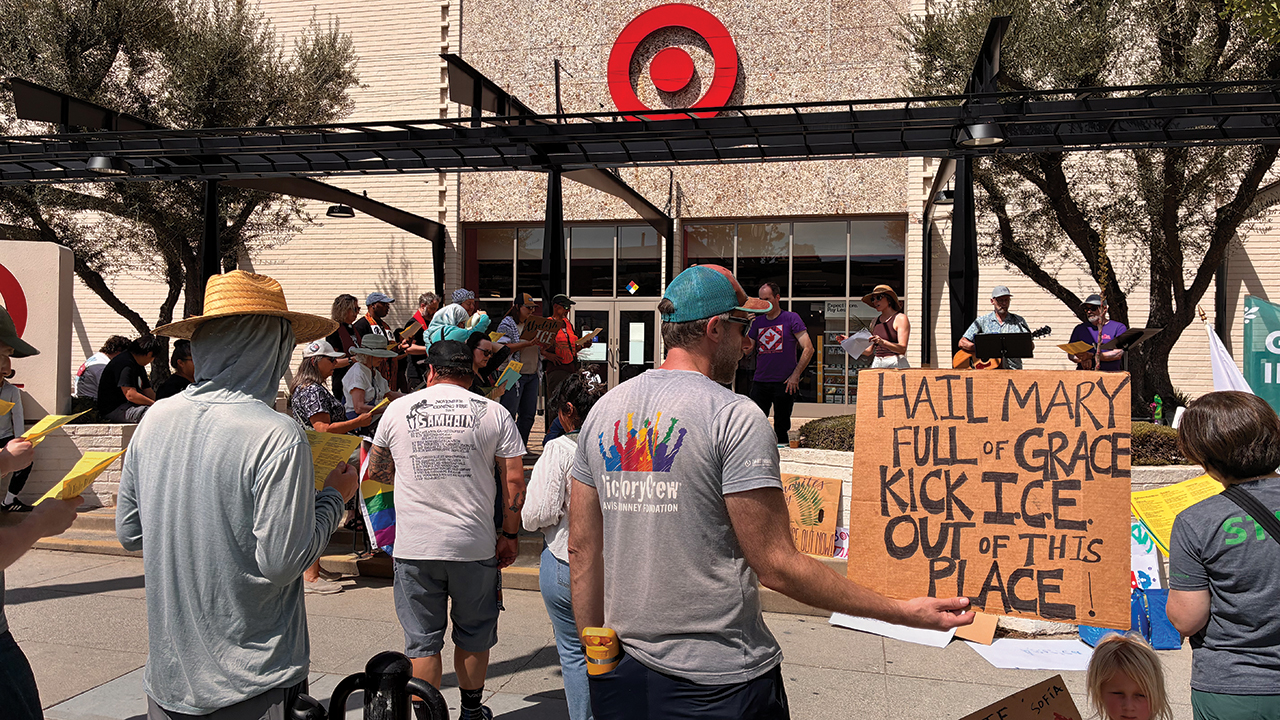
More recently, an adaptation of Mary’s song has been sung at Mennonite Action events protesting the rise of authoritarianism in the United States and Israel. I was moved to tears after I heard “My Soul Cries Out” (Voices Together, No. 412) sung in the Cannon House Building Rotunda during the Jan. 16, 2024, Day of Action in Washington when 130 Mennonites were arrested in a nonviolent sit-in calling for a ceasefire in Gaza.
I read Mary’s words as a synthesis of a biblical theology of hope and political action, rooted in a persevering memory of God’s faithfulness. Mary’s phrase, “He has shown strength with his arm,” calls to mind the refrain throughout the Hebrew scriptures that reminds the Israelites of the Exodus story: God delivered them from enslavement “with a mighty hand and an outstretched arm” (Deuteronomy 26:8, Psalm 136:12, Jeremiah 32:21).
Mary connects past, present and future when she draws on the deep memory of God’s deliverance and God’s covenant with her ancestors. Her hope is in her ancestors’ God, who is also alive and active in the here and now, not just floating on a cloud outside of history. This God is bringing about social, political and economic change in partnership with her and others who gather around the Messiah.
Mary expresses her low social status yet does not seem to feel powerless. She exults in the power of the Mighty One, who has “brought down the powerful from their thrones and lifted up the lowly.” Her lyrics proclaim a reversal of the structures of power. The proud, rich and powerful are no longer on top.
And Mary is a crucial part of that change as one who says “yes!” to God’s action. She consents to birth and nurture God incarnate. She is no meek mother-to-be but a young woman with revolutionary thoughts and faith in God’s justice who has already fed the hungry and sent the rich away empty.
I’ve been a member of Mennonite Action’s Pastoral Team for over two years, and I see a spiritual kinship with Mary in Mennonite Action’s movement.
In the face of rising authoritarianism — evidenced in the weakening of democracy, the repression of critics and dissidents, the scapegoating of vulnerable communities — it can be tempting to allow fear or a sense of being overwhelmed to paralyze us. It can be tempting to accept this reality as the new normal.
Yet Mennonite Action has drawn on the deep, hopeful memory of our faith to proclaim that God’s love knows no borders, that Jesus was a refugee and that all God’s children should be free.
Mennonite Action draws strength from stories of our Anabaptist faith ancestors, who had the courage to break from state religion to follow the teachings of Jesus, even in the face of persecution. Memory of God’s presence with our spiritual ancestors gives us hope to face the genocide in Gaza, the onslaught of ICE raids, the deportations of immigrants and the ways borders are being militarized.
We proclaim, with Mary, that despite the power of the current regime, God has cast down the powerful from their thrones in the past, and God will lift up the lowly again!
It is the lowly and meek, the ones who don’t consider themselves professional activists, who make Mennonite Action so powerful. I witness everyday folks — grandparents, teachers, musicians, nurses, college students and so many others — who have said “yes!” like Mary to the movement of the Spirit. Our collective “yes” is a crack in the imperial projects of death and despair that are getting millions in investments right now.
By taking nonviolent action together, we are practicing resurrection and making Jesus known through his reign of love among us. We are generating hope and magnifying the Lord through our bodies.
With every public action, we make visible God’s love and mercy for the most vulnerable. We make visible the truth that God will hold accountable those who oppress others. Like Mary, trust in the power of the living God at work in us.
Sometimes, when i close my eyes and quiet my mind to pray, I hear a song, sung high and clear above the strains of time. I hear Mary and the saints rejoicing because the promises they heard from God have come to pass, are now being fulfilled and will come to pass.
If you listen closely, you may hear, “My heart shall sing of the day you bring, let the fires of your justice burn! Wipe away all tears, for the dawn draws near, and the world is about to turn” (Voices Together, No. 412). If you listen closely, you may hear the angel speaking to this generation, as to Mary, “Do not be afraid.”
Will you join the song?
Katerina Gea is the pastor of Pasadena Mennonite Church in California. She serves on the Pastoral Committee of Mennonite Action, the Women in Leadership team of Mennonite Church USA and as a member of the Peace Commission of Mennonite World Conference.


Have a comment on this story? Write to the editors. Include your full name, city and state. Selected comments will be edited for publication in print or online.