


PORT-AU-PRINCE, Haiti — Overflowing with rain from Hurricane Matthew, the rushing water of the River Gris washed away Sarditren Dete’s and Antovan Enit’s houses and possessions, destroying their livelihoods.

“Yesterday we lost everything: our chickens, our pig and our garden,” Dete said. “This is how I eat, this is how I feed my children, this is how I keep them safe at night.”
Mennonite Central Committee representatives Paul and Rebecca Shetler Fast of Pittsburgh listened to their stories on Oct. 5, the day the rain from the Category 4 hurricane stopped falling in Port-au-Prince.
The women were recipients of assistance by SAKALA, an MCC partner in Cité Soleil, one of the poorest parts of Haiti’s capital. MCC delivered relief kits full of hygiene supplies, blankets, water-purification tablets and food to families there.
The visit was just the beginning of MCC’s response to the damage caused by Hurricane Matthew in Haiti. Many emergency supplies were already in place, enabling MCC to respond quickly with its partner organizations.
Sitting right at sea level, this vulnerable neighborhood, where most people were already struggling to get by each day, suffered the effects of high winds, rain and a storm surge.

“We know that these first supplies are a stopgap and in no way address the long-term challenges that this community and others in Haiti are facing right now,” Rebecca Shetler Fast said. “But it is important to us to be present in these communities right away, to bear witness to the effects of the hurricane and to provide what immediate assistance we can.”
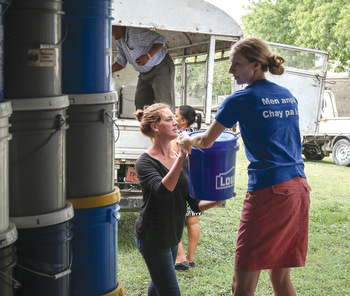
Other MCC emergency distributions in Port-au-Prince took place Oct. 6. On Oct. 7 MCC partners, staff and local government officials planned to carry blankets and relief kits to 220 families living in remote areas of the mountains of the Artibonite Department two and a half hours northwest of the capital. An MCC disaster-assessment team also is at work in the Artibonite, where high winds, heavy rain and flooding damaged houses, killed livestock and destroyed crops.
The flooding raises concerns about increased incidents of cholera, a disease carried by contaminated water that typically peaks in the fall rainy season. It has already infected more than 800,000 people and killed an estimated 10,000 people since cholera came to Haiti in 2010.
MCC’s 20 years of reforestation work in the mountains around the town of Desarmes in the Artibonite may have saved lives, according to Monfleuri Previlman, a municipal leader for agroforestry coordination.
“Before this work, a hurricane this size would have resulted in large landslides and floods on the plain and many, many lives lost,” Previlman said. “This is the type of durable disaster prevention that really works; lives were saved because of it.”
MCC’s response in the Artibonite and Port-au-Prince will continue to unfold in the coming days and weeks as the impact of the storm becomes clearer. Haiti’s interior ministry announced on Oct. 7 that the death toll had reached 500 people.
While the longer-term response to Hurricane Matthew’s catastrophe is still developing, immediate help is appreciated by those whose lives have been turned upside down.
Paul Shetler Fast said he was struck by the importance of water purification tablets to Hudson Reny-Jean of Cité Soleil, where flooding contaminated well water.
“He held these 3-cent tablets in his hand and just kept repeating, ‘These are such a blessing; these are such a blessing for our community,’ ” he said.
Monetary donations to support MCC’s response in Haiti can be made at mcc.org/hurricane-matthew or by calling 888-563-4676. Checks can be mailed to MCC, 21 S. 12th St., PO Box 500, Akron, PA 17501.


Have a comment on this story? Write to the editors. Include your full name, city and state. Selected comments will be edited for publication in print or online.