


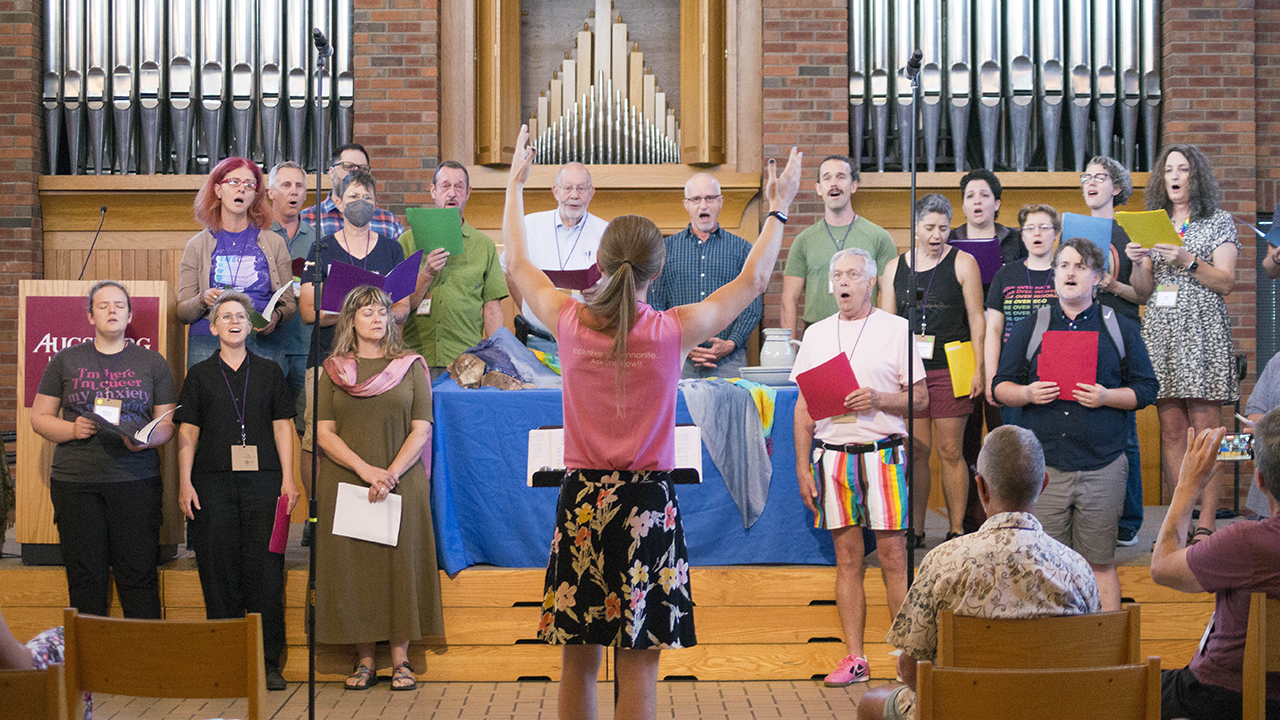
For 50 years, a stalwart band of Brethren and Mennonites chipped away at church walls that excluded LGBTQ+ people and built a robust community rooted in care, dignity and belonging.
While the struggle for equality is far from over, their persistence sparked such striking change that several people said “I can’t believe how far we’ve come” during the 50th anniversary celebration of the Brethren Mennonite Council for Lesbian, Gay, Bisexual and Transgender Interests, or BMC, May 29-31 in Minneapolis.
However, recognizing that progress is not inevitable, some also expressed concern about resurgent anti-queer bias.
Annabeth Roeschley, BMC executive director, summarized the progress, the backlash and the unfinished journey.
She described BMC as a “sanctuary of fierce and tender care in the wake of ecclesial violence” and a place of “healing from religious trauma.”
And yet, she said, “We are in a different era now, and the floodwaters of fascism, fear and repression are rising again. . . . We have not fully dismantled the walls of injustice, but the walls are indeed crumbling.”

With joy, revelry and a few tears, about 130 people, most from the LGBTQ+ community, gathered to reflect on a 50-year journey out of persecution and isolation — a path marked by struggles with the institutional church and by efforts to integrate their sexuality with their faith.
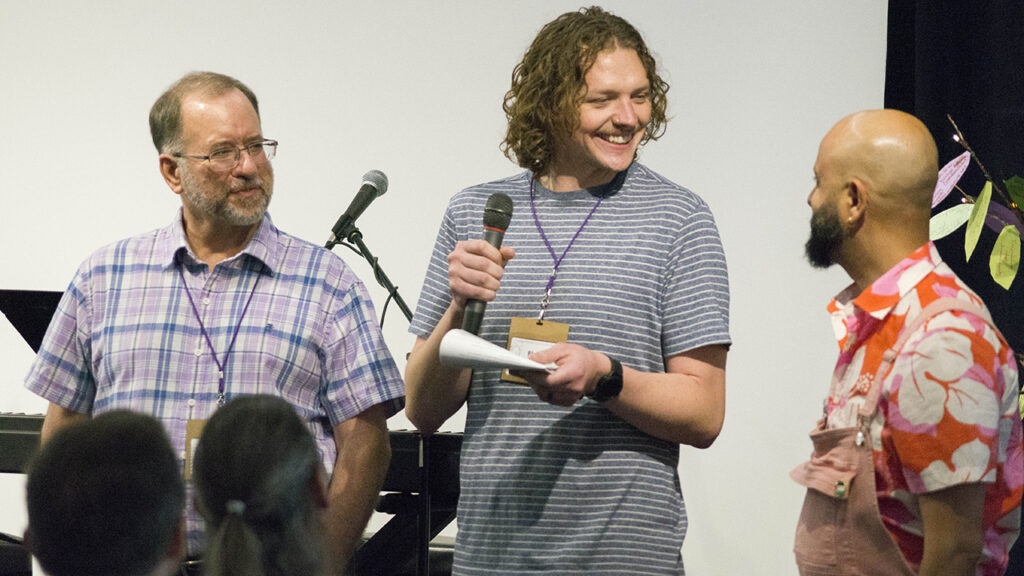
Sometimes that integration was possible only in other denominations that offered a haven from the rejection experienced in Mennonite and Brethren churches — Anabaptist faith traditions to which many still feel a conflicted loyalty.
Philip R. Wenger of Lancaster, Pa., who got involved with BMC in 1978, said the event’s joyous spirit warmed his heart. He recalled that 40 years ago, when BMC began holding national gatherings, cameras were kept away because some participants hadn’t revealed their sexual or gender identity to their families or churches.
The secrecy that was necessary in those early days — when people who weren’t “out” would have put their jobs, reputations and church membership at risk if their attendance was known — has “evolved into an open celebration, embracing the diversity of gender identity and equality for all who yearn for fellowship with a church they love,” Wenger said. “We have come so far in one generation.”
Evidence of change includes the ministries of about 20 licensed and active openly LGBTQ+ pastors in Mennonite Church USA, six to 10 in Mennonite Church Canada and seven to nine in the Church of the Brethren, according to estimates by BMC leadership.
Most Mennonites involved in BMC are current or former members of MC USA or MC Canada, the two most progressive Mennonite branches, born from a 2002 merger of the Mennonite Church and General Conference Mennonite Church.
Amy Short, BMC’s executive director from 2000 to 2003, said the merger “resulted in some incredibly painful ripples.” Congregations that affirmed LGBTQ+ people “were disciplined or kicked out of their conferences, and pastors had their credentials reviewed and revoked for participating in same-sex blessings or being affiliated with welcoming congregations,” she said.
Similar actions happened before the merger as well and among the Brethren.
“The Church of the Brethren acted out in its own ways,” Short said, “by raising and shattering the hopes of LGBT individuals and by dangling ordination as a carrot and then yanking it away. . . . When the denominations couldn’t figure out what to do with us, we found community in one another.”
The LGBTQ-affirming Anabaptist community has been growing for decades. Today, 153 groups have signaled their welcome by joining BMC’s Supportive Communities Network. Most are congregations, along with several organizations, universities and a camp.
At the denominational level, MC USA has taken the most LGBTQ-friendly stance. In 2022, delegates passed a Resolution for Repentance and Transformation and repealed the Membership Guidelines, a document that banned pastors from officiating same-sex unions. (Marriage equality became law in Canada in 2005 and the U.S. in 2015.)
The resolution established several LGBTQ-affirming policies, including LGBTQ+ representation on MC USA’s Constituency Leaders Council, a national gathering of church leaders. It confessed that church policies had done “violence to LGBTQIA people by failing to affirm their full, God-given identities and restricting their full participation.”
In tension with the emergence of inclusive policies and practices, the 31-year-old Confession of Faith jointly held by MC USA and MC Canada affirms only traditional marriage. Mennonite and Brethren statements from the 1980s condemn same-gender sexual behavior.
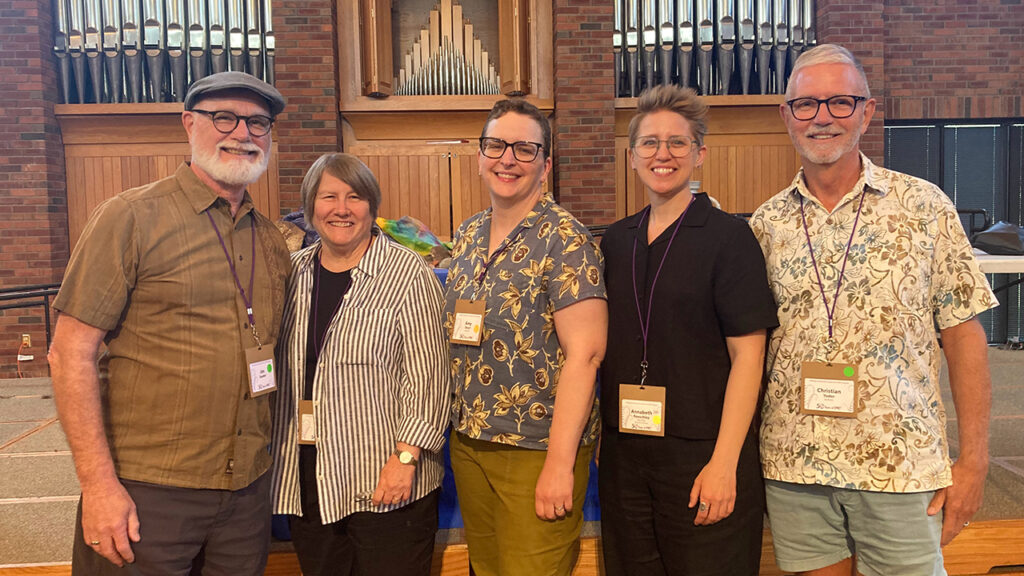
During the celebration weekend, five of BMC’s six former coordinators and executive directors (founding coordinator Martin Rock was unable to attend due to ill health) reflected on their years of leadership.
Christian Yoder and Jim Sauder served in the 1980s and ’90s. Sauder noted that during his tenure, BMC used the phrases “dancing at the wall” and “graced safe spaces” to describe its efforts to build a network of empowered people.
“We were not banging our heads against the wall, begging for acceptance, as some saw us, but we were dancing and creating our own new community and inviting others to join us in the dance,” Sauder said. “Together we created the graced safe spaces that allowed us to live out our shared Anabaptist values of peace and social justice.”
Petitioning denominational leaders for inclusion at church conventions was a long-term battle. Carol Wise, executive director from 2003 through 2021, recalled that after yet another rejection for exhibit space from the Church of the Brethren, BMC devised a dramatic demonstration at the 2005 annual conference.
Toting lumber, hammers and nails, BMC supporters, including queer people and their parents, formed a procession into the convention center and proceeded to build “a crude but very functional” communion table.
The pounding of nails echoed like gunshots in the cavernous hall.
“As people pounded out their holy anger, frustration, determination, strength and love, it sounded quite literally like shots being fired across the bow, which it was,” Wise said.
Several hundred people were fed at the table, she said, symbolizing a joyful vision of inclusion.
“After decades of difficult work,” Wise said, “power dynamics were slowly beginning to shift.”
As the movement grew, “more cracks appeared in the walls” as the Pink Menno group, Inclusive Mennonite Pastors, Supportive Communities Network and others “stepped forward in ways beautiful, profound and often surprising,” Wise said.
Cracking the walls of exclusion fissures in denominational unity. Since the 1990s, both the Church of the Brethren and MC USA have shrunk and splintered, partly due to conflict over differing views of sexuality and scripture.
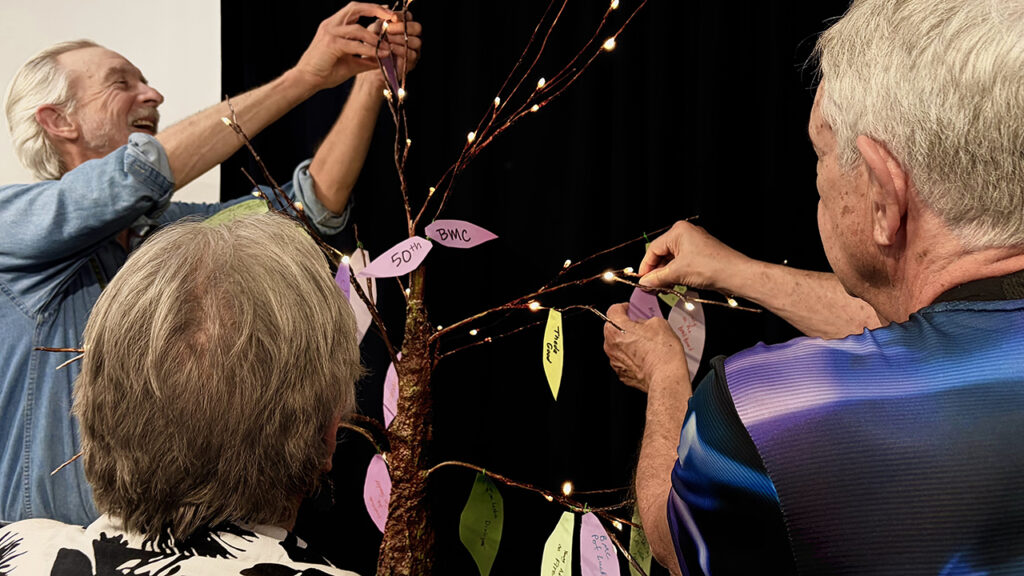
At the celebration, Liz Ullery Swenson, pastor of a Church of the Brethren church plant, WildWood Gathering in Olympia, Wash., reflected on parallels and contrasts between the Brethren and Mennonite denominations.
“It seems that the Mennonites are slightly ahead on the work of inclusion, and the Brethren have farther to go,” Swenson said. “Hearing Mennonites talk about their experience is very different from mine as a queer person in the Church of the Brethren. . . .
“The Brethren are much more rooted in sticking together and unity, while Mennonites have been more willing to break. The loss in not being willing to separate is that no one is able to live into their spirituality in its fullness, and that hits hard on LGBTQ individuals, as we are asked to assimilate to make others feel more comfortable.”
Irvin Heishman, pastor of West Charleston Church of the Brethren in Tipp City, Ohio, has seen both the losses and gains of LGBTQ+ inclusion. He came out as gay while pastoring his congregation.
“We lost some members when we became open and affirming,” he said, “but we are really thriving, and there’s a deep, spiritual genuineness and love for each other.”
On the denominational scene, he said, “one of the things that breaks my heart is the number of talented, dedicated people who have dropped out of church life because of being rejected — pastoral talent, musical talent — gifted, creative people with deep faith who were not welcomed.”
Two MC USA conferences have repented of actions that drove gay pastors away. A workshop during the celebration featured the stories of John Linscheid and Keith Schrag, who received apologies from the conferences that removed their ministry credentials in the 1980s, along with reinstatement of their credentials (Western District for Linscheid in 2025 and Central District for Schrag in 2023).
A third story in the workshop — titled “Journeys of Repair,” moderated by former BMC board chair Xaris A. Martínez — told of BMC’s engagement in a process of repair and truth-telling with Camp Friedenswald, which had banned BMC’s Queer Camp after hosting it from 1999 to 2005.
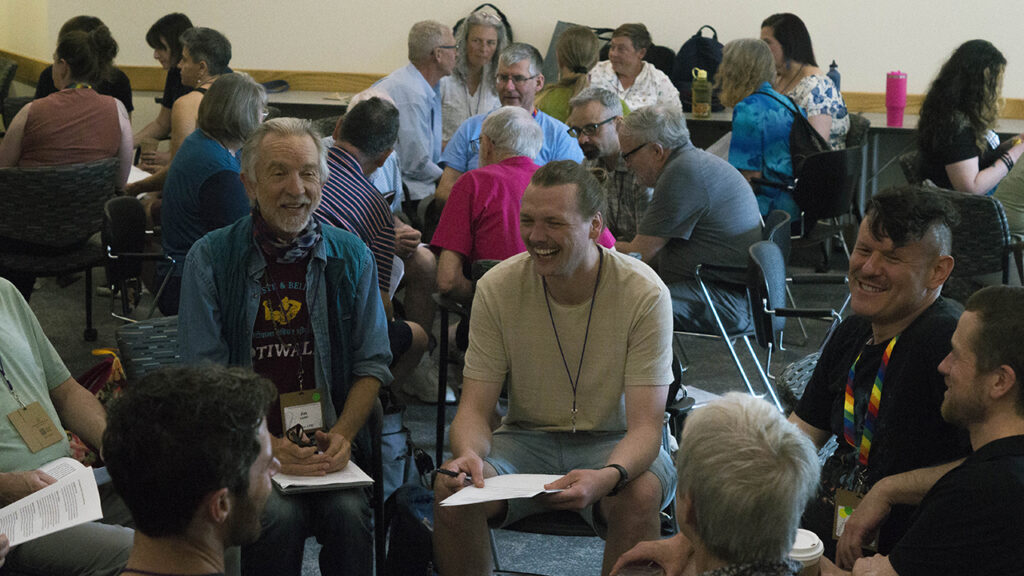
Among other workshops, Jonny Rashid, pastor of West Philadelphia Mennonite Fellowship, led a discussion on queer theology, which includes an awareness of intersectionality, or how different kinds of systemic inequalities interact.
“I want to join people fighting for liberation everywhere,” Rashid said.
In that vein, Josih Hostetler, former BMC treasurer, led “Solidarity Together: Supporting Immigrants in the LGBTQ+ Community.”
The weekend theme was “Rooting Our Stories: Reveling in 50 Years of Queer and Trans Anabaptist Resilience.” Events were held at the Elmer L. Andersen Library on the University of Minnesota campus and at nearby Augsburg University.
The Andersen Library houses the Tretter Collection in GLBT Studies, which includes the BMC archive as part of its holdings on LGBTQ+ history. The Tretter Collection, under the guidance of curator Aiden Bettine, co-hosted the anniversary celebration to introduce participants to BMC’s archive. This included the curation of exhibits highlighting BMC’s archival material and guided tours of the vast underground caverns that preserve a wide variety of archives.
The closing session on Sunday morning began with a “Queer Love Feast” brunch. Love feasts are a Brethren tradition commemorating Jesus’ Last Supper with his disciples.
Participants shared reflections on the weekend, including:
“My younger self would never have believed I could be here.”
BMC’s support “helps us go into non-affirming spaces with courage.”
“The world is incredibly hostile right now, and we are creating a different space.”
“I feel like I’m home again.”
“I’m so grateful for this island of mercy.”



Have a comment on this story? Write to the editors. Include your full name, city and state. Selected comments will be edited for publication in print or online.