


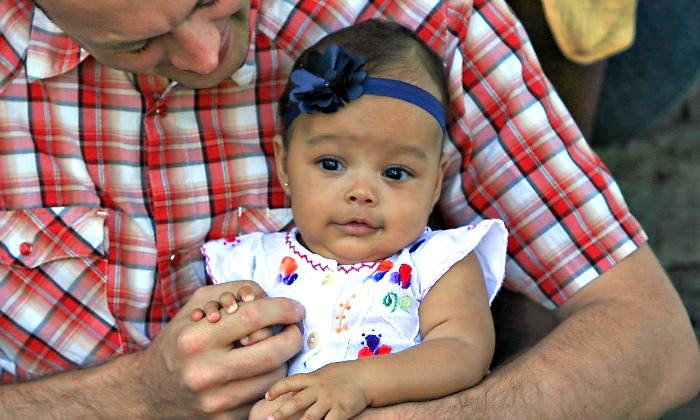
Kurt Hildebrand, an international worker in Haiti with Mennonite Central Committee, explains five years of earthquake recovery to his Haitian-American daughter, Akila (photo). In simple terms, he describes the tides of hope and frustration that have marked his own and Haitians’ experience with the national and international response to the devastating disaster.
To my daughter,
Most new parents worry about the state of the world they have brought their child into. Your mom and I are no different. You’re not even a year old, but here’s what I’d tell you right now, if you could understand me.
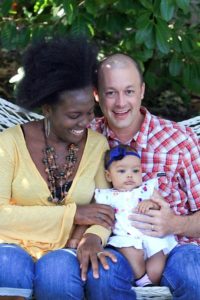
Your mother is Haitian. You were born in Haiti, a beautiful country with an incredible history. I am from the United States, also beautiful, but much bigger, richer and more powerful than Haiti.
These two countries have a long, conflicted relationship. Eight years ago I left my home country to live in Haiti, and I fell in love with it, just as I fell in love with your mother.
Five years ago, an earthquake caused massive damage to the city where we lived, Port-au-Prince. Those of us who lived through it will always remember the running, screaming, digging through rubble for survivors and wondering if the world had ended.
That day many of the concrete walls that separated private homes from the public crumbled, and the ones that didn’t crumble didn’t matter anymore because everyone took their bed sheets out to sleep in the middle of the street. They didn’t want the concrete structures to fall on them during the aftershocks.

Before the earthquake, Haitians were divided by all kinds of barriers—class, religion and race. But that night and for weeks afterwards, everyone, even us foreigners, slept under the stars together.
Even the world, led by the United States, seemed to come together to help Haiti. Haitians were used to feeling despised, pitied and isolated by the rest of the world, but people from all over the world gave money to charities, and many governments committed billions of dollars to Haiti after the Jan. 12, 2010 earthquake.
We were hopeful, along with many Haitians and other nongovernmental groups, that the earthquake was the wake-up call that Haiti needed. We thought that people wouldn’t just rebuild houses; we would witness the rebirth of Haitian society.
No more corrupt, unresponsive government that allowed haphazard building. No more monopolies and controlling business networks that overprice building supplies and basic necessities. No more letting foreign powers dictate Haiti’s development policy for their profit, causing Haitians to abandon farmland for slums in the capital.
Excitement around these ideas grew, even though 1.5 million people were living in tents. Most of the schools and government buildings were gone, and yet we thought that this was Haiti’s moment to shine.
But the weeks wore on. Heavy rains came in spring, and many tent camps flooded. In spite of the billions pledged, nothing much happened that we could see.
In the tent camps, parents weren’t able to supervise their kids the same way they did when they lived in their own apartments. Lots of teenage girls got pregnant. You are so precious to me, and it breaks my heart to think of the thousands of babies just like you spending their first months and years in a tent.
Then cholera broke out, and the commission to manage the recovery was mismanaged. All this before the first anniversary of the earthquake.
Mennonite Central Committee (MCC), the organization that I work with, did as much as it could with money people donated. Haitian staff brought food, blankets, water filters and other supplies to people without homes. Volunteer engineers came to evaluate schools, churches and houses and tell people if these buildings were safe to enter.
Mostly MCC used its donations to support Haitian organizations as they did the important work of relief and recovery during the last five years—building and repairing buildings and teaching masons how to build safely, teaching vocational and agricultural skills, training people how to deal with trauma, strengthening rural towns so that people could live well outside of overcrowded Port-au-Prince. MCC’s partners are close to the people they work with, and they know their needs better than we do.
They did great work at the community level, as did many other organizations, but it was a small part of a big, overwhelming picture.
Your mother and I believe that small is beautiful—just look at you!
Still, some problems require big solutions, government solutions. So far we’ve been discouraged by the Haitian and U.S. governments.
The money promised to Haiti could have built new homes with access to electricity, water and sanitation for every displaced family. Instead, the government chose cosmetic fixes to try to encourage private investment and tourism.
Little by little, rubble was cleaned up and big tents camps relocated, but most of those people ended up in slums. It may always be a mystery what happened to all those billions of aid dollars.
MCC and our Haitian partners haven’t given up on big-picture changes. They were just in Washington, D.C. in November, urging the U.S. and Haitian governments to be more transparent about how the aid money was spent and to address the ongoing housing crisis, including 85,000 people still living in tents.
One of the biggest differences between Haiti and the U.S. is that in the U.S., almost everything looks finished. In Haiti, almost nothing looks finished. The roads, houses and markets all seem to be in a state of construction or decay or both.
But when I look at you, I’m reminded that something unfinished can be something beautiful. Something full of potential.
Kurt Hildebrand and Wilda Mondestin are representatives for Mennonite Central Committee in Haiti. MCC is a faith-based, nongovernmental organization that works in more than 60 countries responding to disasters, encouraging sustainable development and strengthening local peace and justice initiatives. For more information, see stories at mcc.org/haitiearthquake and https://www.haitihousingdc.org/


Have a comment on this story? Write to the editors. Include your full name, city and state. Selected comments will be edited for publication in print or online.