


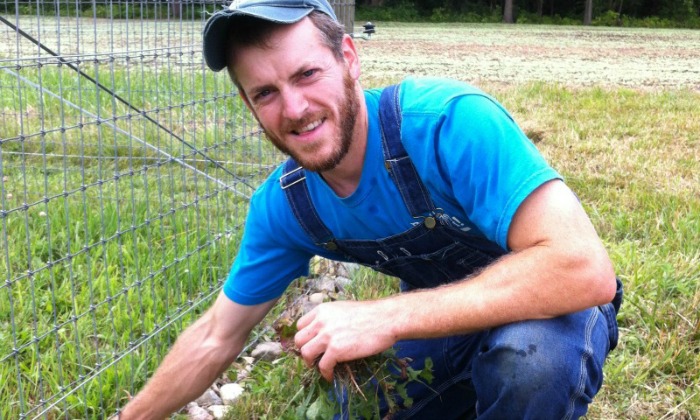
Jon Zirkle weeds outside in the Goshen, Ind., area. Photo provided.
After a long day of feeding the chickens, mixing soil, and monitoring produce, Jon Zirkle can finally sit down and enjoy a well-made meal of produce grown on his own farm.
Zirkle is a young farmer living in Goshen, Ind., and the farm manager at Merry Lea Environmental Learning Center of Goshen College.
He oversees all aspects of the Merry Lea Sustainable Farm including planting crops, harvesting and marketing. He also assists with agricultural research and contributes to the Agroecology Summer Intensive program.
Zirkle lived for two and a half years in Vermont, and after college, moved to Chicago. The jobs he found there were all environmentally-related, though the urban professional setting kept him disconnected from being out of doors very much.
One summer, Zirkle taught in the Chicago Botanic Garden’s Primera La Ciencia program in his neighborhood, helping middle-schoolers develop a garden.

Zirkle recalls his determination to create a garden in the vacant lot next to his apartment building. He struggled to make the soil productive and felt too stubborn to give up.
“I felt dead,” he recollects about a later job he took, also an environmental job, which had Zirkle working on the 15th floor of a skyscraper, wearing a tie to work, and sitting in a cubicle without windows.
Zirkle heard about Goshen from his friends and the community seemed like a good fit for him. Zirkle first heard about Mennonites in Belize while studying abroad, but didn’t really learn about Mennonites until meeting a number of them through Mennonite Voluntary Service (MVS) while living in Chicago (the Pilsen neighborhood) back in 2006.
He came to Goshen to reconnect with Mennonite faith community and to be closer to old friends and family he had been away from for several years while in Vermont.
His plan was to begin farming in some capacity with friends, even though the original plan involved his former wife. She and Zirkle divorced while in Vermont. Goshen was a place he thought he could find healing, and start over.
A family of farmers and an interest in the outdoors when he was young led Zirkle to taking a class on sustainable agriculture with Au Sable Institute, a Christian environmental field school that offers courses in various biology topics, which helped him see that his passion for environmental stewardship, food/eating/cooking, and being out in the soil growing plants all connected to farming.
After getting a masters degree in plant and soil science and some experience in the field, Zirkle knew he needed to go back to the Midwest to pursue the next stage of life and consider farming.
New England had already achieved a healthy food system and a culture of sustainable agriculture. He wanted to be part of developing such a movement in the Midwest.
Zirkle had been attending church at Assembly Mennonite, Goshen, and was making connections and meeting people in Goshen.
He started attending Assembly Mennonite in March 2012 as soon as he moved back to the area. Heidi Siemens-Rhodes was one of the pastors and dying at that time. It was a very powerful time to step into that community.
Soon, Zirkle was informed of an opening for a farm manager at Merry Lea Environmental Center. He was hired, and started in May 2013, working closely with agroecology professor Dale Hess and David Stoesz who was interning.
“To me, the line between daily life and work is muddy,” he says. “It’s all a form of prayer.”
Becoming Mennonite has been helpful to him in seeing that lifestyle and day-to-day matters are quite central to following Christ. He is trying to be more intentional about daily spiritual practices—prayer, reading Scripture, stopping to appreciate the beauty of God’s creation, and eating thoughtfully.
“My Mennonite tradition—more than other denominations of which I’ve been part—reminds me that we are all called to be earth keepers, and agricultural work for me is a meaningful way to do so,” he says. “I also see suffering and peacemaking play out in my work in ways I find very rich.”
We are all called to be earth keepers.
Zirkle feels blessed to spend a lot of time outside. Not a day goes by when he is not struck by a gorgeous sunrise, fascinating insect, or the sacred sounds of birds.
He sings and hums a lot while working, and prays, talks to God, and processes questions and spiritual ideas while doing repetitive physical tasks like weeding, hoeing, and planting.
“On most days, I find myself in awe of how worms, chickens, cover crops, and fallen leaves enrich the soil and I think about themes from the Genesis stories of creation,” he says.
He thinks a lot about the interrelations of life and death he sees playing out on the farm, and likes to make note of analogies he sees between faith/sScripture and natural processes (competitiveness of weeds, consequences of overharvesting, etc).
A source of joy in his job is when he gets to lead devotions or evening vespers for students who are living at Merry Lea.
A current aspect of daily life and work Zirkle is working to address is honoring some sort of Sabbath. Rest is important in agriculture and “seems rather central to the Creator’s intention for the earth and for its creatures to be healthy and humble,” he says.
Aside from worship on Sunday mornings, Zirkle often goes on walks or runs on Sunday afternoons, reads or journals, and tries to eat a meal with friends or people from church. He tries not to dwell on work matters too much and tries not to do too much in the garden beds he has in Goshen. It’s an on-going struggle to keep the day different, though one he is trying to honor more.
Another aspect he also wants to know more about is fasting as a spiritual practice. Working in small-scale agriculture, Zirkle is constantly working with food ingredients, and finds that it is easy to think too much about food and forget how indulgent this can be.
Fasting is not something Zirkle does regularly, but something he wants to learn more about and try on a semi-regular basis. He sees a connection between fasting and spiritual contemplation, self-discipline, re-focus and an opportunity for prayer.
He spends far too much time dwelling on food sometimes, and that focus and time could be spent elsewhere by some intentional short-term fasting, he says. Zirkle hopes it can be part of his Lenten tradition this year, in particular.
Even when it’s cold, Zirkle has to get outside at least part of the day.
“Nothing beats the blues like bright winter sun when there is snow on the ground,” he says.
In farming, there are still outdoor projects in cold weather—snow to clear, winter tree pruning, composting, etc. And there are tasks in the greenhouse, which although unheated, gets him outside.
At the same time, cold weather allows Zirkle to get done the important indoor tasks: planning, cleaning the office desk, assessing sales records, taxes, much-needed reading, writing, website work, crafting farm internship job descriptions, field and seed planning. (Seeds have to be ordered in winter, otherwise companies can run out by spring.) He also attends and speaks at farm conferences, which are all in December, January, February, and early March.
Winter is certainly different due to the cold, but it’s actually quite busy, he says.
 Sara Albaba is a senior at Goshen College and a Spring 2015 intern for The Mennonite. She is an English writing major and is from Elkhart, Ind.


Have a comment on this story? Write to the editors. Include your full name, city and state. Selected comments will be edited for publication in print or online.