


As a junior high student, Iris de León-Hartshorn met with her school counselor to decide what classes to take in high school.
A good student throughout elementary and junior high school, she planned on signing up for college prep courses.
The counselor looked at Iris’ proposed schedule and said, “Oh, you know Mexicans don’t go to college.”
The counselor encouraged her to look into something vocational, perhaps studying cosmetology.
“I walked out of there sobbing,” she says.

“I wanted to be an astronaut, not a hairdresser. That counselor could have ruined my life.”
Fortunately, Iris had another teacher that was also a good mentor. When she told him what happened with the counselor, he was furious and vouched for her.
Later, as a senior, she aced those college prep courses and was offered a college scholarship and two merit scholarships.
She went on to receive her master of arts in conflict transformation and peacebuilding through Eastern Mennonite University, Harrisonburg, Va.

Iris has held various top leadership roles in Mennonite Central Committee (MCC), Mennonite Church USA and Pacific Northwest Conference and currently serves as director of transformative peacemaking for Mennonite Church USA. She lives in Portland, Ore.
In April, she received the Race, Church and Change award from Luther Seminary, St. Paul, Minn.
In addition to these numerous notable accomplishments, Iris is known in many circles for her strong and dedicated leadership in racial and gender justice in the church and related institutions.
Pacifism and music
Iris was born in 1951 in Laredo, Texas—the oldest of four daughters. A few years later, her family moved to California.
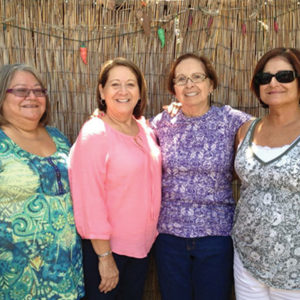
Her mother was a concert pianist and exposed her to classical music early on. “Some people are surprised to hear that because I’m Hispanic,” she says.
“I can’t remember not having music in our house,” she says. “I remember dancing around like ballerinas with my sisters.”
Iris played the clarinet and flute, and the same teacher that stood up for her in junior high taught her ballads on the guitar.
Not surprisingly, music became a way for her to express her desire for peace and justice. A little later in life, she began to examine the antiwar messages in the lyrics of Pete Seeger and Peter, Paul and Mary.
As a young adult in Colorado, she joined two other young musicians and played music in coffeehouses and pubs protesting the Vietnam War.
“At this time, I began to see myself as a pacifist,” she says.
Music also connected her to her husband, Leo, a drummer, although they like different styles.
“He grew up with country Western, which I hated, and he doesn’t really like classical music,” she says with a laugh.
Now she listens to a variety of music. Her favorite musician is Lila Downs, a Mexican-American singer-songwriter whose music touches on social issues such as indigenous people’s lives and immigration.
Click here to listen to Lila Downs on Spotify.
Finding real faith
At the same time, Iris discovered the power of music as a young teen, she started to question her Catholic faith and upbringing.
“I did everything I was supposed to do—Communion, confirmation, confession—but I just didn’t feel connected to God and the church,” she says.
At age 16, she scheduled a time to meet with a priest to share her questions with him.
When she knocked on the parish door, he greeted her with booze breath and slurred words.
“My father was an alcoholic, so I thought to myself, I have this at home. Why would I want it at church?” she says.
After that, she started reading the Bible on her own and found inspiration and newness in Scripture. However, she felt alone in her family with these thoughts.
“My grandmother was disappointed in me, and my sisters thought I was a fanatic,” she says.
But when one of her friends in high school introduced her to a Presbyterian church, she visited and soon got involved in the youth group. She joined that church and never looked back.
Later, as a 20-year-old, she joined a Southern Baptist church in California where her sister was a member because the Presbyterian church would not rebaptize her due to her infant baptism.
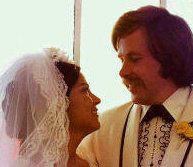
Iris also met Leo at that church. They married and began their life together in 1973.
In the mid-’70s, they became members at Delores Street Baptist Church in San Francisco, which was “a very transformative experience,” Iris says.
In the mid-’80s, they decided to leave the Southern Baptist Church and explore becoming part of the Mennonite church through the encouragement of James McClendon, an Anabaptist theologian.
Tragedy in Houston
Iris and Leo’s first Mennonite church experience was Houston Mennonite, where Leo was a pastor for 10 years. In Houston, Iris was also a busy woman.
Over those years, she was part of a peace and justice group at church, founded the Mid-Texas relief sale, joined the Western District Damascus Road Team, took courses at Austin Theological Seminary, did a two-year clinical pastoral education program, served on the MCC Central States board and worked for Northwest Hospice. In 1994, she was ordained by both Western District and South Central District.
Despite all these life-giving experiences, Iris and Leo also faced the most painful experience of their lives in Houston.
In 1990, a friend and church leader they knew for 17 years sexually abused their adopted daughter, Isabel.
(Iris and Leo have two other children, Andy, who is Isabel’s cousin, and Toni.)
Church members slowly and painfully worked through the tragedy and supported the de León-Hartshorns and the other family. Everyone honored the 10-year restraining order placed on the abuser.
However, this abuse to Isabel from a supposedly trusted man was too much to bear.
Born to a mother addicted to heroin, Isabel had lived in five different foster homes.

When Iris and Leo received a call that she was going to be institutionalized at age 6, they decided to adopt her. They later learned that she suffered from attachment disorder, which meant she couldn’t form healthy relationships.
“Sometimes a great sadness comes over me when I hear adoption stories that turn out wonderful,” Iris wrote for Timbrel. “Our family did not have such a story, and there were many times my heart ached so much I thought it would break.”
Isabel was a victim one too many times and has not fully recovered from this abuse.
“If Isabel can ever turn herself around, we’ll always be here waiting for her, but it can’t be the focus of my life,” Iris says tearfully.
Despite the deep hurt, Iris and Leo are now experiencing the joys of being grandparents and parents.
Isabel’s son, Gavin, came to them at 14 months because Isabel was unable to cope. They had custody of Gavin by the time he was 3, and now he is 10 years old.
MCC learnings
After their time in Houston, the family moved to Lancaster, Pa., for Iris’ work as director of the Peace and Justice Program for Mennonite Central Committee U.S. in 1996.
“This was my first encounter with Mennonite culture in a strong way,” she says.
In the beginning of her tenure, MCC assigned another female director, Brenda Wagner, to Iris as a mentor. James Logan, who worked with MCC at that time, also mentored Iris. She says she appreciated both relationships.
“James taught me a lot of things that would have taken me a long time to figure out,” she says. “For example, how the written word is the most powerful tool in that organization.”
“I could say a lot of things, but if I wrote a memo, …” she says with a chuckle.
Prior to this role, she resented writing, but that position enabled her to hone her skills in concise and logical writing.
“It was tough in the beginning but ultimately a gift,” she says.
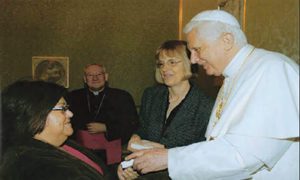
Also, when she first came to MCC, she noticed that the other staff spent most of their days in their cubicles focused on their work
“In my culture, we greet people when we’re walking by and throughout the day, but I could tell that at MCC, many saw this as an interruption,” she says.
Iris—not being one to avoid conflict—had a conversation with her staff about this dynamic, and they found a compromise.
“I encouraged teamwork and intersectionality of work, so that we weren’t working in silos,” she says. “But I also respected my staff’s strong work ethnic and greeted them less.”
These experiences at MCC informed her about the broader church.
“Ethnic Mennonite culture is task-oriented,” she says. “When we work with issues around racism and sexism, people often want a checklist.”
Unfortunately, it’s not that simple.
“It’s not possible with systemic issues,” she says. “This is a system that has to be transformed.”
Iris closed our interview with these words: “Being faithful is interpersonal work and accomplishing tasks. It’s not one or the other. There needs to be a balance.”
Click here for more photos of Iris.
 Anna Groff is executive director of The Mennonite, Inc. Photos provided by Iris.


Have a comment on this story? Write to the editors. Include your full name, city and state. Selected comments will be edited for publication in print or online.