


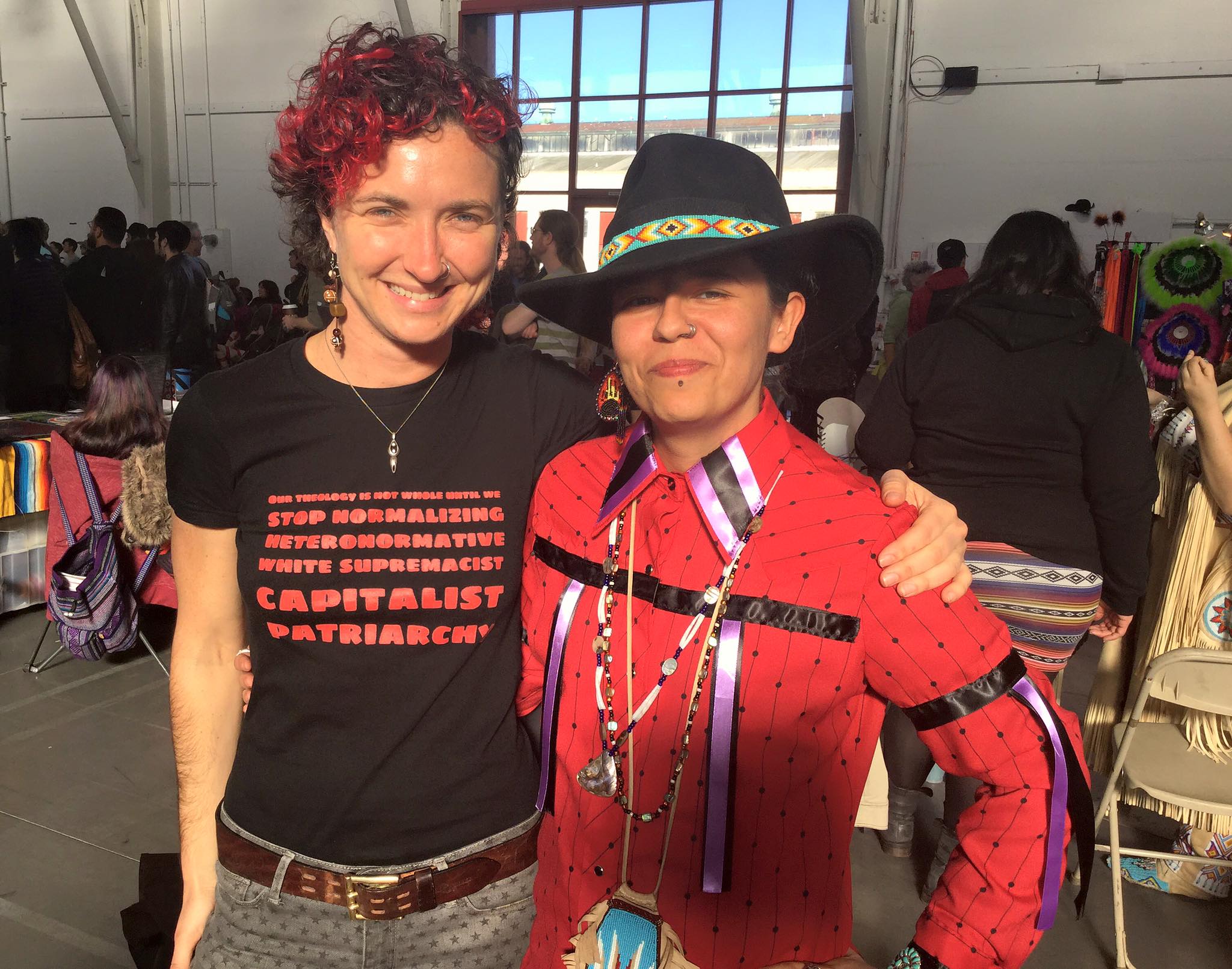
Joanna Shenk is Associate Pastor at First Mennonite Church of San Francisco. This piece was a sermon given on May 1, 2016.
Photo: Joanna and her friend, Zephyr.
The summer I was seven years old my family went on an epic, cross-country trip, from Ohio to California and back. I remember leaving straight from school on the last day and returning the night before the first day of classes in the fall. We drove in our eight-passenger van the whole way, staying at camp grounds and Mennonite-ing-our-way.
For those who don’t know what that means, there is a travel directory put together by Mennonites that lists places you can stay in this country and many others. It is a Mennonite couch-surfing network, of sorts. As far as my family was concerned, we camped in people’s backyards that summer.
Historically, Mennonites have been known for their hospitality, both to friends and to enemies. There are countless stories in Mennonite history where people have shared food or protection or a place to sleep with those in need.
Our congregation is no exception. Just a few weeks ago we collectively hosted 20 people from across the country who are connected with the Mennonite Voluntary Service (MVS) program. As I went about planning for this gathering, I knew it wouldn’t be a problem for our congregation to provide housing and food and a place to meet. It’s just what we do.
Traditionally when we think of hospitality, we think of two different roles: the host and the guest. The host gives and the guest receives. In our lived experienced though, the interaction is more complex. In opening themselves to guests, hosts also receive. They receive new relationships or new insights or other gifts that the guests offer. And when I think of times I’ve been a guest, it’s gratifying to me to also give—whether helping with household tasks or making a meal or giving my attention to things my host is passionate about.
From a theological perspective, hospitality is also more than sharing our homes with people; it’s also about how we welcome new people into our communities and how we enter into contexts where we are the outsiders.
Writing this sermon made me ponder when it is that I put myself in situations where I’m the outsider. It is a vulnerable position, and as a person who can move easily in the dominant culture, I am not usually forced to be an outsider. It’s a choice for me to engage in spaces where my experiences are not normative.
According to theologian Letty Russell in her book, Just Hospitality, “Hospitality is a two-way street of mutual ministry where we often exchange roles and learn the most from those whom we considered different or ‘other.’” But Russell is not content to just stop there. She goes on to question the idea of “the other” and how that can imply distance and separation. Instead, Russell talks about the community embracing difference as a gift while sharing in God’s welcome to all.
That’s all well and good one might say, but how do we actually do it? Turns out it can be tough to learn from each other across difference. To this point, Russell offers three guidelines:
- Pay attention to power.
- Give priority to the perspective of the outsider.
- Rejoice in God’s unfolding promise.
Paying attention to power means that we recognize that people have varied levels of power and access based on their social location. Is it possible for mutual learning to happen when one person (or group) dominates a situation because they assume they know what the other needs? I would say no.
In my own experience, paying attention to power can be as simple as the pace of my stride.
I was walking once with my friend Zephyr, who is indigenous. We were trying to figure out the directions to the place we were going for lunch. I was not paying attention to the fact that I was a few strides ahead of them. I was just going my normal pace. Then I heard Zephyr say, “This is one of the few times I feel comfortable walking behind a settler.” They didn’t say it in a chastising way and yet I realized I hadn’t thought about that at all.
Subconsciously, I felt entitled to lead since I was figuring out the directions and because Zephyr was walking slower than me, but that was perpetuating a power imbalance. From then on I’ve been attentive to slowing my pace and following their lead when we’re together, as well as noticing other instances in which I have a tendency to walk ahead of people rather than with them.
The second guideline from Russell is prioritizing the perspective of the outsider or the person perceived as guest. She writes, “When we begin from the outsider’s perspective, we develop the practice of listening to the pain of others and responding to their initiatives.” At the same time, she points out, this does not mean we can ever assume to understand their experience fully, especially if our social location grants us more power.
When I worked for Mennonite Church USA I thought about this a lot. Part of my job was visiting Christian communities where people often lived together in a household or a neighborhood, kind of like our MVS unit. Often these communities had designated community leaders or founders and they usually had a lot to say.
And at the same time, I usually found myself more interested in conversations with people on the margins of the community. I found that they had insightful perspectives and often talked about the struggles of community life in a way I did not hear from the leaders.
Lastly, Russell encourages us to rejoice in God’s unfolding promise, which is about our communities and ourselves being transformed. When we open ourselves to each other and to the Divine, we will be changed to more fully embody God’s kindom of love and justice.
With all of this in mind I want to turn to our scripture text for today, that focuses on a “worshiper of God” named Lydia.
Who is Lydia and what is going on here? The popular interpretation of Lydia is that she was a wealthy woman with status who supported the Jesus movement and provided space in her home for the congregation that began in Philippi due to Paul’s visit.
I decided it would be interesting to dig a little deeper and see if there might be more to her story, and I found just that in a book by Arthur Sutherland called, I Was a Stranger: A Christian Theology of Hospitality.
Turns out there’s just as much chance, if not more, that Lydia was a freed slave or immigrant, living outside the city gates of Philippi and making a subsistence income in the looked-down-upon trade of cloth dyeing. Granted, purple cloth was sought after by the wealthy, but the folks that made it were not highly regarded.
You see, it was not a pretty business to make purple cloth. First off, the dyeing required a lot of animal urine, so everything was quite stinky. Secondly, if the smell didn’t tip people off that you worked in the business, your discolored skin from the purple dye would. Hence the reason people in this trade lived outside the city gates.
The reason why some scholars believe that Lydia was an immigrant to Philippi and a freed slave is that her name is location specific. The region of Lydia was inland from Philippi and as Philippi became more of center of commerce, many poor people from the countryside migrated there for work. Had Lydia had status, she would have had a name related to her family lineage, rather than just being called a “woman from the region of Lydia.”
The other thing we know about Lydia is that she was a “worshipper of God.” That means she was a Gentile woman who was drawn to the Jewish faith and practiced it with other women in their prayer group by the river.
So, let’s think about Lydia and Paul’s interaction through Letty Russell’s insights on hospitality. Paul is an outsider; someone who’s new to Philippi. From the text we know that he doesn’t have any connections there yet, otherwise he and his companions wouldn’t have spent a few days bumming around the city before they found the prayer group by the river.
Lydia is also an outsider in her context, living outside the city walls as an immigrant laborer. When they meet, Paul and his companions have power in their roles as itinerant preachers and men, and Lydia’s prayer group has the power to invite the men into their space.
Paul is a host as he welcomes Lydia into the Jesus movement through baptism and Lydia is a host as she offers her home as a place of hospitality. Sutherland points out that Lydia’s appeal to Paul is prophetic, not deferential.
“If you have judged me to be faithful to the Lord, come and stay at my home.”
She is saying, Even though by societal standards my home is not regarded as fitting for guests, because you have welcomed me into this movement, we are now community. So, I challenge you, Paul, to honor the significance of my baptism. And Paul did. And Lydia’s purple, strongly-smelling home becomes a place of hospitality for the growing movement.
In this interpretation of the Lydia story, it’s not her wealth or status that makes her home a worthy place of hospitality for the movement. Rather it’s her belief that even as a marginalized person in society, she is a fully participating member in the Jesus movement and she has gifts to offer.
She claimed her power by taking seriously the message that this outsider, Paul, brought to her. And through her actions, the Jesus way found a home in Philippi. And it makes sense to me that this home was outside the city gates, among those who were looked-down-upon. In the stories we have about Jesus, that’s always where he was hanging out.
So what does it look like for us to be people of hospitality? I think it means paying attention to power, both knowing when to claim our power and also when to slow down and follow the lead of others. I think it means paying particular attention to those who are perceived as outsiders by the standards of dominant culture. I think it means not always being the host, but putting ourselves in situations where we are learning from other communities. And I think it means expecting that God’s Spirit is present among us, to strengthen and transform us, as we open ourselves to each other.


Have a comment on this story? Write to the editors. Include your full name, city and state. Selected comments will be edited for publication in print or online.