


Ted Oswald is the Policy Analyst and Advocacy Coordinator for Mennonite Central Committee in Haiti, and has shared the position with his wife, Katharine, since July 2014. He is a licensed attorney and the author of the Libète Limyè Mysteries, a series of novels set in present-day Haiti. You can follow MCC Haiti Advocacy on Facebook and Twitter. This post originally appeared on the MCC Haiti blog.
What’s the best way to teach peace and nonviolence? For youth in Cité Soleil, one of Haiti’s most underdeveloped areas, the answer is soccer.
SAKALA, a partner of Mennonite Central Committee for six years, has scored a goal with this concept. Gangs have broken Cité Soleil into competing turf and plunged the community into cyclical fighting. To the rest of Haiti, people from Cité Soleil’s 34 neighborhoods are stigmatized, and dogged by assumptions of banditry and violence. SAKALA is working to change that perception and teach peace.
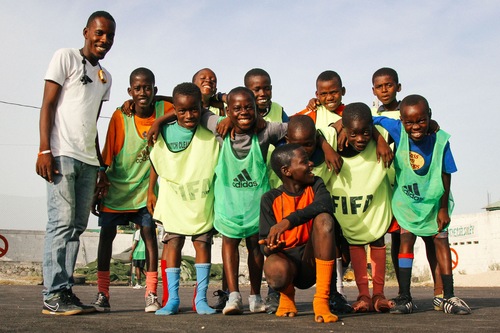
On a humid Monday afternoon, two teams–the 13 and 15 year-old teams–come together for practice just as the sun is beginning to set. They are coached by Karls Jodler Fils-Aimé, a 28-year-old born in Cité Soleil who is equally passionate about soccer and SAKALA’s peacebuilding mission. He fell in love with the sport when he was 12 and learned the goalkeeper position, eventually playing at SAKALA when the program established itself in 2006. Karls loves giving back to the kids on his teams and seeing the progress they make on and off the field.
SAKALA’s name is actually three words – sa ka la – which in Haitian Creole translate loosely to “this can be here.” The program is meant as a reference point, offering a different vision for what Cité Soleil can be. After 10 years of existence, the SAKALA center is a safe space that boasts Haiti’s largest urban gardens, a computer lab, art classes, and space for a diverse sports program – the centerpiece of which is its soccer teams.
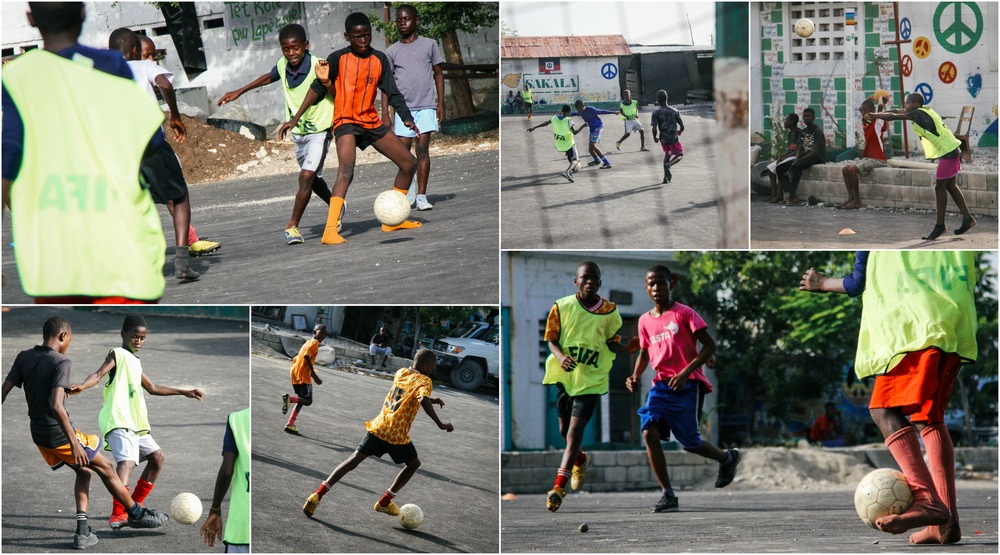
Soccer is a proven winner with the youth. Over 150 boys and girls who range from 9 to 24 years old participate inthe program annually. It attracts kids from all over Cité Soleil and mixes players to break down harmful stereotypes about rival neighborhoods, while teaching conflict resolution and peacemaking principles during practice and play. Players circle up every practice and before every match, and coaches remind them to treat their teammates and opponents well and remember that peace is the ultimate goal. The SAKALA teams are part of a division that holds matches all over Port-au-Prince and even in the countryside, and SAKALA’s players are community ambassadors who compete with groups from other disadvantaged communities, as well as some of Haiti’s most elite private schools.

“When teams from outside Cité Soleil encounter us, they assume we’ll play dirty because of where we come from,” Coach Karls shares, “but they are shocked to find we’re the most respectful players. Whether we win or lose, our players play fairly.”
“Though we’ve yet to win a championship, we’ve been awarded the fair play cup,” an award for best sportsmanship, Karls offers proudly. For youth from Cité Soleil, and SAKALA, this is an achievement worth celebrating.


Have a comment on this story? Write to the editors. Include your full name, city and state. Selected comments will be edited for publication in print or online.