


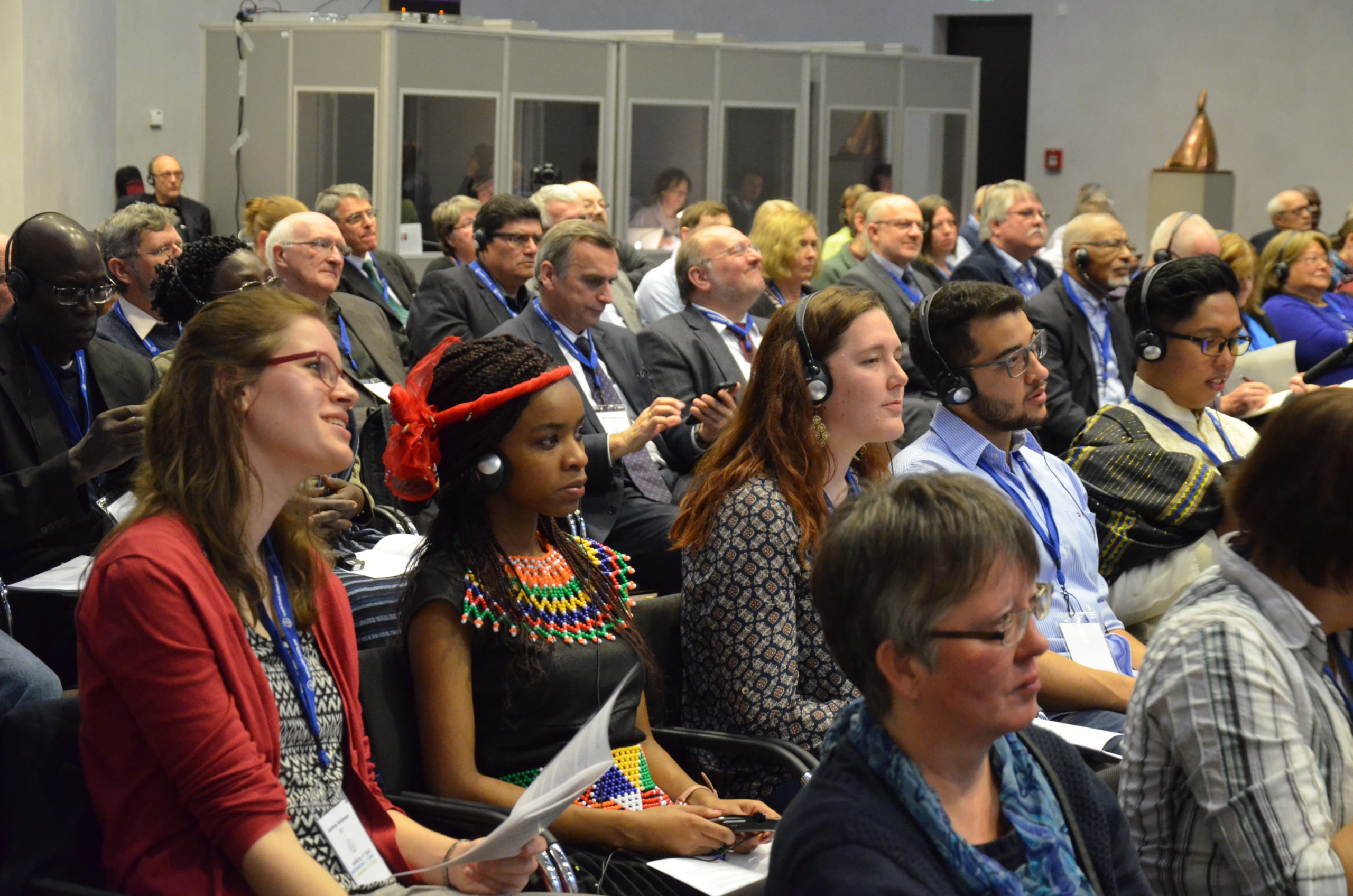
Photo: Young AnaBaptists (YAB) Committee members and audience. Photo by Harry Unger.
On February 12, 2017, regional Anabaptists and leaders from around the world gathered in Augsburg, Germany, for “Transformed by the Word: Reading Scripture in Anabaptist Perspectives,” the first in a 10-year series of events organized by Mennonite World Conference (MWC) to commemorate the 500th anniversary of the Reformation and the beginnings of the Anabaptist-Mennonite faith tradition. This “Renewal 2027” decade engages in a form of remembering that both appreciates and critically reflects on the developments of the early Anabaptist movement and commemorates those beginnings from a global and ecumenical perspective.
“The great upheavals in the church during the sixteenth century gave rise not only to the Lutheran and Reformed traditions, but also to a much smaller Anabaptist movement,” explained Alfred Neufeld, chair of the MWC Faith and Life Commission and chair of the Renewal 2027 Planning Committee.
The early Anabaptists neither identified with the Roman Catholics nor with the Lutherans. To be sure, they shared aspects from both faith traditions but they added their own distinctive aspects of Christian faith gained from their close reading of Scripture. Neufeld named aspects such as personal commitment to following Christ, baptism upon a free confession of faith, a collective approach to reading and interpreting Scripture, a commitment to reconciliation, and a rejection of the state church. As Neufeld reflected on the beginnings of the Anabaptist movement, he asked which of these specific aspects should be retrieved and how the Anabaptist-Mennonite faith history should be reimagined in view of a faith community that has grown into a global movement within the larger body of Christ.
Remembering the past
During his welcome address, César García, general secretary of MWC, borrowed the words of the Colombian novelist Gabriel García Márquez: “Life is not what one lived, but what one remembers and how one remembers it in order to recount it.”
García called for a remembering that critically reflects on habits of the past to create the possibility of renewal. He asked the audience to seek a heart that remembers what has been broken in the past in order to move the path forward toward reconciliation and renewal. He also reminded attendees that Scripture is to be understood as the script for our daily life of Christian discipleship.
Valerie Rempel, member of the MWC Faith and Life Commission, further proposed a radical reading of the Bible in the spirit of the early Anabaptist movement as a way of re-engaging “with God’s Word and our own theological tradition to see how it can offer us wisdom for living as Christians in our world and for engaging in mission that invites all people.”
In their talk, “Allowing ourselves to be set straight”, the historian Astrid von Schlachta and the theologian/church historian Hanspeter Jecker illustrated the tradition of early Anabaptists’ Scripture reading with visual material and excerpts from sixteenth-century writings.
Using a quote by Conrad Grebel from 1524, “after we took up Scripture and examined it on a great many issues, we became better informed,” Jecker illuminated how Anabaptists shared with Martin Luther the call for centrality of the Bible, sola scriptura (Scripture alone). Jecker and von Schlachta addressed the dual function of remembering in Anabaptist Scripture reading: the historical accounts of the early movement are both inspiring and unsettling. Stories of the Anabaptists’ radical break from the established church and their courageous life of discipleship through a commitment to reconciliation and love of enemy are uplifting to contemporary believers, while some apocalyptic sentiments espoused by early faith groups in Erfurt and Münster serve as a warning not to fall for literal and dogmatic readings of the Bible.
With a view to the present
Opportunities for reexamining Scripture according to the context of current daily lives and the present global community was provided during the session, “Reading and interpreting Scripture together,” organized by John D. Roth, secretary of MWC’s Faith and Life Commission.
In a collective Bible study of Acts 15:1-21, conference participants discussed ways of reaching agreement on controversial subjects within the church. Beyond that, representatives from the global Anabaptist-Mennonite church reported on current projects and challenges in their home communities. Joji Pantoja from the Philippines spoke about the coffee for peace initiative that protects and enhances the environment while supporting peacebuilders in the field. Tigist Tesfaye Gelagle, mentor of MWC the YABs (Young AnaBaptists) Committee, reported about the church in Ethiopia and the potential decline of emphasis on service, sense of community, and testimony to God’s grace resulting from the influence of the prosperity gospel and postmodern ideologies. Willi Hugo from Guatemala explored how the issues of the sixteenth-century movement are relevant to his church today and how people of his faith community find renewal through remembering Anabaptist beginnings.
In the panel “Reading Scripture across the confessions,” ecumenical guests spoke about distinctive patterns of Scripture reading in their own tradition. A trilaterial dialogue between Catholics, Lutherans, and Mennonites focused on topics such as sin, baptism, grace, and discipleship.
Luis Augusto Castro Quiroga, chair of the Colombian Conference of Roman Catholic Bishops, reported on the peace process between the Colombian government and the guerrilla groups FARC and ELN and explicitly thanked John Paul Lederach, Professor of International Peacebuilding at the University of Notre Dame and member of Boulder (Colorado) Mennonite Church, for his conciliation work in Colombia. He also explained that the country has to strive for inner peace that can only be achieved through the mercy and forgiveness outlined in the Bible.
Lutheran Friederike Nuessel from Germany discussed the condemnation of Anabaptists in the Augsburg Confession of 1530 (the primary confession of faith for the Lutheran Church) and how the Lutheran World Fellowship expressed repentance in 2010 for the ways in which Lutherans ignored or forgot Anabaptist persecution. In the spirit of renewal, she referred to Martin Luther’s study of Paul’s letter to the Romans, which transformed his sense of humanity.
Looking toward the future
Nelson Kraybill, president of MWC, introduced young Anabaptists from the Philippines, Zimbabwe, Paraguay, the Netherlands, and the USA in the panel, “Youth voices from the global church.” These members of the YABs Committee talked about the meaning of following the Great Commission (Matt. 28) in their respective countries. Dominik Bergen gave concrete examples from mission work in Paraguay and ways to build relationships with others through social engagement in hospitals, schools, and local soccer clubs. Although he suggested people should become active and involved in evangelization, he also reminded the audience to respect other cultures and religions.
Similarly, Jantine Huisman called for sensitivity when doing mission work in today’s multicultural society. She embraces the opportunity to talk with others and learn about diverse cultures and religions while remaining strong in her own Mennonite faith.
Looking toward the future, the second Renewal 2027 event, focused on the Holy Spirit, is scheduled to take place in Kisumu, Kenya, in spring 2018. Further commemorative events on the renewal of the Anabaptist-Mennonite tradition are scheduled in conjunction with regularly scheduled MWC meetings or the MWC general assemblies of 2021 and 2027.
Berit Jany attends Boulder (Colorado) Mennonite Church.


Have a comment on this story? Write to the editors. Include your full name, city and state. Selected comments will be edited for publication in print or online.