


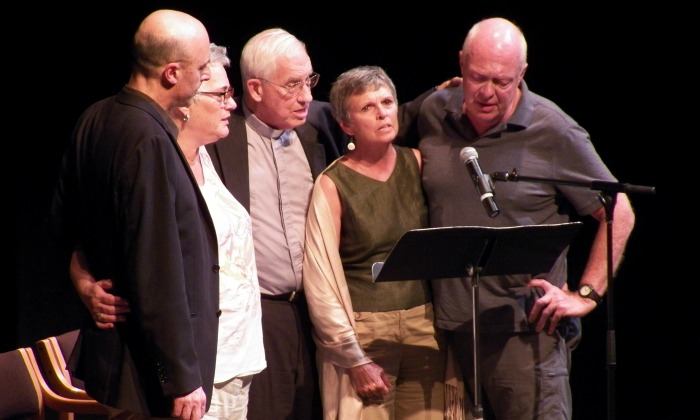
Photo: Jay Shefsky, Maurine Young, Father Robert Oldershaw, Janalee Croegaert and Steve Young sing during a Sept. 6 event at Goshen (Indiana) College.
(Originally appeared in the Goshen College Record)
Over 400 Goshen (Indiana) College students, faculty, staff and community members filled the Umble Center auditorium on Sept. 6 to witness a story of restorative justice.
The evening opened with the question, What’s the right thing to do when one man kills another? A documentary film exploring the answer to that question followed.
In June 1996, the day after he graduated from high school in Chicago, 18-year-old Mario Ramos pulled a trigger and ended the life of 19-year-old Andrew Young. Amid the 90 homicides in Chicago that month, it seemed to be nothing more than a number lost in the statistics. But the aftermath of this tragedy is anything but.
Produced by Jay Shefsky, who works at WTTW, the PBS affiliate in Chicago, the film “A Justice That Heals” follows the wake of this shooting for both the Ramos and Young families.

Ramos was a parishioner at St. Nicholas Catholic Church, Evanston, Ill., and his church community stood behind him while he was in prison. They didn’t support what he had done, but they supported him as a person.
Father Robert Oldershaw, the priest at St. Nicholas, was supporting Ramos’s parents through conversation and just being there. Oldershaw attended many of the court proceedings with the Ramos’s to provide that support. But he also wanted to reach out to Young’s parents, Steve and Maurine.
During his testimony at a court hearing for Ramos, Oldershaw said, “Our faith asks more. It asks that we believe a person can change and there is a justice that heals.”
Initially, the Youngs met Oldershaw with skepticism, but over time they grew to trust him and even began to attend St. Nicholas Parish.
Maurine Young eventually got to a point where she chose to forgive Ramos, who was sentenced to 40 years in prison. Her reasoning? “If God can forgive, why can’t I?” Ramos expressed repentance for what he’d done. In fact, his letter asking forgiveness crossed in the mail with Maurine’s initial letter to him. Maurine even visited Ramos in prison and now considers him a part of the Young family.
Although she embraced forgiveness, Maurine says, she also believed in the importance of justice and accountability. “Justice means there are consequences, consequences that can help bring him to a turning point,” says Maurine. “But there’s also forgiveness.”
During the time Ramos was in prison, people from his church community kept reaching out to him through letters. Many of the people didn’t even know Ramos personally, just his story.
“Who am I to receive love and attention from strangers?” he asked.
Ramos may have not understood all the support he received while in prison, but Oldershaw did. He explained the support as a way to bring “someone back to a fuller humanity.”
While the documentary was made 16 years ago, the emotions seemed just as raw on Sept. 6 as Steve and Maurine Young, Jim and Janalee Croegaert, parishioners at St. Nicholas, Father Oldershaw and Ramos (via video chat) took the stage in Umble following the documentary.
Steve Young shared a homily he had written earlier this year and shared with the St. Nicholas Parish a week after Easter. Twenty years after Andrew’s death, he expressed how hard it was for him to write this.
“It beat the living hell out of me to write this,” he said. “But once I spoke [at the St. Nicholas Parish], I felt extremely liberated.”
Ramos was recently released from prison and is legally unable to have contact with the Youngs, but that hasn’t stopped the Youngs from praying for him, they say. An audience member asked Maurine if she was sad to not be able to see Ramos.
Her response was simple. “I can still pray,” she said.
Ramos realizes he’s been given a second chance, and he continues to lean on his faith and the people around him as he strives to be better.
“This family and community have the biggest hearts I’ve ever seen,” Ramos said.
The night concluded with special music from Jim and Janalee Croegaert. While Jim sang and played the piano, Janalee was joined around the microphone by the rest of the panel. They invited the crowd to join the chorus, singing a prayer, “We watch, we wait, we cry, we long for you.”
https://soundcloud.com/themennonite/prayer-a-justice-that-heals
Dan Coyne, a Goshen College graduate and president of the college’s alumni association, coordinated the event. Coyne lives in Evanston, Ill., and attends Reba Place Mennonite Church. He first heard about the story of the Ramos and Young families from the Croegaerts six months ago and couldn’t get the story out of his mind.
“This is such a powerful story of living out the gospel. It’s a story we desperately need,” says Coyne.
Coyne first learned about Goshen College and its motto, “Culture for Service,” during his time in an Indiana correctional facility as a teenager. Because of the influence of a student who visited the prison, as well as support from members of College Mennonite Church in Goshen, Coyne later attended the college.
“I wanted to bring this story to GC so that we might plant a seed for students,” says Coyne. “There are ways to respond to harm in our lives that don’t have to be an eye for an eye. Forgiveness and justice are real.”
Coyne, the Youngs and Oldershaw gave presentations in five classes on campus as well.


Have a comment on this story? Write to the editors. Include your full name, city and state. Selected comments will be edited for publication in print or online.