


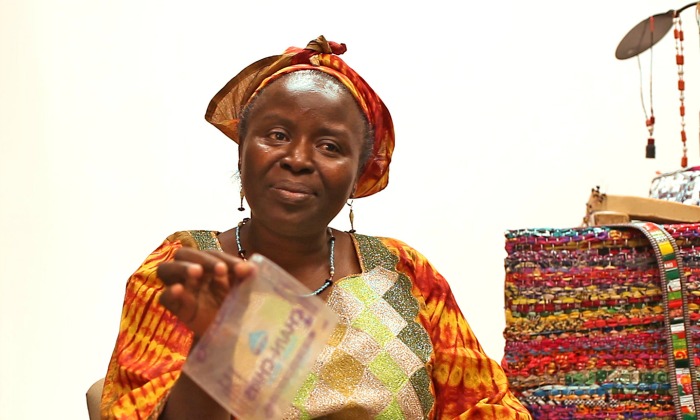
Photo: A discarded water bag can be turned into wallets, purses or simple carry bags with some ingenuity shared by Margaret Ahmed, director of Home Makers, an MCC partner in Nigeria. Home Makers pays some women who are displaced from northern Nigeria to collect the bags and young people struggling with drugs to wash, fold and weave them into products that can be sold. (MCC photo/Brenda Burkholder)
When Margaret Ahmed walks around her hometown of Jos, Nigeria, she sees opportunities that other people don’t see.
When she observes certain trees, seeds on the ground and even garbage, she sees income opportunities. When she sees plastic bags littering the streets, she sees potential merchandise.
Natural beauty products can be derived from some plants, seeds make excellent beads for jewelry and plastic bags can be woven into purses, carry bags and mats. Scraps of cloth turn into beautiful table runners.
Ahmed combines these scavenged resources with her recycling ideas and adds her knowledge of cooking and business as she teaches vulnerable people in Jos how to support themselves.
Ahmed is the executive director and founder of Home Makers Income Generation for Women, a Mennonite Central Committee (MCC) partner.
As a young girl, Ahmed saw her mother cooking and making handicrafts for sale to contribute to the household income. Because of this extra income, Ahmed’s family always had food on the table, she said, and she was able to graduate from high school, unlike many of her peers.
Ahmed has continued to use her mother’s example as she leads Home Makers, an organization she began in 1995. It has grown to 26 different groups of women located in 12 states in Nigeria and also in Niger and Cameroon with an average of 71 women per group.
Through those groups, Christian and Muslim women learn business and money management skills as well as conflict mitigation and mediation. They learn about small scale agriculture and how to develop marketable products, including those that use local resources and can even clean up the community.
Since 2014, she also has been teaching similar skills to youth struggling with drug addictions and

women who sought refuge in Jos after being forced from northern Nigeria by the extremist group, Boko Haram.
During a three-day seminar, she taught the women how to make bread, doughnuts and hair pomade to sell in Jos. She also taught some of them how to make jewelry from seeds and beans.
“Needs don’t know that you are displaced,” Ahmed said at the time. “The needs of these women will only keep increasing. So you need something to help you make an income so you can meet those needs. You need something to do to give hope.”
Some of the displaced women now participate in Home Makers’ newest project, Weave of Hope. This project pays displaced women to collect single-serving plastic water bags, used like water bottles, which people throw away.
Then, youth who struggle with drug addiction and have received training, mentoring and Bible studies through Home Makers, clean, sew and weave the plastic to make purses, wallets and other items for sale.
Pam Shedrach, a drug addict who was battling a 15-year-addiction, has been involved in the weaving program from its inception in March 2015. He wanted to start big with trucks for collection and other equipment, but Ahmed said they needed to start with what they had.
“I accepted it (the job) reluctantly. We started collecting used pure water bags with her, it was such a difficult and degrading task. Washing, cutting, drying, sewing, weaving them takes real time. But she will not give up.”
Shedrach said the work helped him to stop doing drugs without him realizing how that was happening.
“Many times I get the urge to do drugs again, but the work I do leaves no time for me to … hang out with friends who normally take you out to the jungles to take drugs.
“The recycling of the used pure water (bags) is not only cleaning the environment, but it helped clean me up of drugs … and have income every month,” he said. “I am very happy too. I am sure this used pure water project will help clean other youths and provide jobs for them too.”
Ahmed is happy to be able to help people in the community earn a living, but she said that working with one’s hands offers a lot more. The time spent together with people coming from similar experiences also provides an informal kind of therapy for the participants.
“This addresses our needs, it puts smiles on our faces and it gives us peace,” Ahmed said.


Have a comment on this story? Write to the editors. Include your full name, city and state. Selected comments will be edited for publication in print or online.