


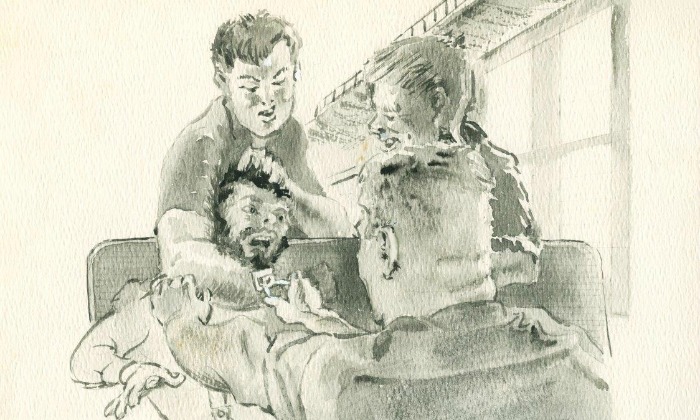
Image: A watercolor painting depicting the Hofer brothers, David, Joseph and Michael, Hutterites and WWI conscientious objectors who were courtmartialed and imprisoned. Joseph and David died in prison after enduring torture. Don Peters, copyright 2014 Plough Publishing, Walden NY.
“The First World War was a tragic and unnecessary conflict.”
These are the first words written by British historian John Keegan in his book, The First World War.
World War I was unnecessary because it was preventable: it was a local conflict that did not need to escalate. It was tragic because at least 10 million people died, 20 million people were injured and 50 million died from the Spanish flu epidemic that incubated in the trenches. One hundred countries were involved and the seeds of World War II were sown.
The Great War happened from 1914-1918 and now we take time to remember: 100 years later.
The United States entered WWI (ironically) on Good Friday, April 6, 1917. It was a war to end all wars, promised President Woodrow Wilson, but he was not a true prophet, just a politician.
And what of those who resisted? Should they not be remembered? Many Anabaptists, Quakers and others would neither fight, nor buy war bonds, nor fly the flag. At the time their voices were often silenced or muted. Mennonites who spoke German as their first language suffered twice.
“Conscientious objectors were the shock troops of anti-war dissent in World War I,” according to historians Scott H. Bennett and Charles Howlett. There are many moving stories of WWI conscientious objectors in the USA, Canada and Europe.
Perhaps the most moving for me is the story of four Anabaptist Hutterites from South Dakota. These Hutterites were part of a 400- year tradition of resistance to war. Jacob Hutter, an early leader, wrote the following in a letter in 1536:
“We do not want to harm any human being, not even our worst enemy. Our walk of life is to live in truth and righteousness of God, in peace and unity. … If all the world were like us there would be no war and no injustice.”
In 1918, three Hutterite brothers, David, Joseph, and Michael Hofer, and Joseph’s brother-in- law, Jacob Wipf, were absolutist objectors. They were in their 20’s, married with children, and farmers with an eighth- grade education. However, they clearly understood that Jesus said no to participate in war. They were court-martialed and sentenced to 20 years of hard labor.
In the Alcatraz prison, they were subjected to torture. In November 1918, they were transferred to Fort Leavenworth, Kansas, where Joseph and David died. The authorities said they died from Spanish flu. Their families and fellow Hutterites considered them martyrs who died from their ill treatment. I knew this account and others from WWI and I felt called to help tell these stories 100 years later.

So a group of us-Quakers, Mennonites, Hutterites, Bruderhof and Peace History Society scholars-met January 2014 to begin planning a symposium. We wanted to tell the stories of those who resisted and dissented out of conscience in WWI and help to make connections to our lives today.
Mennonite Church USA was well-represented in this planning process. Members included John Roth and Duane Stoltzfus from Goshen (Indiana) College; and James Juhnke, Rachel Pannabecker and Chuck Regier from Bethel College, North Newton, Kansas. We met at the National World War I Museum and Memorial in Kansas City, Missouri, and were welcomed warmly by Matt Naylor, the museum president and CEO. Matt, a humanitarian and personal friend, committed the museum to be the venue for our conference.
This symposium, called Remembering Muted Voices: Conscience, Dissent, Resistance, and Civil Liberties in World War I through Today, will be held October 19-22, 2017. We had over 80 paper proposals, including many from scholars outside the USA. There are so many stories to tell!
Georgetown University historian Michael Kazin will talk about American resistance. Ingrid Sharp from Leeds University, United Kingdom, will speak about Germans against the war. Erika Kuhlman will address women in WWI. Goshen College professor Duane Stoltzfus and Hutterite German teacher Dora Maendal from Manitoba, Canada, will tell the Hutterite story. And the story of Mennonite Central Committee, birthed out of WWI, will also be shared.
At the end of the symposium, on Sunday morning, Oct. 22, a memorial service for the Hofer brothers and all conscientious objectors is being planned at the museum. This will be followed by a tour of Fort Leavenworth, Kansas, including the old hospital, where Joseph and Michael died.
In addition, a traveling exhibition called Voices of Conscience: Peace Witness in the Great War will premier at the symposium. To book the traveling exhibition, contact Annette LeZotte, Kauffman Museum, Bethel College.
We must make sure our voices are not silenced or muted today as we proclaim, as disciples of Jesus, a better way than war, violence and injustice.
For more information about the program, keynotes and registration, visit our conference website.


Have a comment on this story? Write to the editors. Include your full name, city and state. Selected comments will be edited for publication in print or online.