


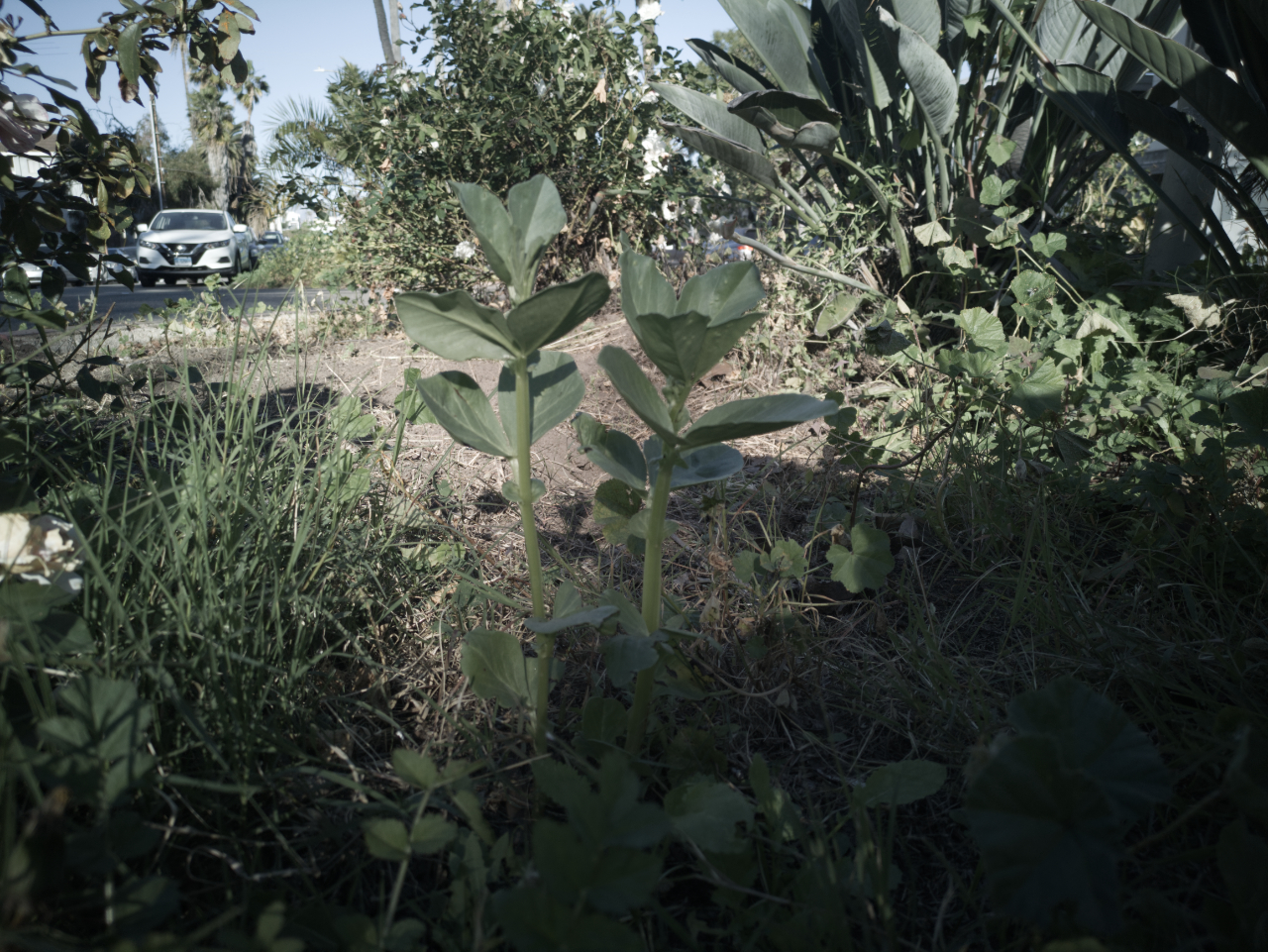
January started off very rainy in Southern California. This is uncommon for recent memory because of the decades of drought, but California is meant to be nourished by the rainy season. In front of my apartment is an unmaintained median. Rain + unmaintained space = AJ is going to grow something. I took advantage of the situation and planted beans in the median. It was mischievous, it had little risk, and it opened up a possibility for many collateral benefits.
The first benefit is that it gave me a reason to get out there and weed the median myself. After giving my beans a few weeks to come up, I went and checked on them. They were established and strong. They took advantage of the rain, like I hoped they would, and were leafing out, becoming big and strong. Since I knew we were on our way to viable plants, I began to weed around them. I weeded the median, I removed trash and I removed the rose hips that were weighing down what would otherwise be lovely rose bushes.
The next collateral benefit from being out and active meant others could see me. One neighbor joined me, and two others asked for me to contact them when I’d be out again. One saw that I was not only weeding but growing additional plants. He offered me connections to the neighborhood council to pay for future plants if they were used for community benefit and beautification. The point of the beans was to share, and I was so excited to find folks to share in the work and in the future bounty. I picked a bean variety that would grow much more than I could eat: the fava bean.
Fava beans are a bush bean. They make thick stocks that can support large harvests of their huge pods. Fava bean pods are gigantic, and they grow double shelled. Each pod has an inner shell and an inner bean. All of them can be eaten depending on how they are prepared.
The whole pod can be grilled or sautéed. The outer shells are fleshy and can be eaten raw, though they are more pleasant once cooked. The inner bean is soft and sweet, and it can be eaten raw. Another benefit of having so many layers of shells means that regardless of how dirty the outside gets, the inside will always be clean and safe to eat raw.
Fava beans are a food that is fresh and safe to eat by hand with no preparation. I picked them as my first median crop not only simply they are prolific, but because they are a safe and reliable way that I can share with my unhoused neighbors.

And since we are on safety: Is it safe to eat from the median? You may be surprised to hear that the answer is a strong “probably.” I prefer risk assessment over fear mongering, so here are some sketches for understanding safety and risk of growing on public land.
The most significant hazard to human health is artificial herbicide and pesticide. Modern herbicides and pesticides are designed to be taken into plant tissues, and that makes them a serious hazard to human health if consumed. Do not eat plants known or suspected to have been grown in soil where herbicides and pesticides are used. My median is neglected and full of weeds. I don’t have any significant reason to believe chemicals were used on this piece of land.
Next, environmental contamination. What about heavy metals in the soil? These pollutants pose a risk to human health. These pose little-to-no risk from eating the stems, leaves, fruits, and seeds when grown in “ordinary contamination.” If the soil meets “Superfund” levels of contamination or if the government orders remediation, then that soil is too polluted to safely use for food production. Additionally, the list of safe plant parts includes stems, leaves, fruits and seeds.
Roots are not on that list. Eating the parts of the plant that are directly in contact with the soil are the parts that carry a legitimate risk of poisoning. Do not eat roots from questionable soil.
And lastly, animal contamination. Droppings from omnivorous and carnivorous animals carry a lot of risk and pollute the soil around it. I know the other median where all of the dog parents irresponsibly leave their dog droppings. I won’t be growing food there, but maybe some zinnias. Urine from animals is not safe to consume, even as urine from animals can’t get through the fava bean pod to the inner bean.
Planting the beans in the median has been a lot of fun. I know food is on the way, and I’m already growing a network of neighbors who want to dig in! And maybe I should end this article here. But I can’t. I am planting beans in the median. As I encourage folks on social media to do the same, I’m getting pushback about accidental lead contamination, which I address in a similar fashion to what I just wrote. And at the same time, federal agents are planting lead in our neighbors.
My faith calls me to transform the world and prepare for the kingdom at hand. I transformed a neglected median into a place where strangers become friends. My faith calls me to feed people. I grow food, keeping in mind what would be practical or impractical for the most dispossessed among us. I am cultivating beans in the median, preparing for a spring harvest, and the daily news is of another body that’s been reaped. My acts feel frivolous in the face of daily horrors. And I plan on seed-starting chard with my neighbors next Saturday.
Every seed sown is an act of hope, an act of planning for tomorrow. Tomorrow will come with its tragedies and with its blessings. I am dutifully, faithfully, planting for tomorrow’s blessings. We will need them.
The response on TikTok to my median bean shenanigans started on January 1. The response was lighthearted and hopeful. I was defiantly growing food in a spot the world neglected. I was craftily using the resources around me to make the world a little better for my neighbors. After the execution of Renee Good, the responses on TikTok changed. They were no longer lighthearted and hopeful; they were resolute and hopeful. Faithfully doing what I can was encouragement for folks around the country to identify what they could do as well.
My adventures with fava beans in the median have been a fun chapter. They helped me connect with my neighbors, local and national. I am excited to cultivate beans through the weeds and bramble of the neglected median. I am steadfast to cultivate hope and faith through the weeds and bramble of the many, many reasons to despair. But I am planting a seed of hope, one bean plant at a time.
Winter sowing
Plants can be started in plastic containers long before they can be grown outside. Great makeshift growing vessels include milk jugs that have been cut in half and clamshell boxes that salad mix comes in.
- Fill the container halfway with potting soil.
- Plant spinach or leaf lettuce seeds 4 inches apart. For gallon containers, place seeds near each corner.
- Place containers in the sun during the day and bring them in if night temperature will be below 30 degrees F.
Resources
Read more about lead contamination and gardening here.


Have a comment on this story? Write to the editors. Include your full name, city and state. Selected comments will be edited for publication in print or online.