


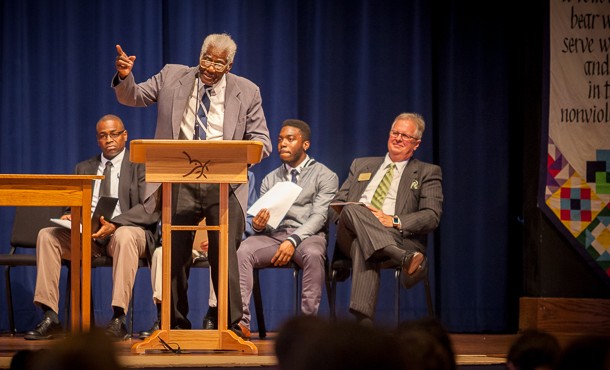
Photo: Dr. Abraham Davis Jr. speaks during a November 2015 chapel service in his honor. Davis was the first director of multicultural services at Eastern Mennonite University in Harrisonburg, Va., from 1980 to 1986. Behind him are (from left) teacher and coach Eric Payne, professor emeritus Titus Bender (not shown), student Philip Watson and President Loren Swartzendruber. (Photo by Michael Sheeler).
As befits a scholar of language and oral interpretation, Dr. Abraham Davis Jr. began a late November chapel service held in his honor at Eastern Mennonite University, Harrisonburg, Va., with a few re-written stanzas of a favorite hymn.
“Jesus loves me, this I know, though my hair is white as snow,” he began. “And my eyes are going dim, I’ve had cataract surgery. Still He bids me to trust in Him. Though my steps are oh so slow…I have a cane. I belong to the Canaanites. Though my steps are oh so slow, with my hand in His I’ll go. On through life, let come what may, on through life, He’ll be there to lead the way.”
Davis, who was baptized in 1943 while serving in the U.S. Army, worked from the 1960s-1980s in Christian institutions of higher education to bring multicultural awareness and diversity into curricula and campus communities.
He came to EMU near the end of his career, serving from 1980-1985 as the first director of the Cross-Cultural Center, the precursor to today’s Multicultural and International Student Services.
Davis was introduced in the chapel service by senior Philip Watson, a member of the Black Student Union and a student representative to EMU’s Diversity Taskforce. Watson spoke of Davis’s scholarly accomplishments and thanked him for the role he played nearly 35 years ago.
“He is one of the unsung heroes of EMU…” Watson said. “His accomplishments paved the way for many of the programs and organizations that are active today.”
An invitation to lead change
The Cross-Cultural Center, known as the CCC, was a place “where international students and students of

color could support each other” and where “strong relationships” could be established with the predominantly heterogenous campus community at the time.
Davis was also tasked with “ethnically integrating the curricula in the various departments,” he said in an October interview at Virginia Mennonite Retirement Community. “The curricula was prevailingly ethnocentric at the time, from the white perspective only. I spoke in chapel, bought books and films for the library, spoke in classes, invited other black professors and musicians to campus from around the country.”
In 1980, as a result of a “cross cultural task force,” Davis also became minority advocate program coordinator.
“It was the beginning of things…It was so new then,” said Davis, of the move towards multicultural curricula and inclusion. “There were some who were supportive. Some professors invited me to class and some would send students to me. Some people had never met a black professor with a PhD from a Big 10 university. Even now, that’s true.”
Carpenter to professor
Davis’s six years at EMU were among his last appointments in a long and challenging career in academia. He often encountered prejudice and bigotry. Just a few years before he began teaching at Indiana University while earning his doctorate in rhetoric and public address, a crowd of white students had marched with Confederate flags in protest of the election of a black student to the position of student body president.
While Davis jokes that he might now choose a more practical major than rhetoric, and perhaps even a different career, he is sure of one thing looking back: that his professional choices were driven by a hunger to know more about the Bible.
Raised in South Carolina under Jim Crow restrictions and trained as a carpenter, Davis says his parents, neither of whom attended high school, encouraged him to seek further education. But it was his acceptance of Christ at age 22 while stationed with the U.S. Army in Marseilles, France, and his subsequent baptism in Okinawa in 1946, that changed his life.
“After I became a Christian, I became much more interested in people than in building things,” Davis says.
When he came to EMU in 1980, Davis had taught a wide variety of subjects at several universities, including South Carolina State College for Negroes (now South Carolina State University) in Orangeburg, S.C., Houghton (NY) College, , Indiana University in Bloomington, and Messiah College in Grantham, Pa., where he rose to be dean of the Philadelphia campus.
‘Work to be done’
Among the speakers to honor Davis were President Loren Swartzendruber and professor emeritus Titus Bender, a member of the committee who hired Davis from his position at Messiah.
“I’m grateful for the work that Dr. Davis did while he was here and I pray that we can continue his legacy,” said Swartzendruber. “There is still much work to be done and we know that.”
He noted that the current campus community continues to work on cultural competencies and communication as it welcomes an increasingly diverse student population (this year’s freshman class includes 37 percent of students who are ethnic minorities or from another country). Swartzendruber also spoke of EMU’s early support for integration–the college admitted its first black student in 1949, one of the first two institutions in the former Confederate states to do so.

Though Watson, with the assistance of Multicultural and International Student Services Director Susannah Lepley, was the organizer of the service, Eric Payne was the link between past and present. It was Payne who met Philip Watson one day outside the fitness center. Payne is an assistant coach with women’s basketball and Watson a sprinter on the track team. The two started talking, and Payne urged Watson to reach out to Davis, who lives in the Virginia Mennonite Retirement Community.
“It’s been a mission of mine to see that Dr. Davis get his recognition and I’m honored to be here to help in that…,” said Payne, who has coached at EMU since 2002. “This is a high point in my life. I told Dr. Davis that a few days ago and he thought I was joking but it’s true.”
Teacher and coach mentored by Davis
Payne calls Davis a mentor even though the two just missed each other on the EMU campus. A native of Waynesboro, Va., Payne came to EMU in 1986 and struggled with the culture on campus. By that time, Davis had seen his position eliminated by budget cuts and was teaching elsewhere. Payne, though, found traces of the professor, of his eloquent rhetoric and his incisive cultural criticism, in the chance discovery of an article by Davis.
Though Payne stayed on campus long enough to help invigorate the Black Student Union, he eventually finished his degree at James Madison University.
Still, that chance encounter drew Payne to seek out Dr. Davis when he returned to Harrisonburg a few years later. For many years, the two stayed in touch. Payne eventually finished credential coursework at EMU and now teaches at Fort Defiance High School. He plans to graduate from EMU with a master’s in education in the spring.
He too, along with Philip Watson, who graduates this spring with a degree in psychology, carries on a legacy that was sustained and energized by Davis and his work at EMU.
“It was one of the great honors of my life to be part of this,” Payne said. “I thank God for Dr. Davis.”


Have a comment on this story? Write to the editors. Include your full name, city and state. Selected comments will be edited for publication in print or online.