


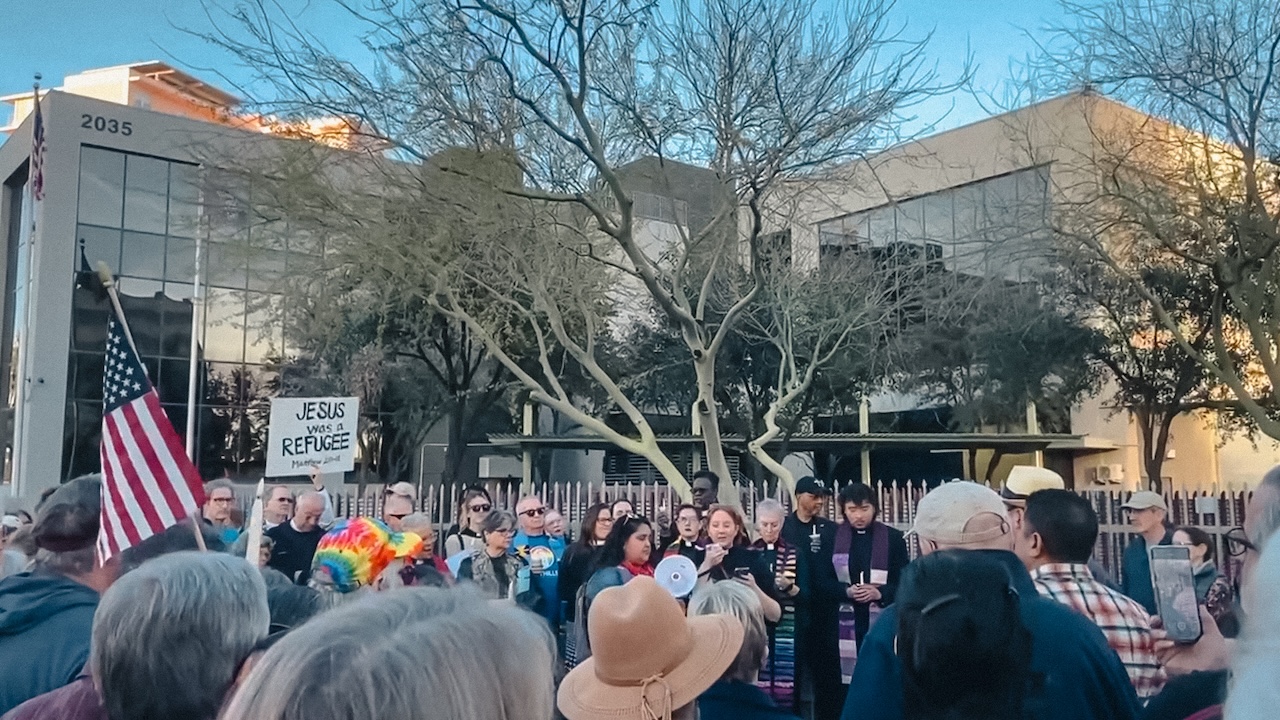
“What do we do about ICE killing and taking people? I think that, of all the people I know, you might know.”
I (Josh) stared at this text message as I was getting ready for church, a friend’s question landing like a ton of bricks. Recently, Minneapolis has become a focal point. Federal immigration enforcement actions resulted in the unnecessary killing of community members – including Alex Pretti and Renée Good – and sparked mass protests, public grief and a barrage of violent political chauvinism.
As people of faith, we’re often asked, “What should we do?” Scripture doesn’t offer a playbook for every moment, but it does illustrate a pattern of care, courage, and justice that can give shape to what our resistance looks like. What it doesn’t offer is a Jesus-shaped excuse to sit things out, even when the violence feels far away.
Here are five biblical reasons this kind of resistance is faithful and some actions you might feel called to take.
A few cautions and a pastoral note:

This is not intended as guidance to help people break the law or hide those facing constitutional lawful processes. The postures I suggest center on accompaniment, public witness, legal partnership and pastoral care: the tools of a people called to love their neighbors and seek justice. For a model of neighborhood rapid response, see the Arizona Whistle Project; for legal observer networks and documentation advice, connect with your local ACLU affiliate.

1. God commands hospitality toward the foreigner
Scripture: Leviticus 19:33-34, Deut. 10:17-19
Case for resistance: God repeatedly commands Israel to treat the foreigner as kin and care for the vulnerable. Historically, this was done to the extent that churches were regarded as safe spaces by default, to the point that many continue to call their worship spaces “sanctuaries,” meaning a place of refuge or safety.
Act: It’s not coincidental that these are collective commands. None of us can carry this all, but each of us can carry a little bit. Draw close to your community. With my friend, I listed five safe people I know on her block and suggested making a plan for what they will do if/when ICE is spotted in the neighborhood. I also said that, if anyone has a relationship with folks in a vulnerable population, explore ways to make sure they’re well-resourced both practically (i.e. groceries and appointments) and informationally (Mennonite Central Committee has resources to support immigrants and migrant allies).
In this way, you and your community can become a sanctuary.
2. Prophets call us to seek justice
Scripture: Micah 6:6-8
Case for resistance: The prophetic tradition is anything but neutral. Naming injustice and pressing for transparency and accountability are part of speaking faithfully.
Act: You can add to the noise on social media, but pushing against lies and privilege in your spheres of influence will lead to conversations where transformation is possible. Organize a space for a brief period of public lament and testimony, with stated goals to name harm, to pray and to invite legal/advocacy partners to explain next steps for accountability.
Your grief can become more than simply outrage.
3. Jesus shows us how to be present with suffering
Scripture: Luke 10:25-37, John 11:35
Case for resistance: The gospel is about incarnation: moving towards wounded people and being present with them. Resistance includes pastoral presence and, as a tradition declaring a “priesthood of all believers,” that can include all Anabaptists. Signs and slogans aren’t bad, but healing and care speak volumes.
Act: Train, invite or seek out a small pastoral-care team (2–4 people) to provide trauma-informed listening, hospitality and practical support for affected families: meals, childcare, rides to court or accompaniment to reporters and lawyers.
As God suffers with us, we suffer with others.
4. The Jesus way sometimes brings division
Scripture: Matthew 10: 34-38, Luke 12: 51-53
Case for resistance: Although God reconciles all things through Christ, that sadly does not mean all our relationships will stay intact. While the goal is never to sever a relationship, we are in a moment where we may need to risk possibly losing friends and family in favor of being a reflection of Christ to the world. Listen with love and speak with conviction.
Act: Spend some time in quiet reflection and ask yourself, “How much am I willing to lose in the name of Christ?” Then choose one relationship or space where you will speak plainly, with the intent to witness, not t0 win. Name harm, tell the truth you see and refuse to let silence protect injustice.
As Jesus’ path took him to the cross, surely ours will require us to shine in dark places as well.
5. Jesus models righteous resistance
Scripture: Matthew 21:12–13, Mark 11:15–17, Luke 19:45–46 and John 2:13–17
Case for resistance: The one time Jesus acts violently, it is a) directed towards the tools of oppression and b) in protest to the perversion of religious systems turned to abuse the marginalized and vulnerable. The fact that this story is in every gospel account is telling, and it sets the bar for where nonviolent people must stop being passive and start considering direct action.
Act: If your faith community is aligned with Christian nationalism and is unwilling to engage in a Christ-centered dialogue, then it is not unfaithful for you to leave. Staying and being spiritually diminished or morally compromised is not a virtue.
Leaving, however, does not mean disengaging. It is a challenging but rewarding journey to find communities – faith-based or otherwise – that continue to encourage you as you seek to grow in the image of Christ. For some, that may be a different congregation; for those where geographically that’s not possible, begin by aligning yourself with trusted partners and community members beyond your immediate context, such as national church bodies and faith-based organizations. In Phoenix, we have the Arizona Faith Network.
The Holy Spirit sees you and will not abandon you. In this liminal time, let your time, energy and giving flow towards places where the gospel is not bent to serve empire.
Sometimes flipping tables looks like refusing to lend your presence or resources to systems that harm, choosing instead to stand where Christ is already at work.



Have a comment on this story? Write to the editors. Include your full name, city and state. Selected comments will be edited for publication in print or online.